First Seen
2026-04-02T05:33:42+00:00
simple-description (qwen3.5_2b-q8_0)
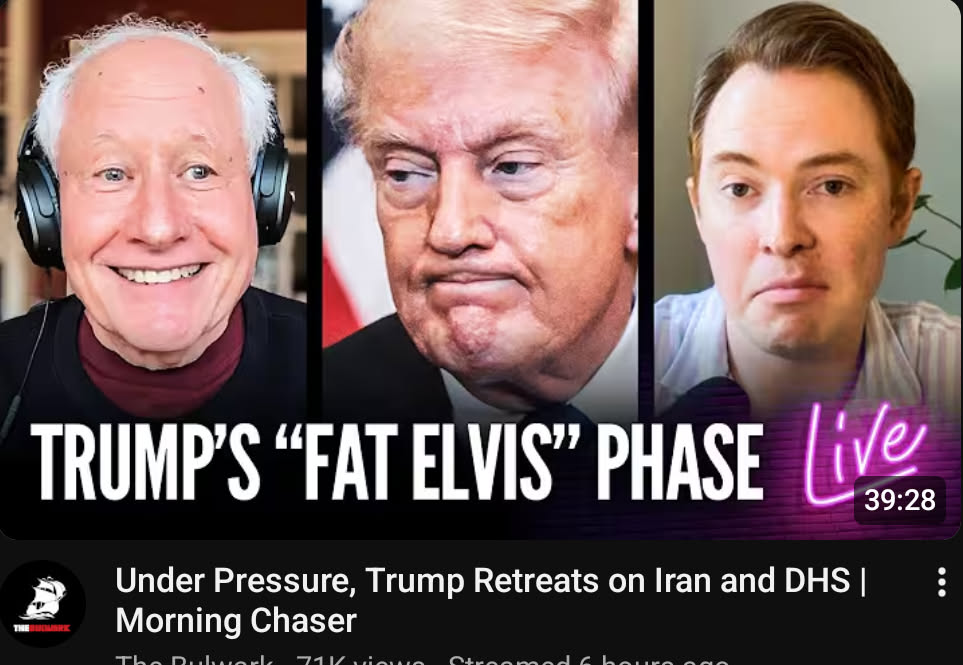
This anti-Trump meme mocks the idea that President Trump is acting like an aging Elvis Presley at this specific moment. It features three figures—comedians John Mulaney and Elon Musk alongside President Trump—grouped under the text "TRUMP'S 'FAT ELVIS' PHASE," implying everyone involved in these political discussions has been reduced to a gruff, old state. The caption also notes that this video is a live stream titled "Under Pressure, Trump Retreats on Iran and DHS | Morning Chaser."
detailed-analysis (gemma3_27b-it-q8_0)
Okay, let's break down this meme from an Anti-Trump perspective, utilizing the frameworks you've requested.
Visual Description
The image is a split-screen comparing three images of Donald Trump. On the left is a contemporary picture of the host, the right side contains two images of Trump. The first Trump image is a more glamorous, "Elvis-like" aesthetic – slicked back hair, a slightly puffed face suggesting weight gain, and a somewhat theatrical expression. The second image of Trump is a contemporary picture. The text overlaid on the images is "TRUMP'S 'FAT ELVIS' PHASE," with a "Live" timer indicating the image is from a live stream. The streamer's logo is in the lower left.
The implication is that Trump is undergoing a visible transformation, possibly linked to stress or a deliberate attempt to project a different persona. The “Fat Elvis” reference is key; it invokes the image of Elvis Presley in his later, less active years, known for physical decline and a more performative, less authentic persona.
Foucauldian Genealogical Discourse Analysis
This meme engages with the discourse surrounding power, appearance, and authenticity, which is central to Foucault's work. We can trace the genealogy (historical development) of how "leadership" has been constructed. Historically, leadership was often tied to images of strength, health, and vigor. Trump initially presented himself in this vein.
However, this "Fat Elvis" phase disrupts that discourse. It signals a possible shift in power dynamics. The meme isn’t simply about Trump’s weight; it’s about how his image is being produced and consumed. The term "Fat Elvis" implies a decline in authority and control, a move away from the "strong man" archetype.
The discourse also plays with the idea of the panopticon – not in the traditional prison sense, but in the way Trump is constantly observed and scrutinized. His physical appearance becomes a site of political commentary and resistance. The Anti-Trump crowd are engaging in a form of counter-discourse, interpreting his image to undermine his authority.
Critical Theory
From a Critical Theory perspective, this meme is a form of ideological critique. The meme challenges the dominant ideology surrounding political leadership and the projection of strength. Trump's image, historically associated with business success and forceful personality, is being dismantled and exposed as potentially fragile or even decaying.
The "Fat Elvis" comparison implicitly asks who benefits from this shift in image and what power structures are being reinforced or challenged. Is this a deliberate attempt by Trump to appear more relatable, or is it a sign of underlying stress and vulnerability? The meme encourages viewers to look beyond the surface and question the underlying motives and agendas.
The meme highlights how the media and public perception are constructed and how those constructions serve particular interests. It also underscores how Trump's image is not simply "natural," but a carefully crafted performance designed to maintain power.
Marxist Conflict Theory
While less direct, a Marxist reading could see this meme as reflecting a broader societal conflict. Trump's initial persona appealed to a segment of the population feeling economically and politically disenfranchised. His "Fat Elvis" phase could be interpreted as a sign of the decay of the ruling class (Trump representing a figure of power and privilege). The meme, then, functions as a symbolic representation of this decline, potentially fueling further resistance.
The meme is also part of a larger "culture war," with the Anti-Trump faction actively challenging the symbols and representations of conservative ideology. The "Fat Elvis" image serves to de-legitimize Trump and his political agenda.
Postmodernism
The meme operates within a postmodern framework. The use of the "Fat Elvis" reference is an example of pastiche—combining different cultural symbols in a new and ironic way. It deconstructs the traditional idea of a powerful leader, replacing it with a pop-culture image known for its excess and decline.
There’s also an element of hyperreality at play. Trump's image is already highly mediated and constructed. The meme doesn’t present "reality" but rather another layer of mediation, a simulation of a simulation. The meme acknowledges that authenticity is impossible in the age of mass media, and therefore playfully undermines Trump’s attempts to project an authentic persona.
In Summary
From an Anti-Trump perspective, this meme is a multi-layered critique of Trump’s persona, power, and the broader political landscape. It leverages cultural references, engages in ideological deconstruction, and exposes the constructed nature of leadership. It's a visual articulation of resistance and a call to question the narratives surrounding Trump and his administration.
Disclaimer: My analysis is based on the provided image and the request to frame it from an "Anti-Trump" perspective. Interpretations of memes can vary, and this is only one possible reading.
simple-description (llama3.2-vision_11b)
The meme features a screenshot from a video titled "TRUMP'S 'FAT ELVIS' PHASE" with three images of former US President Donald Trump. The first image shows an older, overweight version of Trump, while the second image shows a younger, thinner version of Trump. The third image is of a man with a neutral expression, and the text "Under Pressure, Trump Retreats on Iran and DHS | Morning Chaser" appears below the images. The video is from a YouTube channel called "The Bully… 71K views, Streamed 6 hours ago." The image is meant to be humorous and satirical, implying that Trump's appearance has changed over time, and that he is under pressure to make decisions on important topics like Iran and the Department of Homeland Security. The image is meant to be humorous and satirical, implying that Trump's appearance has changed over time, and that he is under pressure to make decisions on important topics like Iran and the Department of Homeland Security.