First Seen
2026-01-04T19:37:34+00:00
simple-description (qwen3.5_2b-q8_0)
Anti-Trump Context
This meme is labeled as "Anti-Trump" because it satirizes the President's treatment of the bald eagle—the national symbol of freedom—as a domestic pet or livestock rather than a dignitary figure. The humor relies on mocking his administration's disregard for wildlife and its symbolism, often involving jokes where he makes rude noises or gestures toward the bird.
Description for Non-Viewers
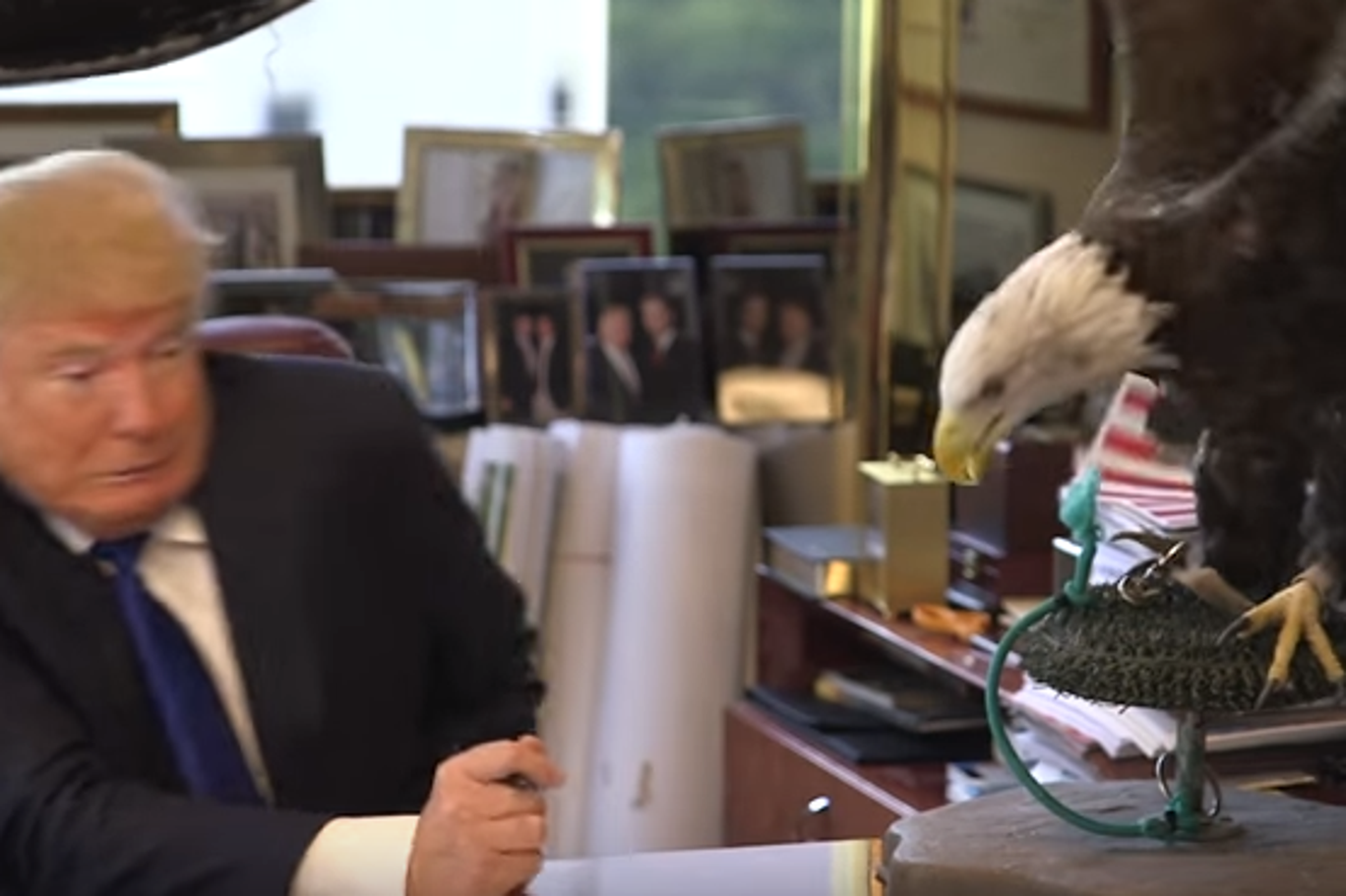
In this scene, Donald Trump is leaning in extremely close to a bald eagle that has been perched on a stand in the Oval Office. He appears to be inspecting the bird or making a mocking gesture of disdain toward it. The joke is absurd because the President is interacting with an animal in a manner that suggests disrespect, contrasting his usual image of executive authority and civility.
Visible Text
Upon closer inspection, there is no distinct text or labels clearly visible in the image. While there are frames behind him containing portraits of other politicians and a stack of papers near the eagle's feet, none appear to have legible titles or words that can be read.
detailed-analysis (gemma3_27b-it-q8_0)
Okay, let's break down this image – Donald Trump with a tethered bald eagle – through the lens of an "Anti-Trump" meme context, utilizing the specified theoretical frameworks where applicable.
Visual Description
The image depicts Donald Trump seated at a desk, appearing somewhat disengaged while looking off to the side. He's in a suit and tie, and the surroundings suggest a formal office – likely the Oval Office. However, the focal point is a bald eagle, the national bird of the United States, standing on a perch directly in front of Trump. Crucially, the eagle is tethered with a harness and what appears to be a breathing apparatus. The eagle's expression, though anthropomorphized, seems forlorn or even distressed. The scene is framed to emphasize the disparity between Trump's detachment and the constrained condition of the iconic symbol of American freedom. The composition evokes a sense of awkwardness and discomfort. Trump is surrounded by images of himself and other predominantly white men, further emphasizing a certain kind of power structure.
Foucauldian Genealogical Discourse Analysis
From a Foucauldian perspective, this image is a powerful disruption of established discourses around American exceptionalism, presidential power, and national symbols. Traditionally, the bald eagle is deployed in a discourse of liberty and strength, linked to the very foundation of American identity. This meme genealogically excavates the power dynamics behind that symbolism.
- Power/Knowledge: The image shows how power constructs “truth.” The ‘truth’ that America is inherently free and strong is juxtaposed with the visibly controlled, even suffering, eagle. The very act of tethering a symbol of freedom is a demonstration of power over the idea of freedom.
- Discipline & Punishment: The harness and breathing apparatus can be read as instruments of discipline. Foucault argued that discipline is about normalizing behavior. The tethered eagle isn’t being punished in a traditional sense, but its freedom is curtailed, signifying a more subtle form of control. Trump, as the figure overseeing this situation, embodies the disciplining force. The image implies that Trump’s administration and ethos also sought to discipline, rather than liberate.
- Discourse of Patriotism: The meme undermines the discourse of patriotism. Rather than being a celebratory symbol, the eagle is a captive symbol, suggesting that Trump’s version of patriotism is artificial, enforced, and ultimately damaging to the ideals it claims to represent.
Critical Theory
This meme utilizes a core tenet of Critical Theory: the critique of ideology. It dismantles the myth of American exceptionalism and exposes the underlying power structures at play.
- Ideology and False Consciousness: The image challenges the ideological assumption that American leadership inherently embodies freedom and strength. The tethered eagle represents a “false consciousness” – a belief in something that does not align with reality. The traditional image of the eagle perpetuates the idea that the USA is a beacon of liberty, but this image exposes it as potentially hollow.
- Hegemony: The meme critiques the hegemonic control over national narratives. Hegemony, in this context, refers to the dominance of a particular worldview. By subverting the traditional symbolism of the eagle, the meme challenges the dominant narrative about America and its leaders.
- Enlightenment Critique: Critical Theory is rooted in a critique of Enlightenment rationality. The image could be seen as a comment on the instrumentalization of nature (the eagle) for political ends – a rejection of the Enlightenment ideal of humans controlling and dominating the natural world for their benefit.
Postmodernism
The meme operates within a postmodern framework by deconstructing and re-contextualizing a national symbol.
- Simulacra and Simulation: The eagle, traditionally a “real” symbol of freedom, becomes a simulacrum – a copy without an original. It represents freedom but is itself physically constrained, creating a disconnect between the signifier (the eagle) and the signified (freedom). The image blurs the lines between reality and representation.
- Deconstruction: The meme actively deconstructs the traditional meaning of the eagle, dismantling the established associations of freedom and strength. It highlights the constructed nature of symbolism.
- Irony and Parody: The situation is inherently ironic: a symbol of freedom being held captive by a leader often accused of authoritarian tendencies. This irony is crucial to the meme’s effectiveness.
Why it works within the "Anti-Trump" category:
The image is particularly effective within an anti-Trump context because Trump's presidency was often characterized by aggressive nationalism, self-promotion, and perceived authoritarianism. The image resonates with criticisms of his leadership style and policies. It encapsulates a feeling, common among critics, that Trump co-opted and distorted patriotic symbols to serve his own purposes, while simultaneously curtailing freedoms and undermining democratic institutions. It's a visually striking and emotionally resonant expression of anti-Trump sentiment.
I hope this thorough analysis is helpful! Let me know if you'd like me to elaborate on any particular point.
simple-description (llama3.2-vision_11b)
This meme is a satirical image of a scene from a 2016 interview with Donald Trump, where he is seen talking to a live eagle. The image shows Trump sitting at a desk, with the eagle perched on a nearby table, looking directly at him. The text "I'm a . . .” is seen on the screen, implying that Trump is being asked to fill in the blank. The meme is likely meant to be humorous and satirical, poking fun at Trump's often-ridiculous and . . . . . . . . . . . . . . . . . . . . . . . . . . . . . . . . . . . . . . . . . . . . .