First Seen
2026-03-27T21:27:28+00:00
simple-description (qwen3.5_2b-q8_0)
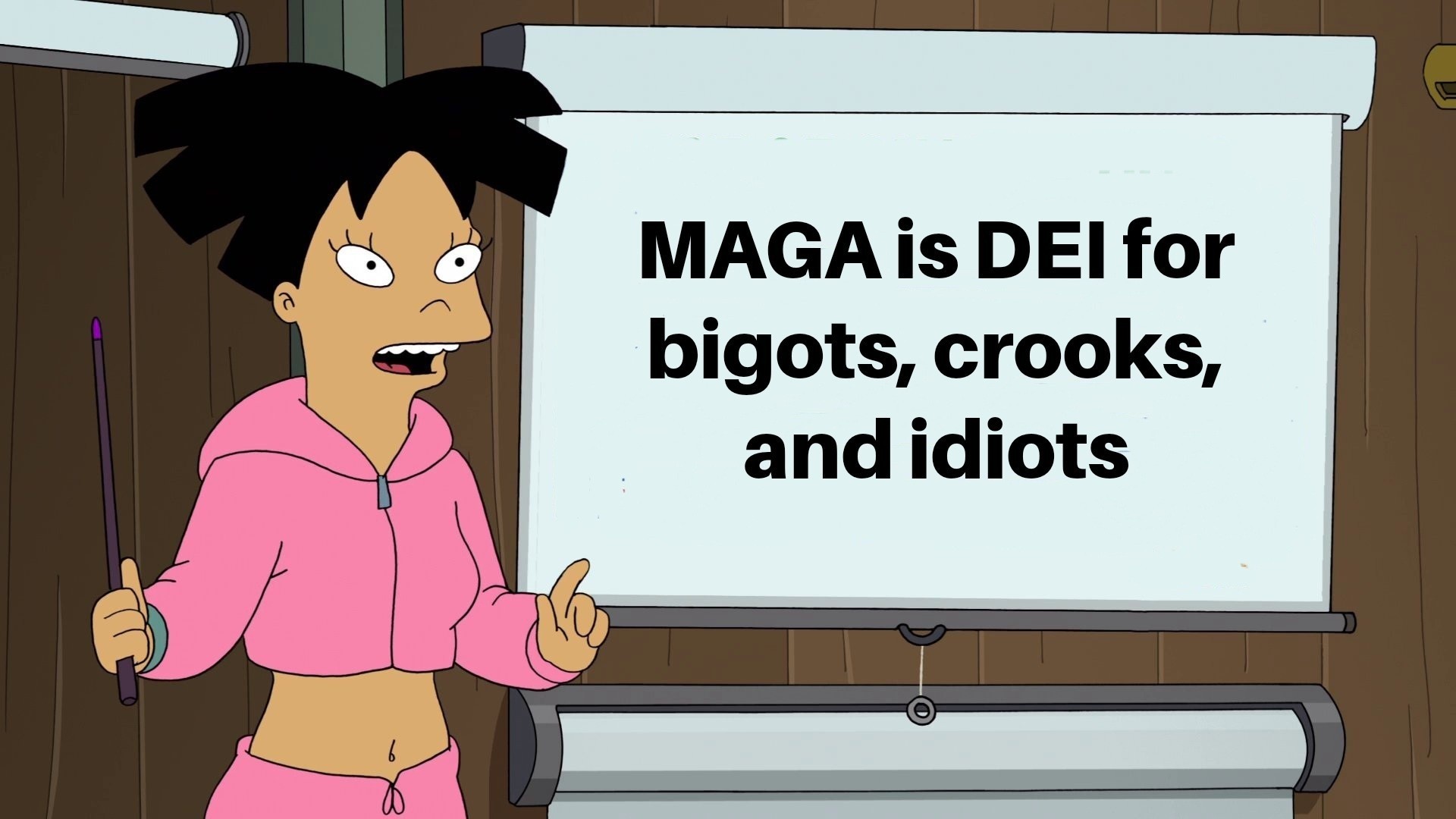
This political joke suggests that Diversity, Equity, and Inclusion (DEI) policies are simply tools used to bully people rather than help them. It argues that "MAGA" is essentially an ideology designed to exclude marginalized groups by labeling those labeled "bigots," "crooks," or "idiots." The furious expression of the character Liz Shaw emphasizes her anger at this hypocrisy and the perceived cruelty of policies meant for inclusion being used as weapons against them.
detailed-analysis (gemma3_27b-it-q8_0)
Okay, let's break down this meme from an anti-Trump perspective, utilizing the requested theoretical frameworks where applicable.
Visual Description
The image features Leela from the animated show Futurama. Leela is depicted in a pink tracksuit and appears to be giving a presentation. She has one hand raised in a gesture that looks like she is lecturing, with a pointer in the other. Behind her is a projector screen with large black text: "MAGA is DEI for bigots, crooks, and idiots."
The choice of Leela is interesting – she is often a voice of reason and justice within the chaotic universe of Futurama. Using her in this context suggests a debunking or satirical take on the MAGA movement. The pink tracksuit is a playful choice that may soften the sharp message, or conversely, might play on gender stereotypes.
Critical Theory
This meme operates squarely within the realm of Critical Theory, specifically the Frankfurt School’s concern with the manipulation of culture and the rise of authoritarian tendencies. The core claim – "MAGA is DEI for bigots, crooks, and idiots" – is a pointed critique designed to deconstruct the MAGA slogan’s positive framing.
- Ideology Critique: The meme argues that MAGA, which claims to represent the "forgotten man" or a return to traditional values, is in reality a rallying point for harmful and destructive elements. The labeling of supporters as "bigots, crooks, and idiots" directly challenges the movement’s self-representation.
- Exposing Power Dynamics: By equating MAGA to a perversion of DEI (Diversity, Equity, and Inclusion), the meme suggests that MAGA exploits the language of identity politics for exclusionary purposes. DEI is generally associated with progressive values; the assertion here is that MAGA appropriates its structure to consolidate power for prejudiced groups.
- The Culture Industry: This meme, as digital content, is part of the "culture industry" that critical theorists like Adorno and Horkheimer examined. It's attempting to intervene in the public sphere, challenging dominant narratives and offering a counter-discourse.
Foucauldian Genealogical Discourse Analysis
Michel Foucault’s work on discourse, power, and knowledge is highly relevant. This meme can be viewed as a disruption of the dominant discourse surrounding MAGA.
- Discourse and Power: MAGA is not merely a slogan; it’s a discourse – a system of thought, language, and practices that constructs a particular reality. This meme attempts to undermine that discourse by reframing its meaning and associating it with negativity.
- Genealogy: A Foucauldian "genealogy" would trace the historical origins of the language and ideas within MAGA, revealing its power structures and the ways it has been used to justify exclusion. The meme participates in this genealogical work by exposing the underlying assumptions about who “deserves” a return to a perceived “golden age.”
- Power/Knowledge: The meme challenges the knowledge produced by and through the MAGA discourse. By labeling supporters with derogatory terms, it asserts a counter-knowledge that devalues their perspective and attempts to diminish their power.
Marxist Conflict Theory
While not its primary focus, elements of Marxist Conflict Theory can be observed here.
- Class Conflict: The meme implicitly highlights class tensions. "Crooks" could be interpreted as a reference to the economic corruption associated with some figures within the Trump administration and the broader elite structures that MAGA purportedly serves.
- False Consciousness: The meme suggests that MAGA supporters labor under a “false consciousness,” unaware of the true beneficiaries of the movement’s policies and rhetoric. The labeling of "idiots" implies a lack of critical awareness.
- Ideological Struggle: The meme is part of a larger ideological struggle between competing worldviews – a struggle between those who benefit from the status quo (as the meme suggests MAGA does) and those who seek to challenge it.
Postmodernism
Postmodernism's deconstruction of grand narratives and emphasis on subjectivity also come into play.
- Deconstruction of Meaning: The meme deconstructs the meaning of MAGA by presenting it as the opposite of its stated goals. It undermines the idea that there is a fixed or inherent meaning to the slogan.
- Relativism of Truth: The meme implicitly challenges the notion of objective truth. The labeling of supporters ("bigots, crooks, and idiots") is a subjective judgment, but it's presented as a revealing truth.
- Rejection of Meta-Narratives: MAGA often presents itself as a meta-narrative – a story about restoring a lost national identity. The meme rejects this narrative, exposing its flaws and contradictions.
Queer Feminist Intersectional Analysis (Less Direct but Present)
While less directly addressed than other frameworks, intersectionality is relevant.
- Intersection of Oppressions: The term "bigots" indicates an awareness of the ways MAGA supporters often harbor prejudices against marginalized groups based on race, gender, sexuality, etc. It implicitly acknowledges the intersectional nature of oppression.
- Challenging Dominant Norms: The meme challenges the norms of respectability politics, directly calling out those who support a movement associated with harmful ideologies.
- Deconstruction of Masculinity: The meme, and the association of MAGA with "crooks," could also be seen as a critique of toxic masculinity and the abuse of power.
In conclusion, this meme is a multi-layered critique that leverages several theoretical frameworks to challenge the MAGA movement. It's a rhetorical intervention designed to deconstruct its ideological foundations and expose its perceived harmful consequences.
simple-description (llama3.2-vision_11b)
The meme features a character from the animated TV show "Futurama" named Leela, who is pointing to a whiteboard with a message that reads, "MAGA is DEI for bigots, crooks, and idiots." The character is wearing a pink outfit and holding a pointer, and the background is a brown wooden wall. The meme is likely intended to be humorous and satirical, using a popular TV show character to make a commentary on the topic of DEI (Diversity, Equity, and Inclusion) and its perceived connection to MAGA (Make America Great Again) ideology. The use of the character's signature style and tone adds to the satirical nature of the meme.