First Seen
2026-03-09T04:16:17+00:00
simple-description (qwen3.5_2b-q8_0)
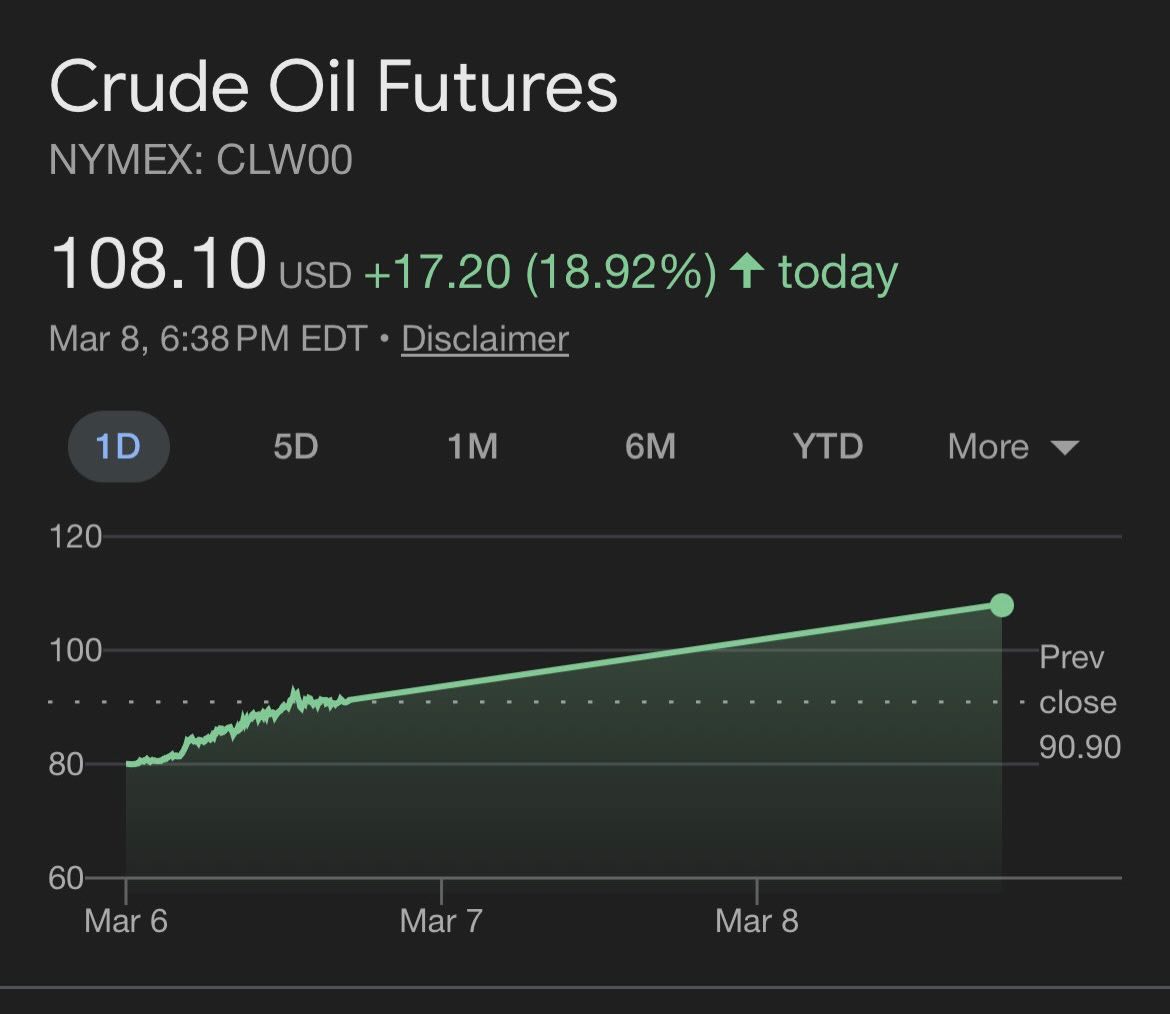
This graphic serves as a visual metaphor for explosive political momentum and rapid growth. Much like the image depicts crude oil futures prices surging with a solid green upward trendline to surpass $108, supporters use it to illustrate how support for their candidate's policies surged dramatically overnight, creating an illusion of massive wealth creation and "green shoots" in the economy.
detailed-analysis (gemma3_27b-it-q8_0)
Okay, let's break down this image—a graph of crude oil futures spiking sharply on March 8th—from an "Anti-Trump" category perspective, utilizing the requested theoretical frameworks where applicable. It’s important to remember this analysis is projecting a specific interpretive lens.
Visual Description
The image shows a line graph charting the price of Crude Oil Futures (NYMEX: CLW00). The timeframe displayed is from March 6th to March 8th. The price started around $80 USD and dramatically increased to $108.10 USD, representing an 18.92% jump. The graph visually emphasizes this rapid ascent with a prominent green line and a clearly marked “Prev close” line at $90.90, contrasting it with the current price. The overall presentation is of a market experiencing significant volatility and a rapid increase in price.
Critical Theory
From an Anti-Trump perspective, this image can be viewed through the lens of Critical Theory, specifically regarding power structures and ideology. The spike in oil prices is not seen as a neutral economic event. Instead, it's likely interpreted as a symptom of larger issues of unchecked corporate power and the manipulation of global markets, issues that were seen as exacerbated during the Trump presidency.
- Ideological Critique: The Anti-Trump perspective often argues that the previous administration fostered an environment of deregulation that benefitted large corporations (including oil companies). This deregulation, it would be argued, allowed these companies to manipulate markets with impunity. The price spike is, therefore, not simply a market reaction but an outcome of a deliberate ideological choice to prioritize corporate profit over the needs of everyday citizens.
- Commodification & Exploitation: Critical Theory also examines how systems commodify things that should not be commodified, like basic resources. Oil, as a necessary resource for modern life, is seen as being exploited for profit by these large companies. The surge in price isn’t a reflection of scarcity but of calculated market maneuvers.
Marxist Conflict Theory
This spike in oil prices is fertile ground for a Marxist analysis. At its core, Marxist Conflict Theory focuses on the inherent struggle between the ruling class (bourgeoisie) and the working class (proletariat).
- Class Warfare: The price increase directly impacts the working class, who rely on affordable energy for transportation, heating, and essential goods. It represents a transfer of wealth from the working class to the oil companies (the bourgeoisie). The meme, within this context, implicitly critiques this power dynamic. It showcases the material consequences of a system that prioritizes the accumulation of capital by a few at the expense of many.
- Capitalist Crisis: The spike could be interpreted as a symptom of the inherent instability of the capitalist system, where the pursuit of profit leads to crises like this, impacting everyday people.
- False Consciousness: The Anti-Trump perspective might see media narratives around the oil price increase (e.g., geopolitical events) as attempts to mask the fundamental issue of capitalist exploitation and maintain a "false consciousness" among the populace.
Foucauldian Genealogical Discourse Analysis
This framework allows us to examine how the language and discourse surrounding the oil price increase shapes our understanding of it. Foucault looked at how power operates through the creation of knowledge and how seemingly neutral statements are imbued with power dynamics.
- Discursive Construction of "Crisis": The very framing of the event as a "crisis" is important. Who defines it as a crisis? The media? Government officials? Oil company executives? The Anti-Trump perspective would scrutinize these actors and their motivations. Is the “crisis” real, or is it being manufactured to justify certain policies or to increase profits?
- Genealogy of "Energy Independence": The Trump administration promoted "energy independence" as a key policy. A Foucauldian analysis would examine the historical construction of this concept. What did "energy independence" mean? Who benefitted from it? Was it genuinely about national security or a justification for increased fossil fuel production and corporate profits? The spike might be seen as a direct consequence of those earlier policies.
- Power/Knowledge Nexus: The "expert" analysis (from economists, analysts, etc.) about the causes of the spike is also part of the discourse. Foucault would argue this “knowledge” isn’t neutral but is interwoven with power structures.
Postmodernism
A postmodern reading would challenge the idea of a single, objective "truth" about the oil price increase.
- Deconstruction of Narratives: The Anti-Trump perspective would likely deconstruct dominant narratives offered by the media and political figures. The spike is not simply a matter of supply and demand; it’s a complex interplay of factors, and any attempt to present a simple explanation is a form of simplification that masks underlying power dynamics.
- Relativism & Subjectivity: Postmodernism emphasizes that our understanding of the world is shaped by our individual and cultural contexts. The Anti-Trump perspective offers a specific context—one that critiques unchecked power and corporate influence—and therefore interprets the event in a particular way.
- Simulacra & Simulation: This could be stretched slightly, but one could argue the entire market is a “simulation” – divorced from reality and manipulated by algorithms and financial instruments. The spike then becomes a hyperreal event with little grounding in actual material conditions.
In Conclusion
From an Anti-Trump standpoint, this image isn't merely a chart of oil prices; it's a visual representation of systemic problems—corporate greed, deregulation, and the exploitation of the working class—that were seen as amplified during the previous administration. The theoretical frameworks (Critical Theory, Marxism, Foucault, Postmodernism) are used to dissect the underlying power dynamics and challenge dominant narratives surrounding this economic event. The image serves as a visual cue for this perspective, a symbol of a system seen as rigged against ordinary people.
simple-description (llama3.2-vision_11b)
The meme is a screenshot of a financial market chart showing a significant drop in the price of crude oil futures, with a large red "D" indicating a drop in price. The text above the chart reads "Crude Oil Futures: D-". The meme is likely referencing the economic impact of the Trump administration's policies, particularly the 2017-2018 oil price crash, and the "D" is a reference to the "D”-like drop in oil prices.