First Seen
2025-10-05T02:15:15.204345+00:00
simple-description (qwen3.5_2b-q8_0)
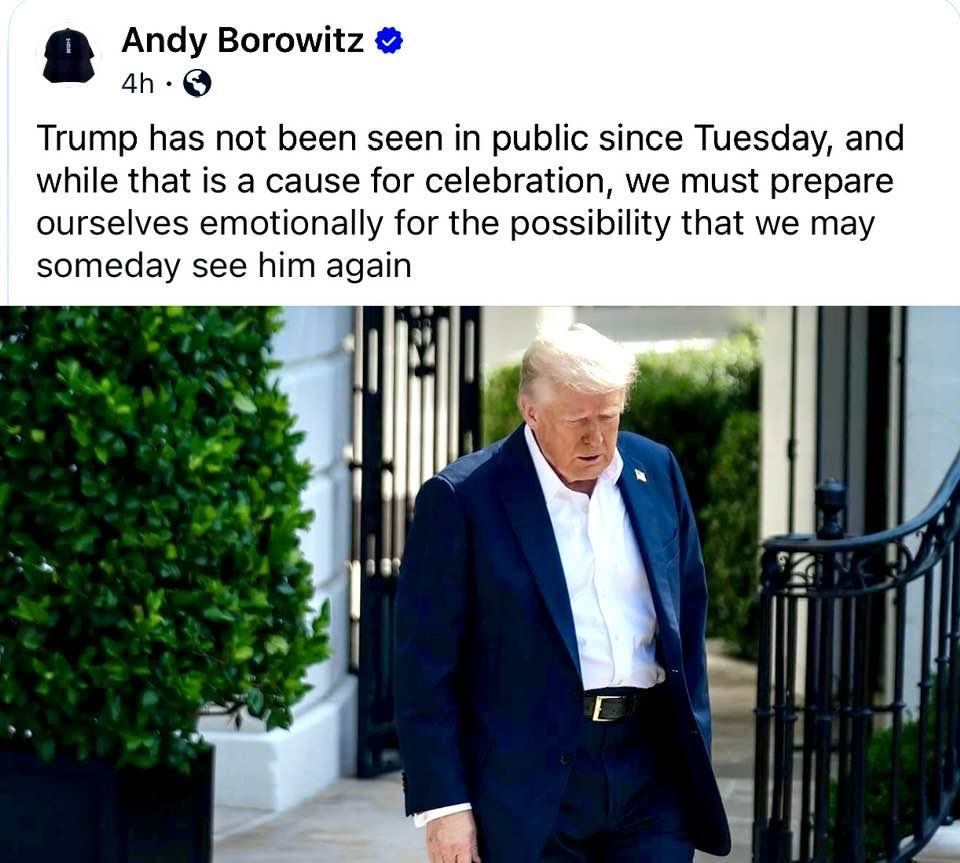
From an Anti-Trump perspective, this image humorously suggests that Donald Trump is "fading" from public sight while pretending it is a celebratory pause in his career before his inevitable return. The caption frames his absence as a "cause for celebration" yet simultaneously warns followers to "prepare ourselves emotionally" for him potentially coming back one day like he did years ago. It implies his recent departure was a temporary step toward a future where he might re-emerge into the spotlight.
detailed-analysis (gemma3_27b-it-q8_0)
Okay, let's break down this meme from an anti-Trump perspective, utilizing the frameworks you've requested where applicable.
Overall Tone & Category Context: This meme, posted by Andy Borowitz (a well-known satirist), operates within an explicitly anti-Trump framework. It uses sarcasm to express relief at his relative public absence while simultaneously acknowledging the continued threat he poses. The humor comes from the incongruity of "celebrating" his absence while simultaneously bracing for his inevitable return. The core sentiment is one of weary vigilance.
---
Visual Description
The image shows Donald Trump walking with his head down, appearing dejected. He's wearing a dark suit, with a red tie. The setting is outside the White House, with carefully manicured greenery and black wrought iron fencing in the background. The composition emphasizes his physical posture—slumped shoulders, lowered gaze—which can be interpreted as a sign of defeat or withdrawal. The image itself isn't inherently aggressive but subtly portrays a diminished and less assertive figure. The overall aesthetic evokes a sense of loss of power, even as the text acknowledges it may not be permanent.
---
Foucauldian Genealogical Discourse Analysis
From a Foucauldian perspective, this meme taps into the discourse surrounding Trump. Trump’s power wasn’t based solely on formal office but on a skillfully constructed narrative around authority, strength, and "making America great again." This narrative was disseminated through carefully controlled communication (rallies, Twitter, media appearances).
His current absence is a disruption in that discourse. Borowitz’s text performs a counter-discourse: celebrating his absence not as a temporary setback, but as a moment of liberation from the constant barrage of that previous narrative. The acknowledgment of a future return ("we may someday see him again") highlights how power is not simply “possessed” but constantly produced and negotiated through discourse. The meme acts as a way to examine how the power dynamics surrounding Trump were formed and maintained, and how they can be momentarily fractured. It’s a moment to rethink the accepted “truths” propagated by Trump’s discourse.
---
Critical Theory
Applying Critical Theory, particularly the Frankfurt School's emphasis on the "culture industry," we can see this meme as a response to the commodification of political discourse. Trump, through his media presence, was a constant, unavoidable spectacle. His absence represents a break in that spectacle.
The text's sarcasm speaks to a critical understanding of how Trump's persona was manufactured and used to manipulate public opinion. "Celebrating" his absence is a refusal to participate in the spectacle, a rejection of the manufactured reality. The anticipation of his return is a recognition that the structures that allowed him to gain power (media, social networks, political polarization) still exist and will likely facilitate his re-emergence. The meme signals a critical awareness of these underlying systems.
---
Marxist Conflict Theory
Through a Marxist lens, Trump's rise can be seen as a symptom of class conflict and the anxieties of a declining capitalist system. His appeal to a base of voters who felt left behind by globalization and economic changes represented a challenge to the established power structure.
The meme, then, isn't just about Trump as an individual; it’s about the tensions he represented. His absence is a temporary easing of that tension. But the "emotional preparation" for his return signifies that the underlying material conditions that fueled his rise haven't been fundamentally addressed. The meme points to a continuing class struggle and the potential for similar figures to emerge. It’s a moment of relative peace before the inevitable resurgence of conflict.
---
Postmodernism
From a Postmodern perspective, the meme deconstructs the notion of a singular, objective "truth" about Trump. Trump himself was a master of simulacra – creating a hyperreal persona that often had little connection to reality.
The sarcasm in the meme questions the very idea of “celebration” and “preparation.” It acknowledges the absurdity of the situation – simultaneously rejoicing in his absence and fearing his return – which reflects the Postmodern sense of fragmentation and uncertainty. There is no "natural" or logical response; the emotional state is deliberately contradictory. The meme highlights the constructed nature of political narratives and the difficulty of finding meaning in a world saturated with information and misinformation.
---
Queer Feminist Intersectional Analysis
While not the primary reading, a Queer Feminist Intersectional lens can identify how Trump’s rhetoric and policies actively targeted marginalized groups. His appeal was often based on reinforcing traditional gender roles and exclusionary nationalist ideologies.
The meme's underlying relief at his absence can be read as a moment of respite for those who were directly harmed by his policies. The "emotional preparation" suggests an awareness that those harms could be repeated. The need for emotional strength and resilience implies an understanding of the ongoing trauma and vulnerability experienced by marginalized communities under a regime like Trump's. This lens helps to center the experiences of those most affected by his politics.
In essence, the meme is a layered statement that leverages satire to express the complex emotions and anxieties felt by those who oppose Trump and recognize the continued potential for his return to power. It is a reminder that the struggle against the ideologies he represents is far from over.
simple-description (llama3.2-vision_11b)
The meme is a screenshot of a Facebook post by Andy Borowitz, a satirical writer, where he comments on the lack of public appearances by former US President Donald Trump since his election loss in 2020. The post reads: "Trump has not been seen in public since Tuesday, and that's a cause for celebration, we must prepare ourselves emotionally for the possibility that we may see him again someday." The image is likely a photo of Trump, but the text is the main focus of the meme.