First Seen
2025-06-09T01:38:23.046035+00:00
detailed-analysis (gemma3_27b-it-q8_0)
Okay, let's break down this meme – a photo of Donald Trump descending a flight of stairs – through the lens of an "Anti-Trump" category. It's a surprisingly potent image that sparked a lot of online commentary, and we'll see how it resonates with several critical theories.
Visual Description
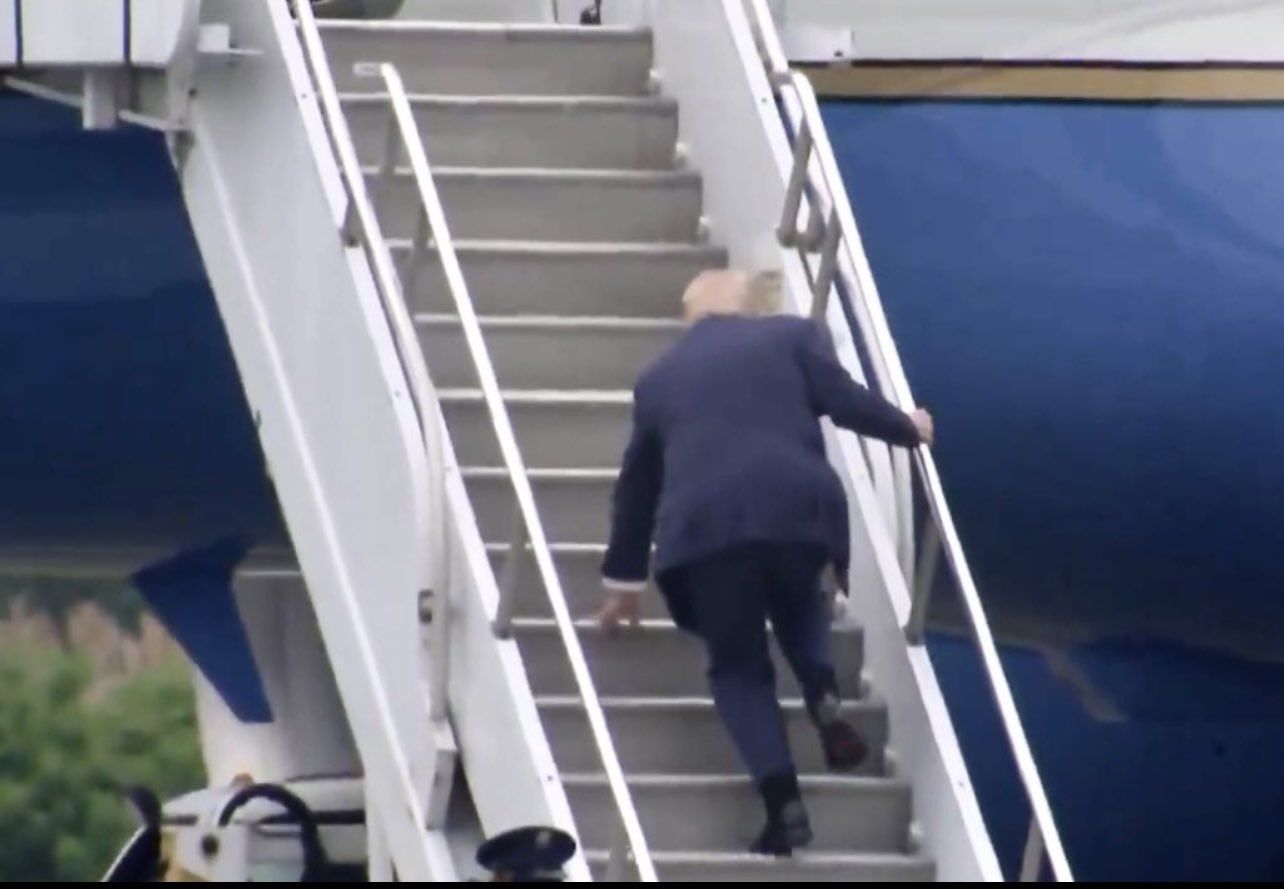
The image depicts Donald Trump, seen from behind, carefully walking down a flight of metal stairs, likely leading from Air Force One. He is wearing a dark suit and appears to be gripping the handrail with both hands. His gait seems slow and cautious. The background is blurred, showing a glimpse of greenery and a blue tarp/wall. The composition emphasizes his descending movement, and the framing focuses on the physical struggle of the act. The color scheme is fairly muted, with the white of the stairs contrasting with Trump's darker clothing.
Foucauldian Genealogical Discourse Analysis
From a Foucauldian perspective, this image isn't simply about Trump's physical abilities. It represents a disruption of the discourse of presidential power and competence. Traditionally, American presidents have been presented as strong, capable leaders. The image actively works against that constructed narrative.
- Power/Knowledge: The image subverts the power/knowledge nexus that traditionally underpins the presidency. The visual demonstrates a loss of control – literally, as he needs to hold onto the rail – which undermines the image of the all-powerful leader.
- Genealogy of the Leader: Foucault's genealogical method traces how concepts (like "leadership," "strength," "competence") have been historically constructed. This meme is a rejection of the traditional, often idealized, genealogy of the American President. It pulls at the thread of the accepted image of a leader's physical and mental fortitude.
- Discipline & Biopolitics: The need for Trump to grasp the railing suggests a body subject to discipline. He’s not the unconstrained, commanding figure expected of a President. It speaks to the vulnerabilities of the body, which are often hidden in discussions of power and political figures.
Critical Theory
Critical Theory is concerned with challenging existing power structures and ideologies. This image serves as a critique of the performative aspects of power.
- The Performance of Leadership: Trump’s presidency was marked by a deliberate and highly theatrical performance of power. This image deconstructs that performance, revealing the frailty beneath. It breaks the illusion of invincibility.
- Ideology: The image challenges the ideology of the strong, decisive leader that has been a cornerstone of American political culture. It forces viewers to confront the reality of the individual behind the manufactured image.
- Commodification of the Leader: Trump, in many ways, commodified himself, presenting an image of success and strength. The image undercuts this commodification, presenting the leader in a state of vulnerability rather than a state of spectacle.
Marxist Conflict Theory
While perhaps less direct, a Marxist reading can see this image as representing the inherent contradictions within capitalism and the ruling class.
- Decline of the Bourgeoisie: Trump, often seen as representing the interests of the capitalist class, is physically descending. This can be interpreted as symbolic of a decline of bourgeois power and legitimacy. It's a visual metaphor for a system under strain.
- Alienation: The awkwardness of his descent might also be seen as reflecting alienation – the separation of the individual from their labor, their community, and even their own bodies.
- Representation and Class: The elite travel associated with Air Force One highlights the distance between the ruling class and the working class. The visual can amplify the feeling of disconnection and resentment.
Postmodernism
Postmodernism is interested in questioning grand narratives and exposing the constructed nature of reality.
- Deconstruction of the Presidential Image: The image actively deconstructs the "presidential" image, revealing it as a curated performance rather than an inherent quality.
- Simulacra and Simulation: Trump’s persona was often described as a simulacrum – a copy without an original. This image suggests that the simulation is breaking down, revealing the human (and perhaps flawed) figure underneath.
- Rejection of Metanarratives: The image refuses to offer a clear interpretation or "truth" about Trump. It exists as a fragmented image open to multiple readings, rejecting the idea of a single, unifying narrative about leadership.
In essence, within the “Anti-Trump” context, this seemingly simple image is a remarkably effective tool for challenging the established norms of power, questioning the constructed image of a leader, and highlighting vulnerabilities that were often obscured during his presidency. It became a visual shorthand for a range of criticisms.
simple-description (llama3.2-vision_11b)
The meme is a photo of Donald Trump walking down a staircase, but instead of his feet touching the ground, they are hovering above it, as if he's floating. The image is captioned "When you're not a good person, but you're good at pretending to be one". This meme is from the category "Anti-Trump" because it pokes fun at Trump's reputation for being dishonest and hypocritical, suggesting that even his actions seem to defy gravity.
detailed-analysis (gemma3-27b-vision)
Okay, let's break down this image with the requested theoretical lenses.
Visual Description
The image depicts a person, visually identified by body shape and clothing as former U.S. President Donald Trump, descending a set of metallic aircraft stairs. He is seen from the rear, wearing a dark suit and tie. The stairs are brightly lit, creating strong contrasts and shadows. The background consists of a blurred green landscape and a dark blue sky. The composition emphasizes the verticality of the stairs and the figure's movement downwards. A couple of hats are barely visible on the bottom left. The image is captured at a slight low angle, making the figure appear somewhat imposing, even while descending. The lighting and angle contribute to a sense of formality and authority, despite the act of simply walking down steps.
---
Foucauldian Genealogical Discourse Analysis
This image lends itself to a Foucauldian reading focused on power dynamics and the construction of authority. The stairs themselves become a metaphor for hierarchical structures. Climbing or descending them isn’t simply a physical act; it is a performance of power.
- Discourse of Presidential Authority: The entire setting – the aircraft steps, the suit, the implied arrival/departure from Air Force One – represents a specific discourse of presidential authority. This discourse is constructed through repetition, ritual, and visual symbolism. We recognize the authority because of these established signifiers. Trump's descending the stairs performs this authority.
- Discipline & Surveillance: Though not immediately obvious, the image hints at the larger systems of discipline surrounding the presidency. Every movement, every gesture is scrutinized and documented. The photograph itself is a form of surveillance, contributing to the construction and maintenance of this discourse.
- Genealogical Trace: A genealogy of this visual trope – the president descending stairs – would reveal how this image has been used throughout history to reinforce specific ideas about power, leadership, and national identity. This image isn’t just about Trump; it’s a performance of a longer, historically-rooted power structure.
---
Critical Theory
From a critical theory perspective, the image is an illustration of how ideologies are embedded within seemingly neutral spaces and actions.
- Dominant Ideology: The image embodies aspects of a dominant ideology centered around traditional notions of leadership, national strength, and the role of the President. The suit, the aircraft, the setting all contribute to this narrative.
- Representation & Power: The image, as a representation, isn’t neutral. It shapes our understanding of power. Trump is presented as a figure of authority through this visual framing.
- The Spectacle: This image can be seen within the context of the “spectacle” (Debord). The scene isn’t about the practical act of descending stairs, but about presenting a leader, reinforcing his image, and maintaining a certain level of distance and mystification.
---
Marxist Conflict Theory
A Marxist reading might focus on the image as a symbol of the class structure and the perpetuation of power imbalances.
- Power & Control: The aircraft and the descent can be understood as a visual representation of the ruling class’s detachment from the everyday realities of the working class. Trump, as the former President, embodies the elite class.
- Symbolic Capital: The image serves to reinforce his symbolic capital – his status, authority, and recognition. This capital is maintained through these visual performances.
- Ideological Reproduction: The image contributes to the ideological reproduction of the existing power structure. It normalizes the idea of a hierarchical system where a select few hold power and control.
---
Postmodernism
A postmodern analysis would emphasize the image's constructed nature and the instability of meaning.
- Simulacra & Simulation: The image could be seen as a simulacrum – a copy without an original. The image isn't about a "real" event, but a staged performance that exists for its own sake. It has become a spectacle, detached from any genuine action.
- Deconstruction of Authority: By focusing on the performance aspect, a postmodern reading might deconstruct the idea of inherent authority. Trump isn’t "naturally" a leader, but a figure whose authority is constructed through image and representation.
- Loss of Grand Narratives: A postmodern lens would question the grand narratives around leadership and national identity, highlighting the fragmented and contested nature of meaning.
---
Queer Feminist Intersectional Analysis
While the image itself doesn't explicitly present any queer or feminist themes, this analysis can provide a perspective on how power operates and how certain bodies are marginalized within it.
- Masculinity & Power: The image reinforces traditional notions of masculinity associated with power and authority. Trump's body language and attire embody this.
- Absent Bodies: The absence of diverse bodies and perspectives in this image – notably women, people of color, and LGBTQ+ individuals – highlights the ways in which power remains concentrated in the hands of a privileged few.
- Intersectional Oppression: The image contributes to a system of intersecting oppressions. While the primary focus isn't on gender or sexuality, it's important to recognize how power structures operate to marginalize groups based on multiple identities.
I have tried to provide thorough analyses based on the theoretical frameworks requested. Please let me know if you would like any aspect elaborated on further.
simple-description (llama3.2-vision)
The meme depicts a photo of former US President Joe Biden, 78, stumbling down the stairs of Air Force One, his feet tangled in his own legs. The image is captioned "I'm not going anywhere" in a humorous nod to the president's age and his infamous gaffes. The meme pokes fun at Biden's age and his tendency to make embarrassing mistakes in public.