First Seen
2025-05-18T16:46:27.449518+00:00
detailed-analysis (gemma3_27b-it-q8_0)
Okay, let's break down this meme from an anti-Trump perspective, applying relevant theoretical lenses where applicable.
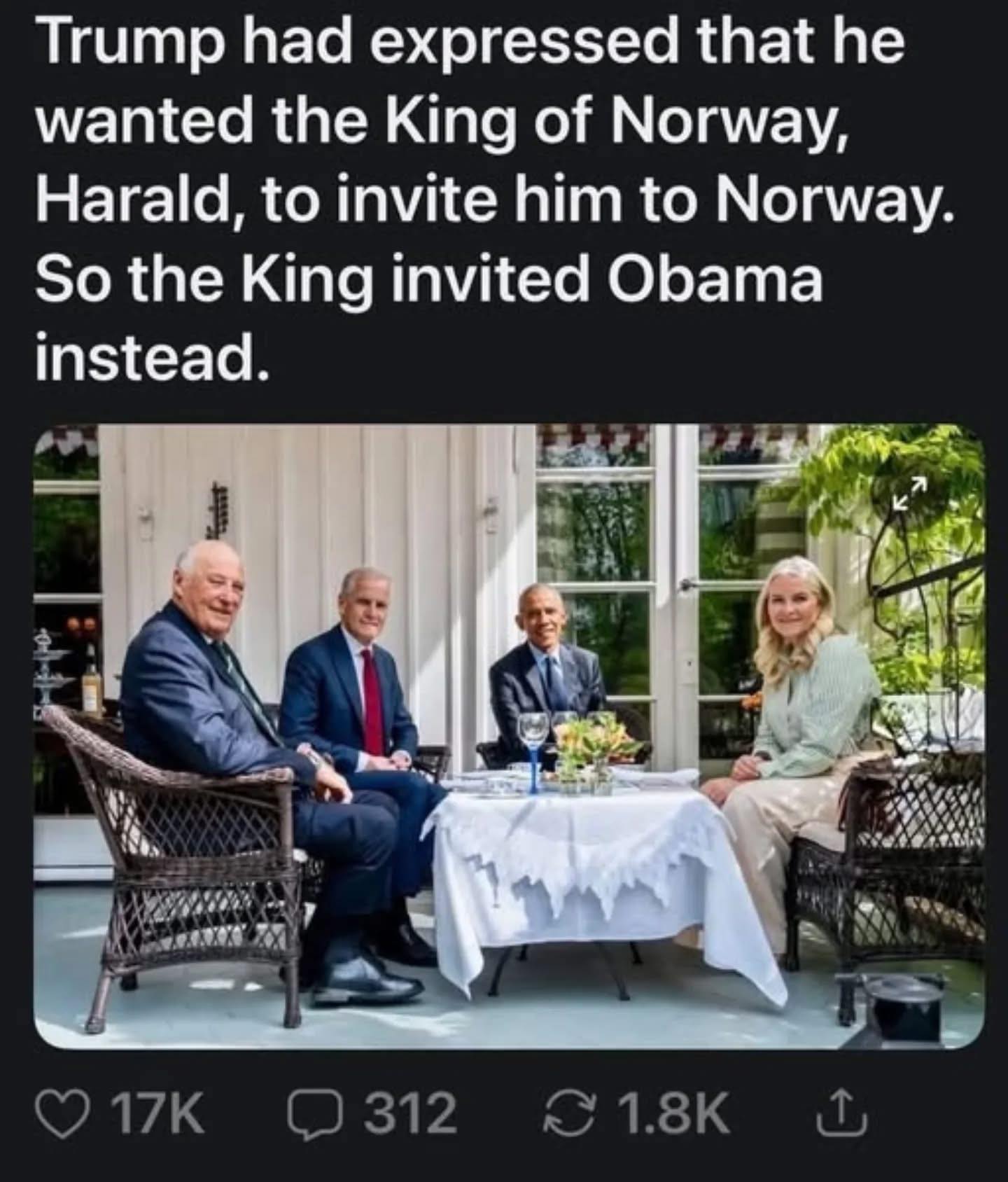
Overall Framing: The meme operates as a validation of anti-Trump sentiments by portraying a scenario where a figure of global authority (the King of Norway) actively rejects Trump’s overtures and instead extends an invitation to Barack Obama, who is commonly seen as a positive figure representing a more diplomatic and internationally respected United States. This is framed as a 'win' for progressives.
Visual Description
The image depicts a formal outdoor gathering. Seated in wicker chairs are King Harald V of Norway, and former U.S. President Barack Obama. A young woman, assumed to be a member of the royal family (Princess Ingrid Alexandra), stands behind them. A table with a floral arrangement and place settings is in front of them, creating a scene of polite, diplomatic hosting. The setting is bright and airy, suggesting openness and a welcoming atmosphere. The composition subtly centers Obama, visually positioning him as the guest of honor.
Foucauldian Genealogical Discourse Analysis
This meme taps into and reinforces the discourse around legitimacy and power. Foucault would be interested in how “power” isn’t simply top-down (Trump wanting an invite), but is also diffused through discourses and social practices.
- Discourse of Presidential Authority: Trump constantly sought to redefine the discourse of presidential authority, emphasizing personal power and flouting international norms. This meme undermines that by showing a foreign head of state discerning a more legitimate leader in Obama. The King’s decision (the event itself) becomes a "statement" that re-asserts a different set of standards for presidential conduct and international respect.
- Genealogy of International Relations: The genealogy, tracing the historical shifts in international relations, reveals a traditional emphasis on diplomacy, respectful engagement, and shared values. Trump's approach was often seen as disrupting this genealogy. The meme positions the King’s actions as a return to, or preservation of, a more established order.
- Truth Regimes: Trump frequently challenged "truth regimes" (accepted ways of knowing and establishing what is real). The meme implies that the King's decision is a "truth" about Trump's international standing—that he is not regarded as a desirable partner by those upholding certain norms.
Critical Theory
From a Critical Theory perspective (often rooted in the Frankfurt School), this meme represents a critique of the "authoritarian personality" and the erosion of democratic norms.
- Rejection of Instrumental Rationality: Trump often exemplified instrumental rationality - achieving goals regardless of moral or ethical concerns. The meme implicitly critiques this by highlighting the King’s choice as guided by a more principled approach – choosing a leader (Obama) aligned with values like diplomacy and international cooperation.
- Cultural Hegemony: The meme attempts to disrupt the potential for Trump to establish cultural hegemony (dominance of one group’s values). By showcasing the King’s preference for Obama, it signals that Trump's values are not universally accepted, even amongst prominent global figures.
- The Public Sphere: The meme itself thrives within the “public sphere” (Habermas) – a space for public discourse. It is a contribution to a broader conversation about political leadership and the desirability of certain leaders.
Marxist Conflict Theory
While not central, a Marxist reading could be applied.
- Class Struggle on a Global Stage: The meme subtly portrays a tension between different "classes" – not in a strictly economic sense, but in terms of political and cultural power. Trump is seen as representing a disruptor of the established order, and the King as representing the “ruling class” (of nations, diplomacy, and established norms) that rejects his challenge.
- Ideological Control: The meme aims to undermine Trump's ideological control by demonstrating that his brand of nationalism and populism does not resonate with all power structures, even those in traditionally allied nations.
Postmodernism
Postmodernism is less directly applicable, but can offer insights.
- Deconstruction of Authority: The meme subtly deconstructs the idea of absolute authority. Trump desired validation from the King, but the King’s rejection demonstrates that authority is not automatically granted but is conferred based on values and perceptions.
- Simulacra & Simulation: Trump often relied on creating a "simulacrum" (a copy without an original) of leadership - emphasizing spectacle and image over substance. The meme implicitly critiques this by contrasting it with the authenticity of a diplomatic act – the King’s genuine invitation to Obama.
In conclusion:
The meme's strength lies in its succinct narrative and symbolic resonance. It isn’t presenting a complex political argument, but rather functioning as a satisfying “mic drop” moment for those opposed to Trump. It leverages the perceived prestige of the Norwegian monarchy and Obama’s positive image to reinforce an anti-Trump narrative, relying on both emotional appeal and implicit critiques of his leadership style and international standing. The theoretical frameworks above help illuminate how this simple meme operates as a form of political commentary and cultural resistance.
Disclaimer: My interpretations are based on the context of the meme as presented and an understanding of the theoretical frameworks mentioned. Different people might interpret it in slightly different ways.
simple-description (llama3.2-vision_11b)
This meme is a satirical commentary on the relationship between former US President Donald Trump and former UK Prime Minister Boris Johnson. The meme juxtaposes a photo of Trump and Johnson with a quote from a fictional scenario where Trump invites the "King of Norway" to a dinner, but actually invites Obama instead, implying a humorous and ironic twist on the original story. The meme is likely to resonate with those who follow news about Trump's controversies and have a sense of humor about his eccentricities.