First Seen
2025-06-19T01:56:56.705618+00:00
detailed-analysis (gemma3_27b-it-q8_0)
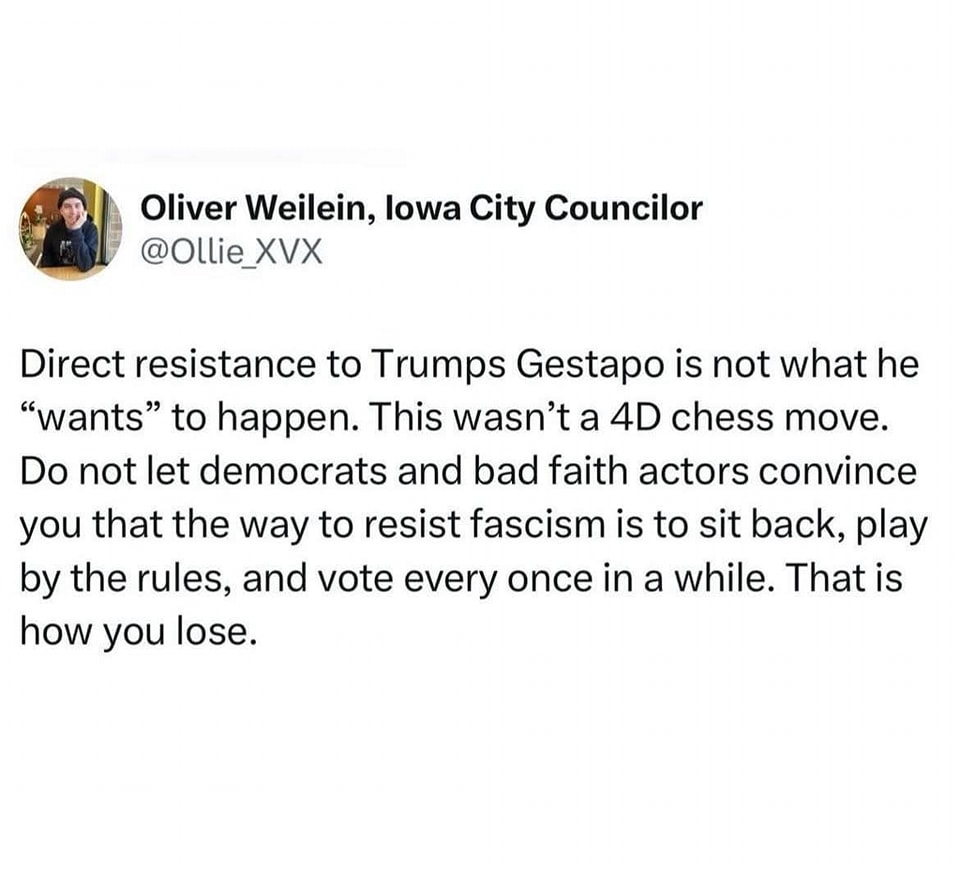
Okay, let's break down this tweet from Oliver Weilein, an Iowa City Councilor, through the lens of Anti-Trump sentiment, and analyzing it with the theoretical frameworks you've provided where applicable.
Please note: This analysis will be fairly pointed, reflecting the strong emotional and political context. I will strive for objectivity in the analysis itself, but the subject matter is inherently partisan.
---
Visual Description
The "meme" is simply a tweet with a profile picture of Oliver Weilein, identifying him as an Iowa City Councilor. The core content is a text statement. The visual element, therefore, adds credibility through the association with a publicly elected official, signifying someone with perceived authority and a stake in the political discourse.
---
Critical Theory
This tweet is steeped in Critical Theory. Specifically, it's a rejection of what the author perceives as a false consciousness fostered by liberal institutions ("Democrats") and bad-faith actors (likely referring to those who advocate for sticking to established norms of political engagement).
- Critique of Ideology: The tweet argues that the dominant narrative—that resistance should be channeled through voting and playing by the rules—is an ideology serving the interests of the oppressive power structure (represented by "Trump's Gestapo"). This aligns with Critical Theory's focus on how dominant ideologies mask underlying power imbalances.
- Rejection of Instrumental Reason: The phrase "4D chess" is a common internet trope suggesting complex, hidden strategies. Weilein explicitly rejects the idea that Trump's actions are part of a master plan designed to provoke a certain reaction. It's a challenge to the idea that one can rationally deduce and counter the "enemy's" logic (a hallmark of instrumental reason, which Critical Theory critiques).
- Power Dynamics: The tweet identifies a clear power dynamic between the ruling class/fascists (“Trump’s Gestapo”) and the resistance. This aligns with Critical Theory’s analysis of how power operates in society.
---
Marxist Conflict Theory
This tweet operates firmly within a Marxist framework, albeit in a modern, less economic-focused iteration.
- Class Struggle (broadened): The tweet isn't strictly about economic class, but it frames the situation as a struggle between opposing forces: those resisting fascism (implied: the working class, the marginalized) versus the forces of oppression ("Trump's Gestapo," plus those perpetuating a flawed strategy).
- False Consciousness and Hegemony: The concern about Democrats and “bad faith actors” convincing people to “sit back, play by the rules, and vote” suggests a critique of hegemony – the dominance of a particular ideology that leads subordinate groups to internalize the beliefs of the dominant class. In this case, the dominant ideology is one of maintaining the system through conventional political means.
- Revolutionary Action: The tweet implicitly advocates for direct action and resistance that goes beyond traditional political participation. The argument that voting and rule-following lead to "lose" is a rejection of reformism in favor of more radical change. It implies a need for direct confrontation.
---
Foucauldian Genealogical Discourse Analysis
This analysis will focus on how power operates through discourse.
- Power/Knowledge: The tweet is actively constructing knowledge about the nature of resistance. It defines what real resistance looks like (direct action) and delegitimizes alternative approaches (voting as the sole method). This exemplifies Foucault's concept of power/knowledge—how power is exercised through the production and control of discourse.
- Genealogy of Resistance: The tweet implies a history of resistance (implicitly linking it to movements beyond the ballot box). It argues against what the author sees as a recent, co-opted notion of resistance—one that’s been rendered ineffective by those in power.
- "Trump's Gestapo": The use of the term "Gestapo" is crucial. It’s not a literal comparison, but a discursive one. It links Trump's administration to a history of extreme repression and brutality, deploying a potent symbol to evoke fear and urgency. This is a deliberate attempt to discredit the administration through a powerful, emotionally charged association.
---
Postmodernism
While not dominant, elements of postmodern thought are present.
- Rejection of Grand Narratives: The tweet implicitly rejects the “grand narrative” of orderly political progress through traditional channels. It challenges the belief in a linear path to liberation.
- Deconstruction of Political Strategies: The idea of “4D chess” is deconstructed – the tweet argues it's a misleading and ultimately damaging framing. This aligns with postmodernism's tendency to dismantle conventional understandings.
- Relativism of Truth: While not fully embracing relativism, the tweet suggests that the “truth” about resistance is being obscured by deliberate manipulation.
---
Queer Feminist Intersectional Analysis
This framework isn’t a direct fit, but can be applied in terms of the dynamics of vulnerability and resistance.
- Intersectionality of Oppression: While the tweet doesn't explicitly mention intersectionality, the call for direct action implicitly acknowledges that those most vulnerable to oppression (queer, trans, people of color, etc.) may face the most severe consequences from inaction or relying solely on systemic change.
- Subversive Resistance: Direct action, in this context, can be seen as a form of subversive resistance that challenges dominant power structures—a tactic historically employed by marginalized communities.
- Challenging Normative Power: The tweet indirectly challenges the normative power of the state and electoral systems, which have historically excluded and marginalized queer and feminist movements.
---
In Conclusion
Oliver Weilein's tweet is a strongly worded rejection of conventional political engagement, framed as a path to failure. It draws heavily on Critical Theory and Marxist conflict theory, calling for more radical and direct resistance to what he perceives as a fascist threat. The use of loaded language ("Trump's Gestapo") and the rejection of strategic complexity ("4D chess") are deliberate rhetorical choices designed to incite action and discredit alternative approaches. The tweet appeals to an audience already sympathetic to anti-Trump sentiment and prepared to consider more aggressive forms of resistance.
simple-description (llama3.2-vision_11b)
The meme is a humorous commentary on Trump's presidency, specifically his decision to withdraw from the Iran nuclear deal. The image features a quote from Trump's speech, "I'm going to make a deal with Iran," which is then followed by a series of tweets from Trump's account, each one ending with a phrase like "I'm going to make a deal with Iran." The meme is poking fun at Trump's tendency to make promises and then not follow through on them, using a game of chess as a metaphor for his inability to make a deal with Iran.
detailed-analysis (gemma3-27b-vision)
Okay, let's break down this tweet from Oliver Weilein, a member of the Iowa City Council, using the lenses you've requested. I'll only include sections where the framework meaningfully applies.
Visual Description
The image is a screenshot of a Twitter post. The post features a profile picture of a man, Oliver Weilein, with a short beard and wearing a blazer. Next to the picture is his Twitter handle (@Ollie_XVX) and the text of his tweet, which is the core content for analysis. The background is the typical light blue of the Twitter interface.
---
Foucauldian Genealogical Discourse Analysis
This tweet provides fertile ground for a Foucauldian analysis. The central claim hinges on discourse – specifically, a discourse around resistance and its “proper” form.
- Power/Knowledge: Weilein's post implies a power struggle over defining resistance. The tweet doesn’t just call for action; it actively delegitimizes certain forms of resistance ("sitting back, playing by the rules, and voting") as ineffective, framing them as a tactic favored by the opposing forces ("Trump’s Gestapo," "bad faith actors"). This positions Weilein as a knower of true resistance and casts others as complicit in defeat. This is key in the relationship between power and knowledge, for Foucault.
- Genealogy: The use of "Gestapo" is crucial. This historical reference invokes the Nazi secret police, instantly associating perceived opponents with extreme authoritarianism. It’s not just an argument; it's an invocation of a specific historical genealogy – a historical lineage of power and repression. The power of the term lies not in its literal accuracy (a potential point for critique) but in the historical weight it carries. It taps into pre-existing fears and understandings of totalitarianism.
- Disciplinary Power: The call for "direct resistance" can be interpreted through the lens of disciplinary power. By framing passive resistance as a tool of the oppressor, Weilein implicitly demands a more active, potentially confrontational, form of resistance. This implicitly shapes the conduct of those reading the tweet, potentially pushing them towards specific modes of behavior.
---
Critical Theory
This tweet is deeply embedded in the tradition of Critical Theory, particularly concerning the analysis of power structures and ideology.
- Critique of Instrumental Rationality: The mention of "4D chess" (a hyperbolic term for complex strategic thinking) represents a critique of purely strategic, instrumental thinking within the resistance movement. Weilein argues that focusing solely on maneuvering within existing systems ("playing by the rules") is a failure of critical thought. It suggests that simply outsmarting the opposition within their own game isn't enough – a deeper transformation is needed.
- Ideology & False Consciousness: The accusation that "democrats and bad faith actors" are trying to convince people to engage in ineffective resistance suggests a critique of ideology. Weilein alleges that these actors are promoting a narrative that serves the interests of the oppressor, keeping people passive and compliant. This aligns with the Critical Theory concept of false consciousness – the inability to see the true nature of one's oppression.
- The Culture Industry & Reproduction of Power: The claim that some are pushing ineffective strategies can also be interpreted in relation to the reproduction of power. Weilein implies that those promoting "sitting back" are effectively reproducing the very conditions that allow fascism to thrive. They’re not necessarily malicious actors, but their actions reinforce existing power structures.
---
Marxist Conflict Theory
While not explicitly economic, the tweet can be analyzed through a Marxist lens of class and power conflict.
- Power Dynamics and Class Struggle: The tweet frames a clear "us vs. them" dynamic. "Trump’s Gestapo" represent the oppressive force, while the implied "us" are those resisting. This echoes the Marxist understanding of society as structured by class conflict. The accusation of "bad faith actors" within the resistance movement hints at internal class divisions and conflicting interests even within the oppressed.
- False Consciousness & Hegemony: As mentioned under Critical Theory, the claim that others are encouraging ineffective resistance can be seen as a form of false consciousness. This false consciousness serves the interests of the ruling class ("Trump’s Gestapo") by maintaining the status quo.
- Revolutionary Action: The call for "direct resistance" suggests a rejection of gradual reform in favor of more radical action. This resonates with the Marxist idea that systemic change requires a fundamental break from the existing order, rather than simply working within it.
Important Considerations
- Hyperbole and Rhetoric: The use of terms like "Gestapo" is highly charged and potentially divisive. While useful for rhetorical effect, it also risks oversimplification and the demonization of opponents.
- Context and Nuance: A complete analysis would require a deeper understanding of the specific political context in which this tweet was posted.
- Subjectivity: Interpretations of these concepts will inevitably be influenced by one’s own ideological perspective.
Let me know if you'd like me to elaborate on any of these sections or explore other theoretical frameworks.
simple-description (llama3.2-vision)
The meme is a screenshot of a tweet from a fictional city councilor in Iowa. The tweet is a humorous, satirical commentary on the current state of politics, referencing the infamous 4D chess game theory, a popular meme about being one step ahead of an opponent. The tweet's author, a city councilor, expresses a sense of frustration and irony, poking fun at the idea that the "4D" game theory has become a popular meme.