First Seen
2025-04-27T03:02:29.083277+00:00
detailed-analysis (gemma3_27b-it-q8_0)
Okay, let's break down this image/meme from an explicitly "Anti-Trump" perspective, utilizing the requested theoretical frameworks where relevant.
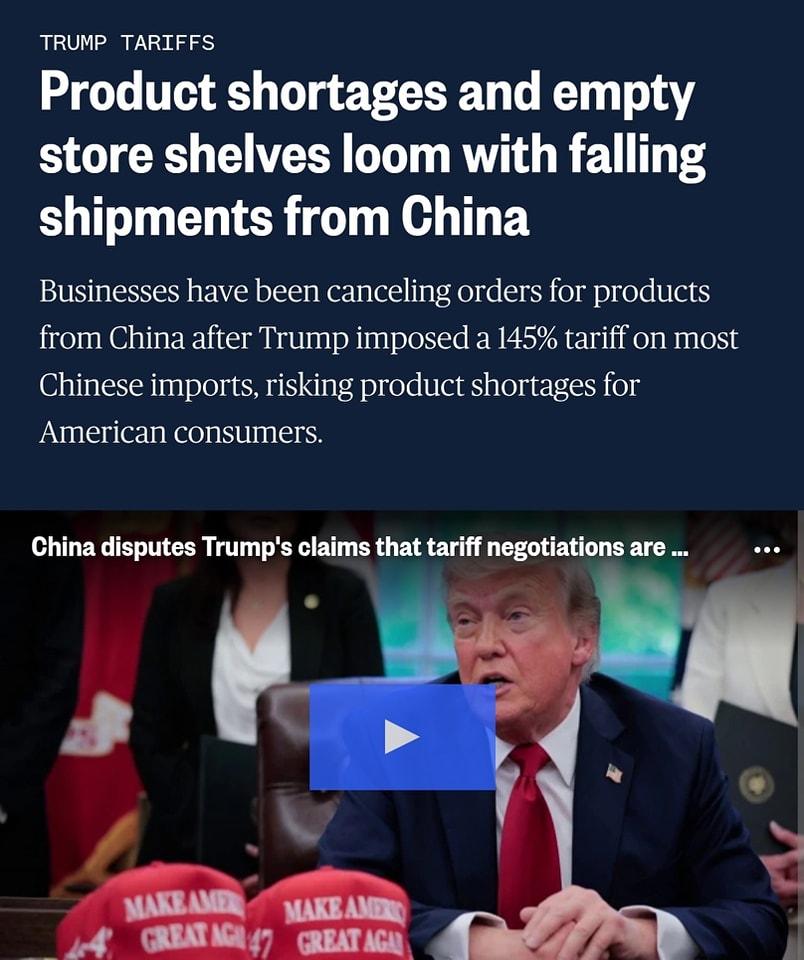
Overall Framing: The meme, presented with the headline "Product shortages and empty shelves loom with falling shipments from China," is designed to demonstrate the negative consequences of Donald Trump's trade policies, specifically his 145% tariff on Chinese imports. The "Anti-Trump" category will present this as evidence of his incompetence, economic mismanagement, and disregard for the average American consumer. It frames Trump as prioritizing a questionable "tough on China" stance over the practical well-being of the U.S. population.
---
Visual Description
The image features a still of Donald Trump speaking at a rally. He is in a position of authority, speaking emphatically, mouth open as if proclaiming something. Behind him, there are multiple flags and supporters holding “Make America Great Again” (MAGA) signs. The flags prominently feature red and are clearly positioned to evoke a sense of nationalistic fervor. Trump's facial expression is intense, suggesting conviction, but within the anti-Trump framework, it's read as self-importance and delusion. The lighting and composition contribute to a sense of drama, but from this viewpoint, it’s theatrical posturing. The fact it includes a "play" icon suggests it is a clip from a video, highlighting a moment of performance and perhaps misrepresentation.
---
Critical Theory
From a critical theory standpoint (especially drawing from the Frankfurt School), the image is a critique of the instrumental reason driving Trump's policies. Critical theory would argue that policies are not neutral or objective but are embedded with power structures and ideologies. Trump’s tariffs are not simply about economics, but about reasserting American dominance and exploiting a perceived weakness in China. The image and its accompanying text expose how this "reason" leads to negative outcomes for the consumer, highlighting a disconnect between the stated goals (making America great) and the lived reality (empty shelves). The MAGA supporters in the background represent the uncritical acceptance of this ideology and the complicity in its detrimental effects. The meme implies that this is an example of a power structure maintaining itself through manufactured consent.
---
Marxist Conflict Theory
Within a Marxist framework, this situation is a classic example of class conflict. Trump’s tariffs are presented as benefiting capitalist interests (domestic producers who face less competition) at the expense of the working class (who face higher prices and potential job losses due to economic disruption). The image suggests that Trump, acting on behalf of capital, is willing to sacrifice the material well-being of ordinary Americans. The tariffs represent a redistribution of wealth upwards, from consumers to corporations. The conflict isn’t necessarily between nations (US vs. China) but within the US, between the owning class and the proletariat. The meme functions as a call to class consciousness—to recognize that the interests of the ruling class are not aligned with the interests of the working class.
---
Postmodernism
From a postmodern perspective, the meme challenges the idea of objective truth and grand narratives. Trump’s claims about trade negotiations (disputed by China, as the headline suggests) are deconstructed as a performance of power, a construction of "reality" designed to appeal to his base. The image acknowledges the inherent ambiguity and instability of meaning. The "Make America Great Again" slogan itself is revealed as a hollow signifier, lacking any concrete meaning beyond its ability to evoke emotional responses. The image suggests that Trump is a master of simulacra—creating a hyperreality that obscures the actual consequences of his policies. There is no "real" problem he is fixing, just a manufactured one to support his narrative.
---
Summary
In the context of the "Anti-Trump" category, this meme operates as a highly charged piece of political critique. It utilizes imagery, framing, and theoretical lenses to portray Trump's policies as harmful, motivated by self-interest, and ultimately detrimental to the American people. It's a deliberate attempt to delegitimize his leadership and expose the perceived hypocrisy of his claims.
Let me know if you'd like me to elaborate on any specific aspect or theory!
simple-description (llama3.2-vision_11b)
This meme is a satirical image that comments on the ongoing trade tensions between the US and China. The meme is likely referencing a news article or social media post about the Trump administration's trade policies, with the text "Anti-Trump" suggesting that the meme is critical of Trump's actions.