First Seen
2025-04-25T19:03:04.767152+00:00
detailed-analysis (gemma3_27b-it-q8_0)
Okay, let's break down this meme from a staunchly Anti-Trump perspective, employing the requested theoretical frameworks where applicable.
Visual Description
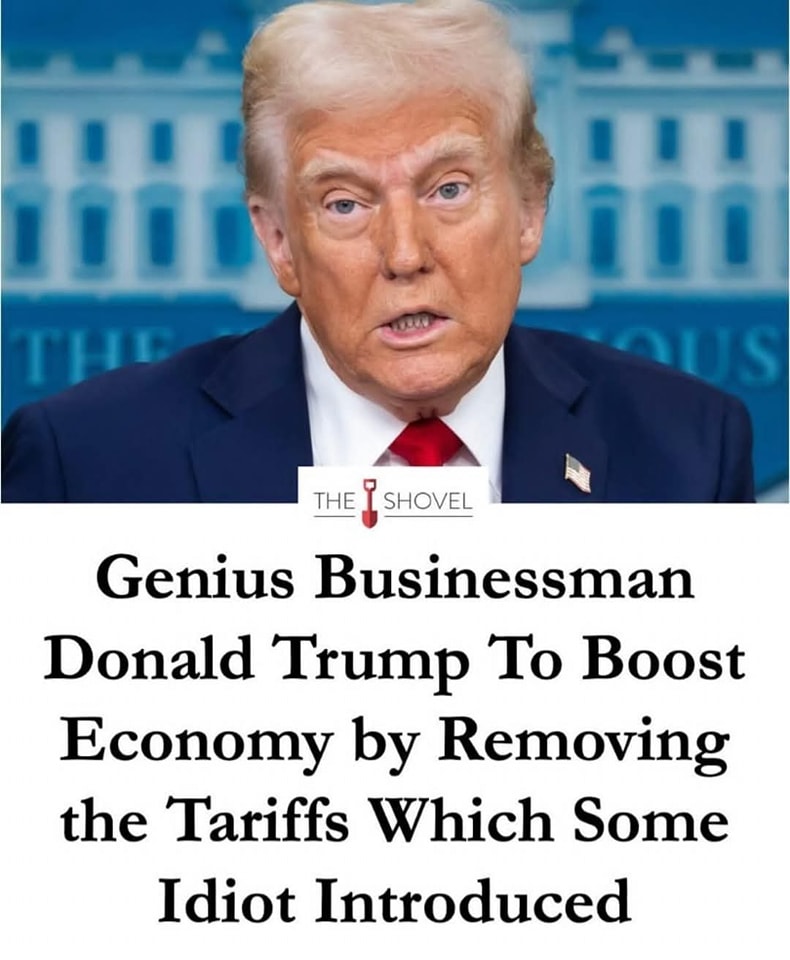
The meme features a close-up image of Donald Trump, appearing with his typical expression of self-importance, set against a blurred backdrop of the White House. The image is likely chosen to amplify his often-perceived arrogance. Beneath the image is text claiming Trump is a “Genius Businessman” who is boosting the economy by removing “tariffs which some idiot introduced.” The text is in a stylized font associated with a satirical news source, “The Shovel.” The visual deliberately juxtaposes Trump’s self-aggrandizement with a backhanded acknowledgement of the tariff policies being corrected. The word “idiot” is a clear insult, implicitly connecting his predecessors’ actions with incompetence.
Foucauldian Genealogical Discourse Analysis
From a Foucauldian perspective, this meme isn't just about Trump; it's about how power operates and how narratives are constructed around "truth." The claim of Trump being a “Genius Businessman” is a prime example of discourse. This isn’t an inherent truth, but a powerful statement created and repeated to assert authority and legitimacy.
The term “idiot” used to describe the previous administration’s tariff implementation operates as a form of power/knowledge. By labeling a past policy and its architects as “idiotic,” the meme constructs a narrative where Trump’s action is not simply a correction, but a demonstration of superior intellect and therefore rightful authority. This genealogy reveals how terms like “genius” and “idiot” aren't neutral descriptors but tools used to establish and maintain power relations. The meme participates in a larger discourse surrounding Trump’s business acumen and economic policies, reinforcing the idea of his “outsider” status and challenging established economic expertise.
Critical Theory
Critical Theory, particularly influenced by the Frankfurt School, is highly relevant here. The meme critiques the ways in which the dominant ideology (in this case, a celebratory narrative of unfettered capitalism) obscures underlying power structures. The claim that removing tariffs will "boost the economy" accepts the premise that economic growth is inherently good, without questioning who benefits from that growth, or what the social and environmental costs might be.
The meme functions as a negative dialectic – a critique of the existing system. It mocks the rhetoric around Trump's supposed business genius, highlighting the inherent contradictions and irrationality of a political system where someone seemingly so self-serving and lacking in expertise can wield such power. It exposes the manipulation of language ("genius," "boost") to legitimize a potentially harmful or ineffective policy.
Marxist Conflict Theory
From a Marxist lens, the meme underscores the inherent class conflict within capitalism. The "boost to the economy" primarily benefits capital (the owners of the means of production) while potentially exacerbating inequalities for the working class. The meme’s sarcastic tone implies that the removal of tariffs is ultimately a move to increase profits for corporations at the expense of workers or consumers.
The use of “idiot” highlights the conflict between different factions within the ruling class, implying a struggle for control of economic policy. It subtly points to the idea that Trump is simply serving the interests of a specific capitalist class by dismantling policies enacted by rivals or those perceived as opposing those interests.
Postmodernism
The meme embraces postmodern characteristics through its irony and pastiche. It doesn’t present a straightforward argument but relies on satire and implied meaning. The claim of Trump being a "genius businessman" is a clear example of ironic simulation – presenting something as real that is obviously not.
The meme's effectiveness relies on the audience's shared understanding of Trump's persona and his history. It doesn’t attempt to persuade through logical arguments but seeks to deconstruct the narratives surrounding him. The use of "The Shovel", a satirical news source, further leans into a postmodern questioning of truth and authority.
In Summary
From an anti-Trump standpoint, this meme is not merely a humorous observation, but a critical commentary on power, ideology, and economic exploitation. It leverages multiple theoretical frameworks to expose the absurdity and potential dangers of Trump's policies and his self-proclaimed "genius." It’s a concise yet potent piece of political satire designed to resonate with those who view Trump as a threat to social justice, economic equality, and rational governance.
simple-description (llama3.2-vision_11b)
This meme is a satirical image that critiques former US President Donald Trump's policies and actions. The image shows a photo of Donald Trump with a caption that reads "Genius Businessman Donald Trump To Boost Economy by Removing Tariffs That Were Imposed by Previous Presidents" in a mock-up newspaper headline. The text is meant to be humorous and ironic, implying that Trump's economic policies are not actually working, and that he is trying to boost the economy by removing tariffs that were previously imposed by other presidents.