First Seen
2025-04-10T02:56:18.722442+00:00
detailed-analysis (gemma3_27b-it-q8_0)
Okay, let's break down this tweet and its accompanying data visualization from the perspective of an "Anti-Trump" category lens. This is a complex analysis, so I'll attempt to address each potentially relevant theoretical framework.
Please Note: Applying these theoretical frameworks is interpretive. There isn't one 'correct' reading, but rather a series of insights based on the core tenets of each. Also, the tweet is relatively straightforward, so not all frameworks will yield substantial results.
Visual Description
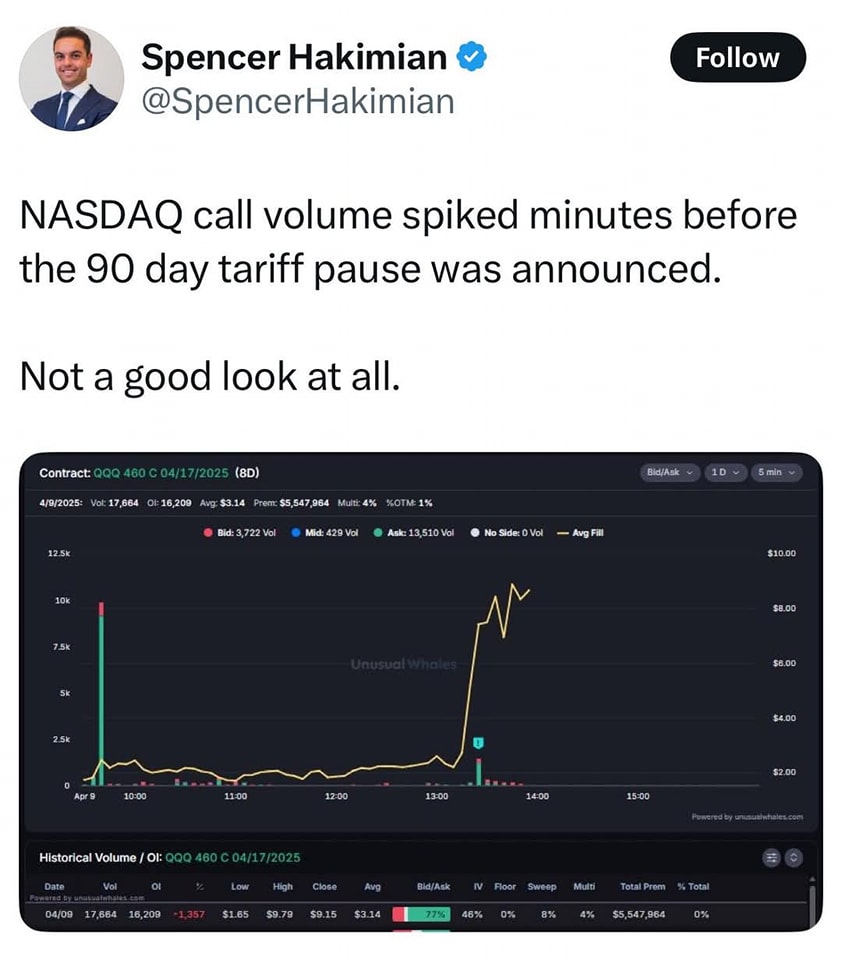
The image shows a tweet from Spencer Hakimian (@SpencerHakimian) regarding a spike in NASDAQ call options volume immediately before a public announcement of a 90-day pause on new tariffs. Below the tweet is a graph (from UnusualWhales.com) illustrating the QQQ (Invesco QQQ Trust, tracking the Nasdaq-100) call option activity on April 9, 2025. The graph demonstrates a steep, almost vertical increase in call option volume around 13:00, peaking shortly before 14:00. Key data points (volume, price, etc.) are also presented in tabular form. The tweet's sentiment is negative: “Not a good look at all.”
Critical Theory
From a Critical Theory perspective, the tweet is a critique of power dynamics and the way institutions (specifically, the financial markets and potentially the government under Trump) operate opaquely and in ways that benefit insiders.
- Ideology Critique: The tweet implicitly challenges the notion of a 'free' and 'fair' market. The timing of the volume spike strongly suggests insider information (or at least, very informed speculation) was used to profit from knowledge that wasn't available to the public. This undermines the ideology of meritocracy and equal opportunity.
- Dominant Discourse: The "Not a good look at all" is understated, acting as a deliberately ironic comment on a potentially illegal or unethical situation. It's a refusal to accept the 'official' narrative that markets are purely driven by rational forces. This challenges the dominant discourse around financial markets and their purported transparency.
- The power to control narratives: This analysis suggests a power structure where select groups have information advantages, allowing them to manipulate markets (or at least anticipate market changes) before the general public.
Marxist Conflict Theory
This is a significant lens for understanding this tweet.
- Class Conflict: The tweet highlights the inherent conflict of interest between the capitalist class (those with access to insider information and the ability to profit from it) and the working class/general public (those who are at a disadvantage). The spike in call options suggests that wealthy individuals or institutions benefited from knowledge unavailable to ordinary investors.
- Exploitation: The exploitation is not direct (like wage labour), but it's an exploitation of information asymmetry. Those "in the know" exploit their privileged access to generate profit at the expense of those without that access.
- Commodification of Information: In a Marxist framework, information, like anything else under capitalism, becomes a commodity. This tweet suggests the buying and selling of potentially illicit information (or, at least, unfairly acquired advantages) as a form of capital accumulation.
- State & Capital: The fact that the tariff announcement is central to this raises questions about the relationship between the state (Trump administration) and capital. Did the state implicitly leak information that benefited certain investors? This speaks to the idea of a state acting in the interests of capital rather than the public good.
Foucauldian Genealogical Discourse Analysis
Foucault's work focuses on the relationship between power, knowledge, and discourse. Here's how it applies:
- Power/Knowledge: The situation reveals how power operates through knowledge. The knowledge of the upcoming tariff pause is power. Those who possess it can use it to generate financial gain, solidifying their position of power.
- Discipline & Control: Financial markets, in this view, aren't just about economic exchange. They are also systems of discipline and control. The rules (or lack thereof) surrounding insider trading contribute to a system where certain actors are privileged and others are subjected to risk.
- Genealogy of “Transparency”: The tweet questions the very concept of "market transparency." The genealogy of this term would reveal how it has been constructed and used to mask underlying power dynamics. The tweet implies that the discourse of transparency is a facade.
Postmodernism
Postmodernism isn’t a dominant framework here, but can contribute some nuance:
- Deconstruction of Grand Narratives: The tweet subtly deconstructs the "grand narrative" of the efficient market hypothesis. This hypothesis claims markets accurately reflect all available information. The data presented contradicts this, suggesting markets are susceptible to manipulation and subjective interpretations.
- Skepticism of Truth Claims: Postmodernism questions the possibility of objective truth. In this context, the "truth" about the market's response to the tariff announcement is ambiguous. Was it simply anticipation? Or was it something more sinister?
- Simulacra & Simulation: The market itself can be seen as a simulacrum – a copy without an original. The value of financial instruments is increasingly detached from underlying realities, existing as a simulation of economic activity.
Conclusion (from an Anti-Trump perspective)
The tweet, through its subtle language and the accompanying data, represents a critique of the Trump era’s financial dealings and the potential for corruption within the administration. It suggests that under Trump, the financial system was susceptible to manipulation and that the interests of the wealthy and well-connected were prioritized over the public good. The timing of the data suggests that those ‘in the know’ anticipated a favorable policy change (the tariff pause) and profited from it, which is, at minimum, deeply unsettling. It is presented as evidence of the failures of unchecked capitalism and the need for greater regulation and accountability.
Let me know if you'd like me to elaborate on any specific point or apply another theoretical framework.
simple-description (llama3.2-vision_11b)
This meme is from the perspective of the "Anti-Trump" category, where it's being used to poke fun at the former President's reputation for making impulsive and unpredictable decisions. The meme shows a screenshot of a stock market chart with a dramatic spike in the price of a stock, implying that Trump's announcement of a new tariff was a surprise that sent the market into a frenzy. The caption reads, "Trump's 2020 tariff announcement was a shock to the market"