First Seen
2026-04-20T21:15:19+00:00
simple-description (qwen3.5_2b-q8_0)
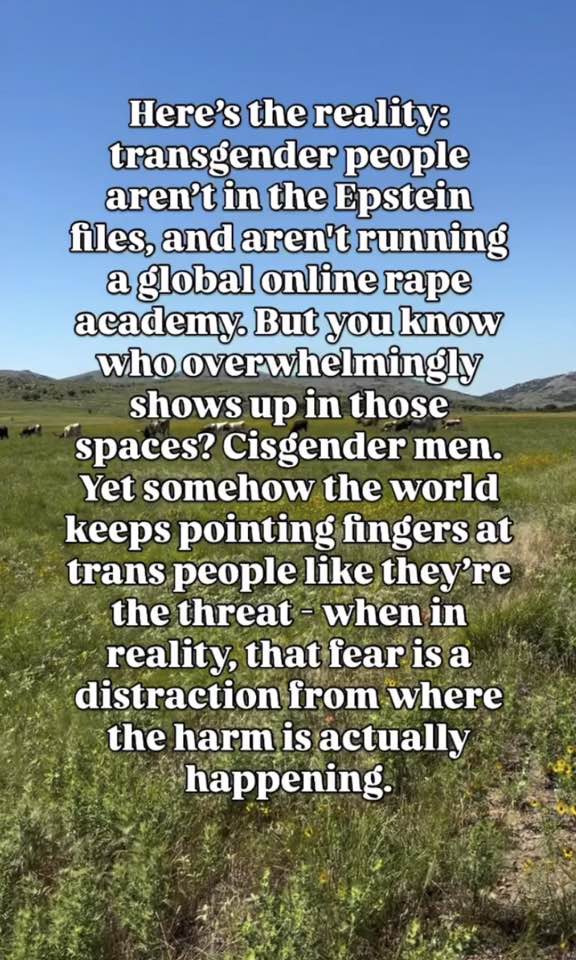
This meme serves as an anti-transphobia argument by explaining that while many people are attacked for being transgender, the danger is actually coming from cisgender men. The text states that Trans people are not the ones involved in crimes like the "Einstein files" or online abuse academies, but rather Cisgender men who overwhelm those spaces. It concludes that the fear and harassment are distractions because the real harm comes from men threatening women, not from transgender individuals themselves.
detailed-analysis (gemma3_27b-it-q8_0)
Here's an analysis of the meme from the perspective of Anti-Transphobia, incorporating the requested theoretical lenses where applicable:
Visual Description
The meme features a photo of rugged, dry, shrub-covered terrain. The image itself is quite neutral and lacks distinct aesthetic features, almost suggesting a sense of barrenness or emptiness. This visually could reflect a feeling of being “exposed” and that there is nothing to hide. The text is overlaid onto the image. This could act as a metaphor for the “ground” on which these arguments are being built.
Queer Feminist Intersectional Analysis
This meme directly engages with a core issue within queer feminist and intersectional thought: the misdirection of blame and the disproportionate focus on marginalized groups as threats while the real perpetrators of harm are shielded.
- Misdirection and Moral Panic: The meme points out a pattern where transgender people are subjected to intense scrutiny and fear-mongering (“pointing fingers at trans people as the threat”), despite having no connection to the very real harms occurring – specifically, references to the Jeffrey Epstein case (sex trafficking) and imagined “global online academies” (likely referring to conspiracy theories of systemic abuse within power structures). This is a classic example of moral panic, where a marginalized group is framed as a danger to society to distract from underlying issues.
- Gender as a Power Dynamic: It specifically highlights the perpetrators as “cisgender men.” This acknowledges the overwhelmingly documented pattern of men (particularly cisgender men) being the primary actors in sexual violence and exploitation. The meme reveals how societal norms and power structures protect those in dominant positions.
- Intersectionality & Marginalization: The critique is framed within a context of systemic harm. Transgender individuals already face disproportionate rates of violence, discrimination, and marginalization. Focusing on them as a threat actively exacerbates these existing vulnerabilities, rather than addressing the root causes of harm.
- The Power of Framing: The meme deconstructs the framing of trans people as the problem. It challenges the narrative that trans existence is inherently dangerous, exposing it as a tactic to divert attention from those who are perpetrating harm.
Critical Theory
From a Critical Theory perspective, this meme is a critique of ideology and the structures of power that perpetuate injustice.
- Ideology & False Consciousness: The meme suggests that the “fear” directed at trans people is not based on genuine threat, but on an ideology that reinforces existing power dynamics. It critiques the “false consciousness” that leads people to see trans people as the problem, rather than the systems that enable abuse.
- Domination & Resistance: The meme can be seen as an act of resistance against this dominant ideology. It attempts to disrupt the prevailing narrative and expose the real sources of domination.
- Deconstructing the Narrative: Critical Theory is centered around deconstructing narratives to expose hidden power structures. The meme seeks to deconstruct the false narrative surrounding trans people, laying bare the underlying power dynamics at play.
Foucauldian Genealogical Discourse Analysis
Michel Foucault's work is relevant here because it focuses on the relationship between power, knowledge, and discourse.
- Discursive Formation: The meme points to a specific "discourse" – a way of talking and thinking about trans people that constructs them as a threat. This discourse isn't "natural" but is produced by power relations.
- Power/Knowledge: Foucault argued that power and knowledge are inseparable. The claim that trans people are dangerous isn’t based on objective truth, but on a specific deployment of knowledge that serves the interests of power.
- Genealogy: A Foucauldian "genealogy" would trace the historical development of this discourse, showing how it emerged and evolved over time to reinforce existing norms of gender and sexuality.
Marxist Conflict Theory
While not a primary lens, elements of Marxist Conflict Theory can be applied:
- Class & Power: The focus on "cisgender men" can be linked to broader patterns of male dominance and the concentration of power within patriarchal systems. This intersects with class dynamics, as those in positions of power are often (though not always) from privileged backgrounds.
- Distraction from Material Conditions: The meme implies that focusing on trans people as a threat is a distraction from addressing material inequalities and exploitative systems that actually cause harm.
In essence, this meme is a concise and powerful critique of anti-trans rhetoric and the systemic forces that allow harm to continue unchecked. It calls attention to the ways in which fear and prejudice are used to deflect blame and protect those in power.
simple-description (llama3.2-vision_11b)
The meme is a satirical commentary on the lack of evidence or credible sources supporting the claims of transgender individuals being in the Epstein files or running a global online rape academy. The text states, "Here's the reality: transgender people aren't in the Epstein files, and aren't running a global online rape academy. But you know who does show up in those spaces? Cisgender men. Yet somehow the world keeps pointing fingers at trans people like they're the threat - when in reality, it's a distraction from where the harm is actually happening." The meme highlights the absurdity of the claims made against transgender individuals and the need to address the real issues of cisgender men's involvement in such activities. It suggests that the focus on trans people is a diversion from the real problem.