First Seen
2024-10-09T21:43:51.563105+00:00
detailed-analysis (gemma3_27b-it-q8_0)
Okay, let's break down this meme from an anti-transphobic perspective, using the theoretical frameworks requested. It's a pointedly ironic meme aimed at exposing hypocrisy.
Visual Description
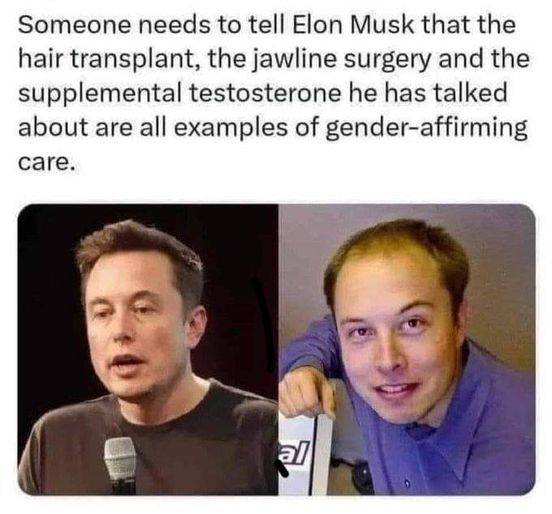
The meme presents a diptych. On the left is a photo of Elon Musk speaking at an event, looking relatively standard in a black shirt. On the right is a photoshopped image of Musk with a drastically altered face – exaggerated jawline definition, fuller hair (likely indicating a hair transplant), and a slightly softened facial structure. The caption explicitly links these procedures – hair transplant, jawline surgery, and “supplemental testosterone” (which Musk has alluded to discussing for his health) – to “gender-affirming care”.
The stark juxtaposition is key. The altered image attempts to exaggerate changes often associated with masculinization.
---
Foucauldian Genealogical Discourse Analysis
This meme heavily relies on a Foucauldian analysis. Michel Foucault's work explored how power operates through discourse, the systems of thought, language, and practice that create meaning. This meme functions by disrupting the established discourse surrounding “gender-affirming care”.
- Power/Knowledge: The dominant discourse frames “gender-affirming care” (historically understood as medical interventions for transgender and gender non-conforming individuals) as something exceptional, controversial, and even dangerous (often framed by conservative political actors). This meme flips that script. It highlights how all body modifications, even those embraced and celebrated in cisgender men, are, at their core, interventions that shape the body in accordance with social ideals.
- Genealogy: Foucault's genealogical method traces the historical development of concepts and how their meanings shift. This meme implicitly genealogizes the concept of "gender affirming care" to reveal its connection with body modification generally, thereby revealing it as not solely belonging to trans people.
- Normalization & Discipline: Musk, as a highly visible figure, embodies societal expectations of masculine presentation (success, strength, etc.). His choices to alter his appearance align with those expectations. The meme exposes that these choices are normalized while similar choices by trans people are pathologized and stigmatized. The "discipline" is the social pressure to conform to gender norms.
---
Critical Theory
Critical theory, particularly related to the Frankfurt School, deals with analyzing societal structures and power dynamics to reveal imbalances and oppression. The meme aligns with this by:
- Exposing Ideology: The meme challenges the ideology that trans body modifications are inherently “unnatural” or suspect while cisgender modifications are simply “self-improvement.” It reveals that both are attempts to conform to (or deviate from) socially constructed ideals of beauty and gender.
- Critique of Dominant Narratives: The meme directly critiques the dominant narrative surrounding gender-affirming care, which is often framed by cisgender perspectives and anxieties. It exposes the double standard in how body modification is perceived.
- Power Dynamics: It highlights how power structures (specifically patriarchy) influence what is considered “normal” or “desirable” regarding bodies. Musk’s actions (and subsequent normalization) reflect this power.
---
Queer Feminist Intersectional Analysis
This meme is deeply resonant with Queer Feminist and Intersectional frameworks.
- Deconstruction of Gender: It deconstructs the rigid binary of gender by demonstrating that "masculinity" itself is constructed and actively maintained through interventions like hair transplants and hormone supplementation. Musk’s actions are presented as performing masculinity, just like trans men are accused of “performing” gender.
- Intersectionality: The meme touches on the intersection of gender with power and privilege. Musk, as a wealthy and influential cisgender man, has the resources and social capital to alter his body without facing the same scrutiny or discrimination as trans people. The meme implicitly points out that the ability to change one's body is unequally distributed, and the social consequences of those changes are highly unequal.
- Anti-Trans Misogyny: The meme addresses anti-trans misogyny by showing how trans people are often demonized for pursuing changes to their bodies that cisgender men are applauded for.
---
In summary: This meme is a clever and pointed critique of transphobia, leveraging irony to expose the hypocrisy of criticizing trans people for seeking medical interventions to align their bodies with their gender identity while celebrating similar interventions undertaken by cisgender men. It draws heavily on critical theory, Foucauldian analysis and queer feminist principles to deconstruct societal norms and expose power dynamics.
simple-description (llama3.2-vision_11b)
This meme is a satirical take on Elon Musk's statements on transgender issues. The image juxtaposes two photos of Elon Musk, one with a caption "Elon Musk" and the other with a caption "Elon Musk's Twitter account was suspended". The meme is implying that Musk's Twitter account was suspended due to his anti-transphobic statements, and the image is a humorous way of highlighting the irony of Musk's situation.
detailed-analysis (gemma3-27b-vision)
Okay, let's break down this meme, applying the requested theoretical frameworks where relevant. It's a loaded piece, so a multi-layered analysis is appropriate.
Visual Description
The meme presents a side-by-side comparison of two photographs of Elon Musk. On the left, Musk is shown speaking at an event, appearing with a full head of hair. On the right, a screenshot from a video call depicts Musk with a receding hairline. The text above the images states: “Someone needs to tell Elon Musk that the hair transplant, the jawline surgery and supplemental testosterone he has talked about are all examples of gender-affirming care.” The juxtaposition highlights a perceived change in appearance, intentionally tying it to contemporary discussions of gender-affirming care.
Foucauldian Genealogical Discourse Analysis
This meme strongly lends itself to a Foucauldian analysis. Michel Foucault's work focused on how power operates through discourse—the ways we talk and think about things—and how this shapes our understanding of reality.
- Discursive Formation of Gender: The meme deliberately reconfigures the discourse around "gender-affirming care." Traditionally, this term refers to medical, surgical, and social interventions undertaken by transgender or gender non-conforming individuals to align their physical or social presentation with their gender identity. The meme disrupts this established discourse by applying it to Elon Musk, who is not generally identified as transgender.
- Power/Knowledge: The text functions as a statement of "knowledge," claiming that Musk's procedures are gender-affirming care. This assertion, however, is not based on traditional definitions. The meme wields power by attempting to redefine a term, placing Musk within a framework he wouldn't typically occupy. It’s a power move to challenge assumptions about gender and appearance.
- Genealogical Examination: A Foucauldian genealogy would trace the history of "gender-affirming care" as a concept, and how its meaning has shifted over time. It would reveal how this discourse is intertwined with medical authority, social expectations, and power dynamics.
- Subjectification: The meme suggests that Musk's actions (hair transplant, jawline surgery, testosterone) can be interpreted as attempts to construct a desired gender presentation—a process of "subjectification" that Foucault explored.
Queer Feminist Intersectional Analysis
This meme intersects with Queer Feminist thought in several ways:
- Deconstruction of Gender Performance: Queer theory challenges the notion of a fixed or essential gender identity. It sees gender as performative—something we do rather than are. The meme implicitly asks: if medical procedures can alter physical appearance to align with a preferred aesthetic, aren’t all such interventions a form of “performing” gender? It subtly suggests that the construction of masculinity (in Musk’s case) isn’t ‘natural’ but actively created.
- Intersectionality: The meme, while focused on gender, also touches upon power dynamics related to wealth and celebrity. Musk’s ability to access and finance these procedures highlights the privilege that allows some individuals to actively manipulate their appearance—a privilege not afforded to everyone.
- Challenging Heteronormative Beauty Standards: The meme subtly critiques the societal pressures on men to conform to certain standards of masculinity. By framing Musk’s procedures as “gender-affirming care,” it implies that even traditionally “masculine” men are actively engaged in constructing and maintaining their gender presentation.
- Reclaiming Language: By deliberately applying the term “gender-affirming care” to Musk, the meme attempts to reclaim language from the transgender community and use it to make a broader point about the constructed nature of gender. (This is where it could be seen as potentially problematic, as it risks trivializing the experiences of transgender individuals).
Postmodernism
Postmodern thought, with its emphasis on deconstruction, irony, and the rejection of grand narratives, is also evident in this meme:
- Deconstruction of Meaning: The meme deliberately deconstructs the conventional meaning of “gender-affirming care.” It disrupts the expected association of the term with transgender identities and applies it to a different context.
- Irony and Satire: The meme relies heavily on irony and satire. It’s absurd to equate Musk’s procedures with gender-affirming care in the traditional sense, and this absurdity is intentional.
- Rejection of Essentialism: Postmodernism rejects the idea of fixed or essential categories, including gender. The meme implies that gender is fluid and performative, and that all attempts to manipulate one’s appearance are, in a sense, forms of gender construction.
- Simulacra and Simulation: (A concept from Jean Baudrillard) The meme highlights how appearance can be a simulacrum—a copy without an original. Musk’s manufactured appearance becomes a substitute for some "authentic" self.
Disclaimer: It's important to note that while these theoretical frameworks can offer insightful interpretations of the meme, they are not necessarily the intent of the original creator. This analysis is subjective and open to debate. Also, while the meme is thought-provoking, it's crucial to be sensitive to the experiences of transgender and gender non-conforming individuals and avoid trivializing their struggles.
simple-description (llama3.2-vision)
This meme is a photo of Elon Musk with a caption that reads: "Someone needs to tell Elon Musk that the hair transplant, the jawline surgery, and the supplemental testosterone he's been talking about are all examples of gender-affirming care." The image shows Elon Musk with a more masculine appearance, implying that he has undergone various cosmetic and medical procedures to enhance his appearance. The caption is a humorous way of pointing out that Musk's efforts to look more masculine are actually a form of gender-affirming care, which is a topic of controversy and debate.