First Seen
2025-05-23T01:20:57+00:00
detailed-analysis (gemma3_27b-it-q8_0)
Okay, let's break down this "meme" (really a news headline and accompanying image) from an "Anti-Tech" perspective, utilizing the requested theoretical frameworks where applicable.
Important Note: The framing as a "meme" feels off. This isn't a humorous image macro; it's a news item that can become fodder for commentary within an anti-tech critique. The anti-tech stance isn't about ridiculing individuals, but about deconstructing the systems and power dynamics they represent. I'll adopt that approach here.
I. Visual Description
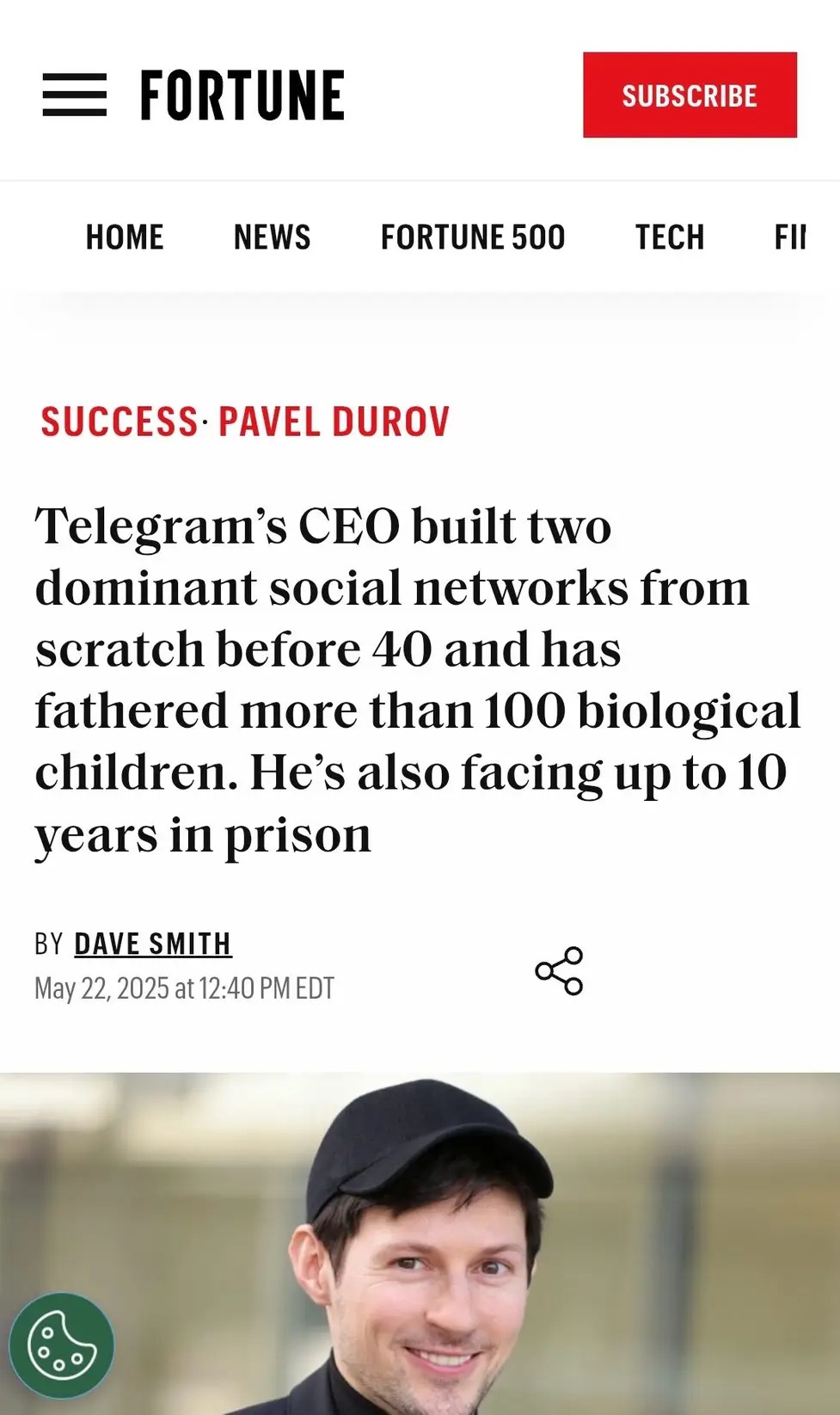
The image shows Pavel Durov, CEO of Telegram, smiling at the camera. He is wearing a black baseball cap and a casual, slightly rumpled dark jacket over a light-colored shirt. The background is out of focus, suggesting an outdoor setting. The overall presentation is designed to project an image of casual success – a tech entrepreneur who is approachable and perhaps even unconventional. The headline juxtaposes this relatively benign visual with startling claims. This dissonance is key to the potential critique.
II. Foucauldian Genealogical Discourse Analysis
This headline, within an anti-tech framework, immediately offers a rich ground for Foucauldian analysis.
- Power/Knowledge: The headline reveals how the narrative around "success" in the tech industry is constructed. It presents a specific form of power – entrepreneurial prowess, specifically the creation of platforms – as inherently valuable. This is then intertwined with seemingly unrelated data (number of children, potential prison time). Foucault would argue that knowledge isn't neutral; it's always linked to power. The way this is presented (success and potential crime, framed together) seeks to shape our understanding of Durov, and by extension, the tech industry.
- Discipline and Normalization: Tech founders like Durov are often normalized as "visionaries" and "disruptors," existing outside of conventional societal norms. However, the potential legal consequences reveal the state's attempt to discipline and control those who create parallel systems (like Telegram), a platform known for its encryption and relative lack of censorship. The headline highlights the tension between the freedom these entrepreneurs claim to offer and the constraints imposed by established power structures.
- Genealogy of "Success": A genealogical approach would trace the historical development of the idea of "success" itself in the context of tech. We can ask: How has "building a platform" become equated with achievement? What systems and assumptions underpin this equation? It would expose the historical shifts that led to tech billionaires being lauded as figures of innovation while the wider social costs of their platforms are often ignored.
III. Critical Theory
From a Critical Theory perspective, this headline reveals the manipulative logic of late-stage capitalism.
- Commodification of Life: The sheer number of children fathered – a deeply personal aspect of life – is presented alongside professional achievement. This implicitly commodifies reproduction, reducing it to another metric of “success.” This links to a broader critique of capitalism’s tendency to turn everything – including human relationships and even procreation – into a quantifiable measure of worth.
- Ideology and Hegemony: The framing glorifies entrepreneurial achievement while downplaying the potential harm (and the legal jeopardy) involved. This reinforces the dominant ideology that technological disruption is inherently good, obscuring the ways in which platforms like Telegram can be used for harmful purposes (e.g., spreading misinformation, facilitating illegal activities). It's a hegemonic process – the normalization of a worldview that benefits those in power (in this case, tech elites).
- The Illusion of Freedom: Telegram is often marketed as a platform for free speech, but the fact that Durov is facing potential legal consequences highlights the limits of that freedom. Critical theorists would argue that the illusion of freedom is often used to justify exploitative systems.
IV. Marxist Conflict Theory
A Marxist lens views this as a demonstration of class contradictions.
- Capital Accumulation: Durov represents the concentrated wealth and power that arises from the ownership of digital infrastructure. The “success” described is fundamentally about capital accumulation – the control of resources and the extraction of surplus value.
- Bourgeoisie vs. State: The conflict with the legal system (facing 10 years in prison) is a manifestation of the inherent tension between the bourgeoisie (the owning class, represented by Durov) and the state (which, in a Marxist view, ultimately serves the interests of the capitalist class, though sometimes in a contradictory manner). The state is attempting to regulate or punish Durov, either to protect other capitalist interests or to maintain control over the flow of information.
- Alienation: The headline subtly hints at the alienation inherent in capitalist society. Durov's life is defined by quantifiable achievements – platforms built, children fathered – yet the headline lacks any sense of human connection or fulfillment.
V. Postmodernism
A postmodern interpretation would focus on the instability of meaning and the fragmentation of identity.
- Deconstruction of "Success": The juxtaposition of "success" and "potential crime" undermines the very notion of a coherent, stable definition of "success." Postmodernism challenges grand narratives and argues that all meaning is constructed and contingent.
- The Simulacrum: Durov's public image is a carefully constructed “simulacrum” – a copy without an original. The headline itself contributes to this by presenting a fragmented, hyperreal portrait of the entrepreneur.
- Identity as Performance: Durov's public persona (the smiling tech bro) is a performance, a constructed identity designed to project a certain image of power and innovation.
In Conclusion
From an Anti-Tech perspective, this headline isn’t about Durov as an individual. It’s a case study in how tech ideology operates, how power is exercised through technological platforms, and how capitalism commodifies even the most personal aspects of life. The headline is a microcosm of broader issues related to surveillance, control, data extraction, and the erosion of privacy. It’s a call to critically examine the narratives we are told about "success" in the tech world and the true costs of technological progress.
simple-description (llama3.2-vision_11b)
The meme is a screenshot of a Fortune article about the CEO of Telegram, Pavel Durov. The article's title, "How Pavel Durov Went From Rich Kid to Anti-Tech CEO," is highlighted in bold. The meme is likely referencing Durov's background and his shift in perspective from a wealthy, tech-savvy individual to an anti-tech CEO.