First Seen
2025-11-06T01:06:07.376393+00:00
simple-description (qwen3.5_2b-q8_0)
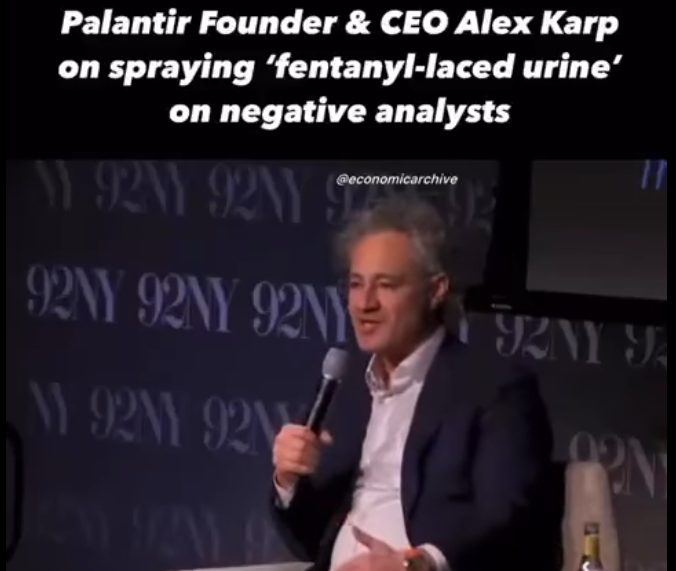
This anti-tech meme mocks the disconnect between modern tech leaders and their actual personas by juxtaposing a professional setting with horrific violence. It shows Palantir's CEO at NYU Stern (indicated by the repeating "92NY" background) speaking on stage, only to be overlaid with text about using "fentanyl-laced urine." This absurdity satirizes how high-level executives in business often speak in shocking terms that clash entirely with their elite, corporate image.
detailed-analysis (gemma3_27b-it-q8_0)
Okay, let's break down this meme through the lens of an "Anti-Tech" category, utilizing relevant theoretical frameworks where applicable.
Image Description
The image shows Alex Karp, CEO of Palantir Technologies, speaking at a public event (likely the 92nd Street Y, as denoted by the branding). He appears animated, gesturing with his hands while speaking. A partially visible can of what appears to be a beverage (possibly beer) sits near the edge of the frame. The text overlay states "Palantir Founder & CEO Alex Karp on spraying 'fentanyl-laced urine' on negative analysts," with a user tag, "@economicarchive," at the bottom. The meme references a viral sound clip from a recent interview where Karp made these provocative statements.
Foucauldian Genealogical Discourse Analysis
This meme is a potent example of how power operates within the "tech" discourse, and it’s a perfect subject for Foucauldian analysis. Michel Foucault's work focuses on power not as a top-down force, but as a dispersed network embedded in social practices and discourses.
- Discourse of Control: Palantir, as a company, embodies the discourse of control and surveillance. Its core business is data analysis for governments and intelligence agencies. Karp's statement, bizarre as it is, is part of this discourse. It reveals the contempt, the willingness to utilize extreme (and potentially violent) imagery, and the sense of impunity that can accompany those who wield power through information.
- Genealogy of Authority: Foucault would be interested in how this type of statement – seemingly irrational, aggressively defensive, and laced with threat – becomes a way of asserting authority in the tech world. It's a performance of dominance, suggesting a "we are above the rules" mentality. It’s a genealogy of tech-bro power, tracing its roots to an assumption of entitlement and a willingness to disrupt norms.
- The Body as Site of Power: The imagery of urine, fentanyl, and spraying directly engages with the body as a site of power. It speaks to violation, contamination, and the willingness to inflict harm. This isn't just about disagreeing with criticism; it's about an attempt to dominate through bodily threat.
- The Production of 'Analysts' as Enemy: The 'negative analysts' aren't just objective observers. They are constructed within this discourse as enemies – a threat to Palantir’s perceived legitimacy and power. By explicitly targeting them with violent imagery, Karp reinforces this binary.
Critical Theory
From a Critical Theory perspective (drawing from the Frankfurt School), this meme exposes the darker side of the “rational” and “efficient” tech industry.
- Instrumental Reason: Palantir’s work is often presented as being about objective, data-driven decision-making (instrumental reason). However, Karp’s outburst reveals that behind this façade lies an irrational, emotionally driven, and potentially dangerous mindset. This challenges the claim that technology is inherently neutral or progressive.
- Culture Industry: The meme itself is part of the “culture industry,” the way dominant ideologies are disseminated through media. It shows how even shocking statements can be circulated and consumed, becoming part of the spectacle. In this case, the shocking statement reinforces the anti-tech narrative by demonstrating the inherent flaws of the industry.
- Alienation and Dispossession: Palantir's reliance on surveillance technologies can be seen as contributing to the alienation and dispossession of individuals, stripping them of privacy and agency. The company and its CEO seem to lack concern for these consequences.
Marxist Conflict Theory
A Marxist analysis would center on class struggle and the concentration of power.
- Bourgeoisie & Proletariat: Karp represents the tech bourgeoisie – the owners and controllers of the means of information. The 'negative analysts' could be seen (loosely) as representing forces critical of this power structure. The statement is a display of class contempt, a refusal to engage with critique from outside the elite.
- Ideological Control: Palantir benefits from the ideological narrative that technology is inherently good and progressive. Karp’s statement threatens to disrupt this narrative, exposing the self-interest and potential ruthlessness of those in control. The meme functions as a demystifying tool, stripping away the ideological veneer.
- Commodity Fetishism: The meme draws attention to the fact that Palantir isn’t just selling software; it’s selling power, surveillance, and a particular vision of the future. The statement is a direct expression of the power dynamic at play.
Postmodernism
Postmodern perspectives would emphasize the constructed nature of truth and the instability of meaning.
- Hyperreality: The outrageousness of the statement borders on hyperreality, where the line between representation and reality becomes blurred. It is a spectacle of its own accord.
- Deconstruction of Authority: The meme deconstructs Karp's authority as a tech leader. By presenting him as someone capable of making such bizarre threats, it undermines his credibility and challenges the notion of expertise.
- Irony and Parody: The meme, in its presentation, relies heavily on irony. The contrast between Karp’s position of authority and his outlandish words creates a sense of absurdity.
In Summary
From an Anti-Tech perspective, this meme isn’t just a funny internet moment; it’s a symptom of a deeper problem. It reveals the power dynamics, the potential for abuse, and the ideological justifications that underpin the tech industry. It's a snapshot of the arrogance and contempt that can accompany unchecked power, and it's precisely this kind of exposure that fuels the growing skepticism and resistance toward Big Tech. The meme succeeds because it is disturbing - it doesn't just critique technology, it presents a glimpse into the potentially dangerous mindset of those who control it.
simple-description (llama3.2-vision_11b)
The meme features a photo of a person, likely a tech industry leader, with a caption that reads: "Palantir Founder & CEO Alex Karp on spraying 'fentanyl-laced urine' on negative analysts." The image is likely a photo of a person in a business setting, such as a conference or interview, with a quote or statement from the person. The meme is likely a humorous or satirical take on a real event or situation, using a fictional scenario to make a point about the tech industry.