First Seen
2026-04-02T05:33:29+00:00
simple-description (qwen3.5_2b-q8_0)
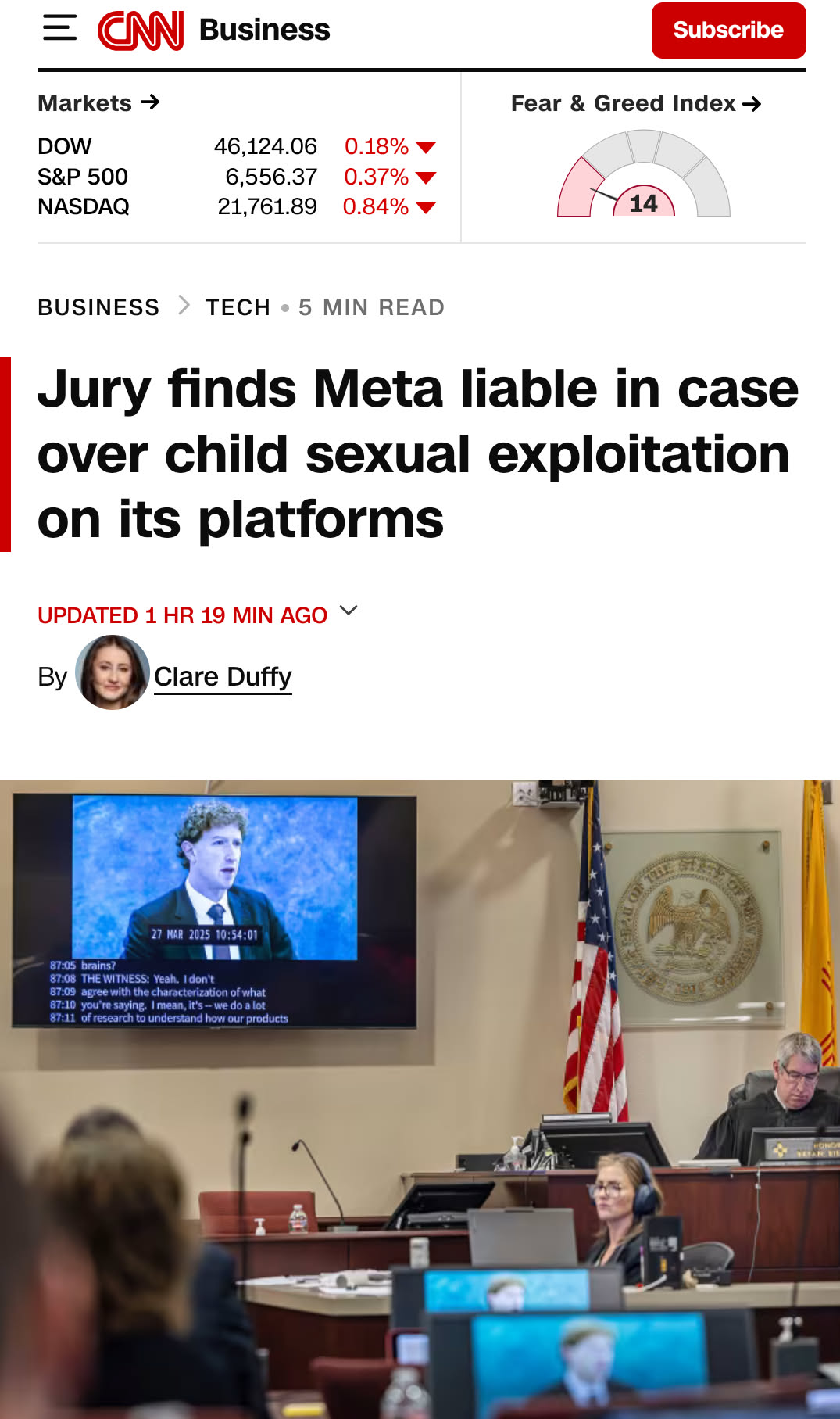
This meme satirically juxtaposes Wall Street stock tickers with a high-stakes courtroom trial featuring Mark Zuckerberg, suggesting Meta is now facing independent legal review rather than corporate control. It depicts Zuckerberg appearing on a monitor in court as a witness against allegations regarding child exploitation and platform safety, using the visible text "THE WITNESS" to symbolize how his tech giant faces judicial scrutiny for handling public data. By including a future date like "27 MAR 2025," the image implies that leadership is under "judicial" review for handling public data rather than just standard business management.
detailed-analysis (gemma3_27b-it-q8_0)
Okay, let's break down this image from an "Anti-Tech" perspective, examining it through several critical theory lenses as you requested. This analysis will focus on how the image reinforces arguments often made by those critical of Big Tech companies like Meta.
Image Context: The image accompanies a CNN news article stating Meta has been found liable in a case concerning the exploitation of children on its platforms (Instagram, Facebook). The image shows Mark Zuckerberg (CEO of Meta) appearing on a computer screen in a courtroom setting, while attorneys are present in person. There's text on the screen displaying timestamps and conversation snippets.
Visual Description
The image is striking in its contrast. A life-size, almost ghostly image of Mark Zuckerberg appears on a screen within a traditional, formally structured courtroom. This juxtaposition immediately creates a sense of distance and alienation. Zuckerberg is present, yet absent – disembodied and mediated through technology.
The focus is on his face on a screen, not on his physical presence, suggesting he is not truly present or accountable. His relatively passive expression juxtaposed with the seriousness of the courtroom atmosphere adds to this effect. The background – the courtroom with its authority symbols like the US seal – implies a legal attempt to hold power accountable. However, the tech interface is also presented as a barrier to justice. The snippets of conversation on the screen appear to be a technical transcript, almost rendering the proceedings into data points.
Foucauldian Genealogical Discourse Analysis
From a Foucauldian perspective, the image reveals how power operates through discourses and technologies. This isn’t just about holding Zuckerberg accountable, but how the very structure of power – its operation, enforcement, and the framing of truth – is now deeply intertwined with tech platforms.
- Power/Knowledge: The courtroom represents the official apparatus of legal power/knowledge. However, the dominance of Zuckerberg's mediated image highlights how Meta now generates its own power/knowledge (through algorithms, data collection, and content moderation policies). This challenges the traditional authority of institutions like the court.
- Discipline & Surveillance: The timestamps and conversation snippets on the screen evoke the surveillance mechanisms inherent in Meta's platforms. The company has immense data on users, and this data is now being used in the legal process. The image subtly suggests that the court itself is, in some ways, operating within Meta’s disciplinary matrix.
- Genealogy: Looking at the historical development of this situation (the rise of social media, the increasing power of tech monopolies, the exploitation of user data), we see how seemingly neutral technologies have become sites of significant power imbalances and potentially harmful practices.
Critical Theory
Critical Theory, in its broadest sense, examines how social structures perpetuate power imbalances. This image powerfully illustrates several key tenets:
- Commodification of Attention & Data: Meta's business model revolves around capturing and commodifying user attention and data. This image highlights how that commodification has a dark side: the exploitation of vulnerable individuals (in this case, children). The court case is a manifestation of the societal harms resulting from this relentless pursuit of profit.
- Alienation: The image embodies the alienation inherent in technologically mediated life. Zuckerberg, as the representative of a tech giant, is seen as distant and removed from the real-world consequences of his company’s actions. This highlights how technology can disconnect individuals from their social and ethical responsibilities.
- Hegemony: Meta has achieved a level of cultural hegemony, meaning its platforms have become so pervasive that they shape our perceptions of reality. The image illustrates the challenge of confronting this hegemony – even within the legal system, Meta maintains a powerful, mediated presence.
Marxist Conflict Theory
From a Marxist perspective, this image reveals a conflict between capital (represented by Meta) and those harmed by its operations.
- Class Struggle: Though not explicitly about economic classes, the image implies a struggle between a powerful corporation (Meta) and vulnerable individuals (children) whose well-being has been compromised in pursuit of profit.
- Exploitation: The very basis of the lawsuit points to exploitation – the exploitation of children for the sake of engagement, data collection, and ultimately, revenue.
- Ideology: Meta's ideology – promoting connection, community, and empowerment – is challenged by the reality of exploitation exposed in the courtroom. The image can be seen as a disruption of the dominant ideology that justifies Meta’s power.
Postmodernism
Postmodern thought questions grand narratives and absolute truths.
- Deconstruction of Authority: The image deconstructs the traditional authority of the courtroom. The presence of the tech interface disrupts the established power dynamics, questioning the ability of the legal system to fully address the harms caused by digital technologies.
- Simulacra and Simulation: Zuckerberg’s image on the screen is a simulacrum – a copy without an original. This embodies the postmodern concept that reality is increasingly mediated by simulations, and it becomes difficult to distinguish between the real and the hyperreal.
- Fragmentation: The fragmented text on the screen, the juxtaposition of the physical and digital, and the overall disorienting composition reflect the fragmented nature of postmodern experience.
In Conclusion:
From an Anti-Tech perspective, this image serves as a potent indictment of the unchecked power and harmful consequences of Big Tech. It visually represents the growing recognition that these companies are not merely neutral platforms but active agents shaping our social, political, and ethical landscapes – often to the detriment of individual well-being and societal values. The image powerfully conveys a sense of alienation, exploitation, and the challenges of holding tech giants accountable in the digital age.
simple-description (llama3.2-vision_11b)
The meme is a satirical image that pokes fun at Meta's lack of accountability. It features a news article from CNN Business with the headline "Jury finds Meta liable in case over child sexual exploitation on its platforms" and a photo of a court room with a judge, a jury, and a screen showing a video of a man testifying. The article is accompanied by a red "Fear & Greed Index" rating of 14, indicating that the market is fearful of Meta's potential liability. The image suggests that Meta's actions have been found to be responsible for child sexual exploitation on its platforms, and that the company is now facing legal consequences. The use of a serious news article and a photo of a court room adds to the satirical tone, suggesting that the topic is too important to be taken lightly. Overall, the meme is a commentary on the importance of holding tech companies accountable for their actions.