First Seen
2026-03-17T07:10:41+00:00
simple-description (qwen3.5_2b-q8_0)
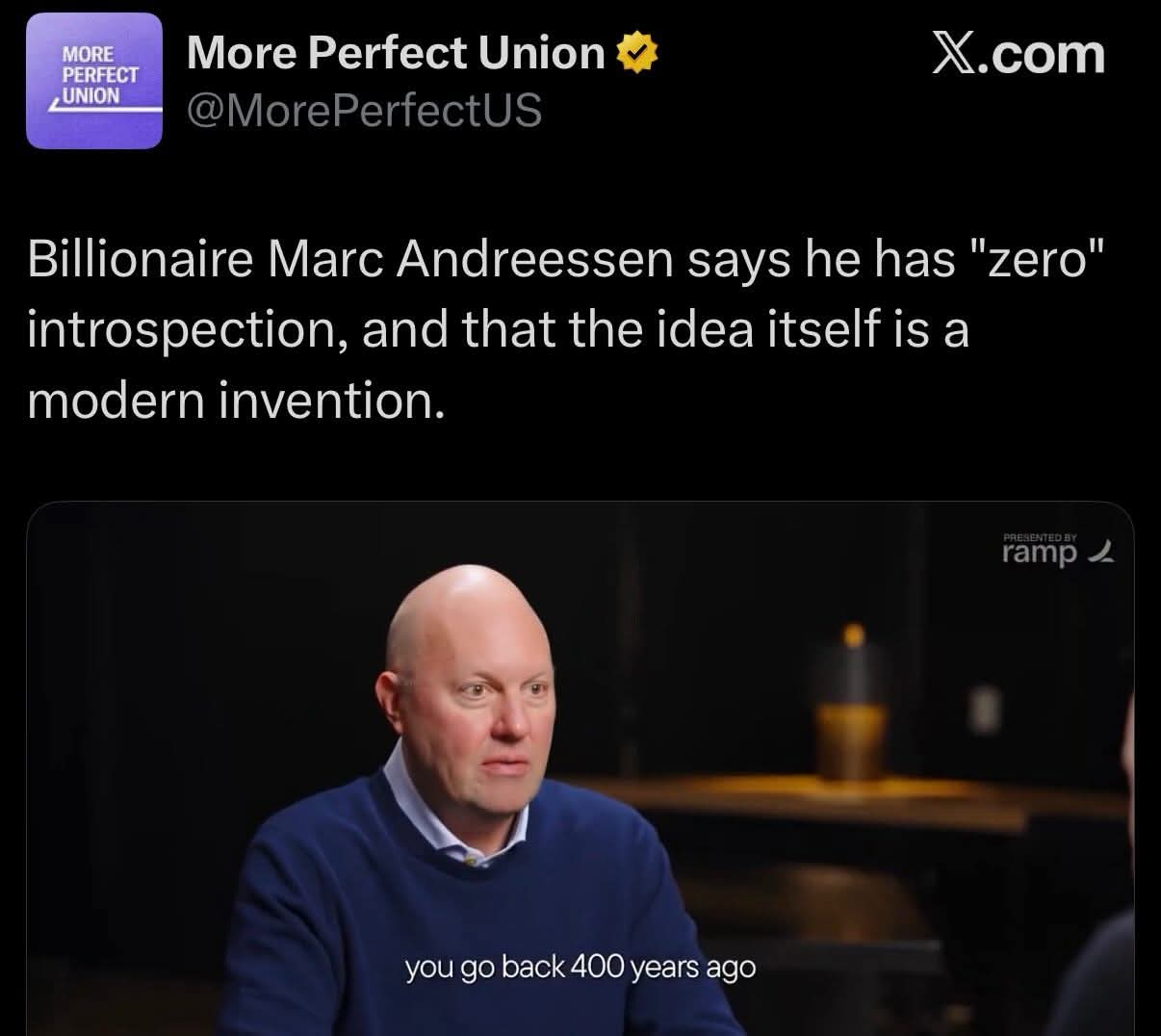
This meme satirizes the disconnect between business history and modern technology trends by showing a clip of tech billionaire Marc Andreessen making an absurd claim about his innovation. The caption alleges that he has "zero" introspection and that the idea itself was a modern invention completely unrelated to 2014's earlier work. It mocks this specific internet culture narrative by finishing with the statement, "you go back 400 years ago."
detailed-analysis (gemma3_27b-it-q8_0)
Okay, let's break down this meme from an "Anti-Tech" perspective, applying relevant theoretical frameworks where applicable.
Overall Context: The meme highlights Marc Andreessen, a prominent venture capitalist, stating he has "zero introspection" and views introspection itself as a recent invention. The “Anti-Tech” category broadly critiques the unchecked power and ideology of technology companies, their impact on society, and the narratives they promote. This meme becomes fodder for that critique, suggesting a detachment from human experience and ethical considerations inherent in the tech elite.
1. Visual Description
The image shows Marc Andreessen seated, looking directly at the viewer with a slightly stern expression. He's dressed in business attire (a dark sweater/jacket and collared shirt) suggesting a professional setting. The background is blurred, focusing attention entirely on Andreessen. The text "you go back 400 years ago" is placed at the bottom of the image.
- Anti-Tech Significance: The polished presentation, the "powerful" pose, and the general visual of a tech titan are all tropes that anti-tech discourse often deconstructs. The image presents Andreessen as representative of a class and an ideology – one that the meme is ultimately challenging. The “400 years ago” text suggests a contrast with a time before modern individualism or psychological awareness, setting up the critique of his statement.
2. Foucauldian Genealogical Discourse Analysis
Foucault's concept of genealogy examines how seemingly natural concepts and practices (like "introspection") actually emerge from specific historical power dynamics.
- How it Applies: Andreessen’s statement isn’t just about personal preference; it is a rejection of the very idea of self-reflection. A Foucauldian analysis would ask: How did "introspection" become a valued practice? What power structures did it challenge? Introspection, especially in a modern context, is connected to ideas of individual agency, psychological well-being, and even resistance to control. By dismissing it as a "modern invention," Andreessen implicitly defends a worldview where individual subjectivity is less important, or even irrelevant. He promotes a power dynamic in which control and optimization are prioritized over inner life. The meme exposes how this dismissal works to re-inscribe a different logic, one potentially aligned with a relentless drive for efficiency and control that often characterizes tech development.
3. Critical Theory
Critical Theory, especially in the tradition of the Frankfurt School, investigates how power structures perpetuate themselves through ideology and the control of knowledge.
- How it Applies: Andreessen’s comment speaks to a type of "instrumental reason" often critiqued by Critical Theorists. This is the idea that everything should be assessed in terms of its utility and efficiency. Introspection, being non-productive in a purely economic sense, falls outside this framework. Critical Theory would argue that this prioritization of instrumental reason is characteristic of capitalist logic, which seeks to reduce everything to quantifiable value. The meme points to the disconnect between this logic and human experience. The “Anti-Tech” perspective highlights how tech’s relentless pursuit of optimization, growth, and innovation can devalue aspects of life that are not directly profitable or measurable.
4. Marxist Conflict Theory
Marxist analysis focuses on class struggle and the economic foundations of power.
- How it Applies: Andreessen, as a billionaire venture capitalist, represents the capitalist class. His dismissal of introspection can be seen as a reflection of a class that has little need or desire for such self-reflection, as it is largely detached from the struggles of everyday life. A Marxist reading would posit that Andreessen's statement is indicative of an ideology that justifies and maintains the existing power structure. Introspection could potentially lead to empathy and an understanding of social inequalities, which are not in the interests of the ruling class. The meme highlights how the wealthy, insulated by their privilege, may lack the motivation to contemplate the systemic issues that cause suffering for others.
5. Postmodernism
Postmodernism questions grand narratives, essential truths, and stable notions of self.
- How it Applies: Andreessen's claim that introspection is a recent invention challenges the idea of a timeless, universal human experience. Postmodernism would likely see this as an attempt to deconstruct the notion of a "natural" human subject. However, the meme itself implicitly reasserts a sense of authenticity. It suggests that Andreessen’s denial is disingenuous or harmful – a rejection of something valuable. The Anti-Tech position frequently rejects the postmodern relativism that can sometimes justify technological changes without ethical consideration.
In conclusion: The meme works because it effectively highlights the values—or lack thereof—of a powerful figure in the tech industry. From an "Anti-Tech" perspective, it’s a potent condemnation of a worldview that prioritizes efficiency, control, and profit over human connection, ethical consideration, and the complexities of the human experience. It suggests that the relentless drive of tech innovation often comes at the expense of our inner lives and our ability to meaningfully connect with ourselves and others.
simple-description (llama3.2-vision_11b)
This meme is from the "Anti-Tech" category, which satirically critiques modern technology and its effects on society. The meme features a screenshot of a video with a man speaking, and the text "you go back 400 years ago" is superimposed over him. The text is likely a response to a previous statement, but the exact context is not provided. The meme is meant to be humorous and satirical, rather than a serious commentary on technology.