First Seen
2025-08-13T20:03:19.966318+00:00
simple-description (qwen3.5_2b-q8_0)
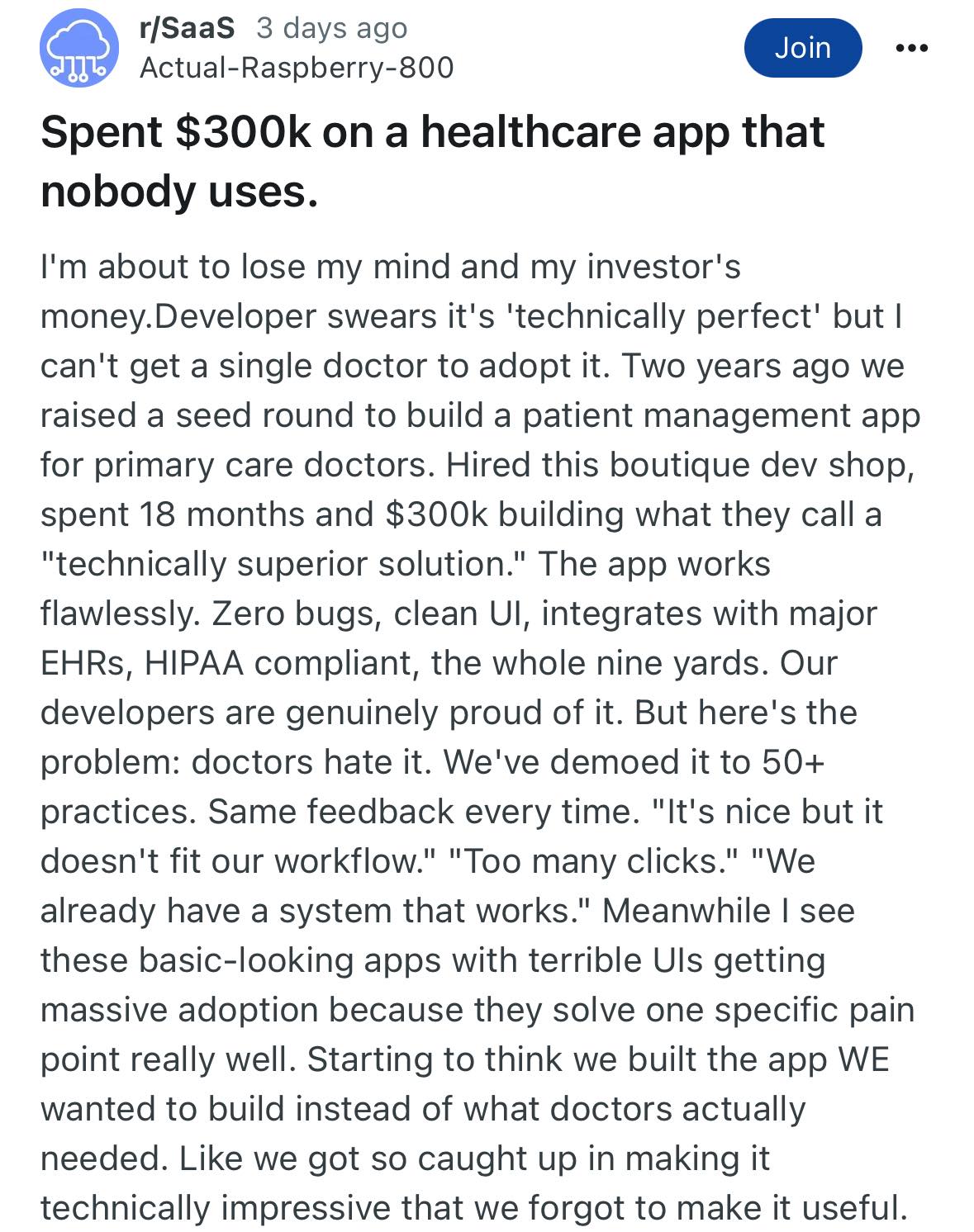
This anti-tech meme critiques the idea that building software with complex technical specs is the ultimate goal of development, suggesting instead that solving actual problems matters more. In this post, a developer explains that they spent hundreds of thousands on an app designed to be "technically superior" for doctors, only to find that the users hated it and discarded it because their workflow didn't match the design.
detailed-analysis (gemma3_27b-it-q8_0)
Okay, let's break down this Reddit post from the perspective of the "Anti-Tech" category, leveraging relevant theoretical frameworks where applicable. The post encapsulates a core frustration within the Anti-Tech mindset—the prioritizing of technical sophistication over practical utility and human needs.
Visual Description
The post is a simple text screenshot from the subreddit r/SaaS (Software as a Service). It's formatted as a first-person lament from a startup founder. There isn’t a strong visual component, but the text itself evokes a sense of frantic desperation, underscored by the mention of lost investment money. The subreddit's "join" button subtly hints at a community of those facing similar challenges. The simplicity of the format feels apt – a raw, unfiltered venting session, indicative of the disillusionment common within the tech industry.
Foucauldian Genealogical Discourse Analysis
This post is a perfect example of how power operates through discourse, a central idea in Michel Foucault's work.
- The Discourse of "Technical Superiority": The founder, and more importantly, the developers, are deeply embedded in a discourse of "technical superiority." This discourse defines value within the tech world by metrics like “zero bugs,” “clean UI,” “HIPAA compliance,” and integration with existing systems. These aren't inherently bad things, but the discourse frames them as the primary goals. This is a normalization of a specific tech-centric worldview.
- The Genealogy of the Problem: Tracing the "genealogy" of this problem reveals how it emerged. The founder and developers weren’t responding to a need articulated by doctors, but rather building a solution they considered superior. The power lies in defining what "superior" means. This genealogy reveals a historical tendency within tech: the drive to impose pre-defined solutions onto complex social contexts, rather than collaboratively designing solutions.
- The Normalizing Gaze: The doctors’ feedback (“It’s nice but doesn't fit my workflow,” “Too many clicks”) represents a resistance to this normalizing gaze. The doctors already have systems that work for them (even if “terrible” by technical standards). The new app is attempting to normalize a new workflow, which is being rejected.
Critical Theory
The post clearly illustrates core tenets of Critical Theory, specifically critiques of instrumental reason and the dominance of systems thinking.
- Instrumental Reason: The project’s focus on technical perfection embodies Max Horkheimer and Theodor Adorno’s critique of “instrumental reason.” The app isn't being developed to improve patient care or alleviate doctors' burdens, but as an instrument to demonstrate technical skill. The means (perfect code, elegant UI) become the end in themselves, obscuring the actual purpose.
- The System and its Discontents: The developers constructed a "system" (the app) based on their understanding of how things should be. The doctors' rejection indicates a failure to understand the lived reality, the complexities and ingrained practices of the healthcare environment. The system's inherent rigidity clashes with the fluid, adaptable needs of the real world.
- False Consciousness: While a strong claim, one could argue the developers exhibited a form of “false consciousness”. They believe they are solving a problem, but are blinded by their own techno-centric biases, unable to see that their solution is ultimately not serving the intended user.
Marxist Conflict Theory
A Marxist lens exposes the class dynamics at play.
- The Labor of the Developers vs. the Labor of the Doctors: The developers' labor, fueled by the investor’s capital, is directed toward creating a product. However, the product is ultimately rejected by the labor force it’s meant to serve – the doctors. This highlights a fundamental conflict. The developers' interests (building a "perfect" app) are not aligned with the doctors' interests (efficiently managing their practices).
- Commodity Fetishism: The app itself becomes a "commodity" fetishized for its technical attributes. Its use value (helping doctors) is secondary to its exchange value (representing technical prowess). The focus shifts from practical benefit to the inherent qualities of the product itself, obscuring the labor and social relations that produced it.
- Capital Misallocation: The $300k spent represents misallocated capital. Instead of investing in solutions that address actual needs, the capital was used to create a product nobody wants, furthering the exploitation of labor (the developers’ time) without producing a viable outcome.
Postmodernism
Postmodern thought questions grand narratives and universal truths.
- Rejection of a "Best" Solution: The post challenges the idea that there is a single "best" solution for patient management. The doctors' preference for basic, "terrible" apps that work highlights that functionality and suitability are subjective and context-dependent. There’s no objective measure of “superiority.”
- Deconstruction of Technical Authority: The developers’ insistence on the app’s technical perfection is deconstructed by the users' outright rejection. The authority traditionally ascribed to technical expertise is undermined.
- The Local and Specific: The success of simpler apps is a celebration of the "local" and "specific"— solutions tailored to particular workflows and needs, rather than grand, universally applicable systems.
In essence, this post is a cautionary tale within the Anti-Tech narrative. It demonstrates the dangers of unchecked technological optimism, the importance of centering human needs over technical brilliance, and the inherent limitations of a top-down, system-centric approach to problem-solving. It's a lament about building a solution for doctors, rather than with them.
simple-description (llama3.2-vision_11b)
The meme is a screenshot of a Reddit post from the r/SelfImprovement subreddit, where a user shares their experience of spending $300,000 on a healthcare app that nobody uses. The post is titled "I Spent $300k on a Healthcare App That Nobody Uses" and includes a humorous and relatable story about the user's experience of investing in a healthcare app that failed to gain traction.