First Seen
2023-11-10T21:34:09+00:00
simple-description (llama3.2-vision_11b)
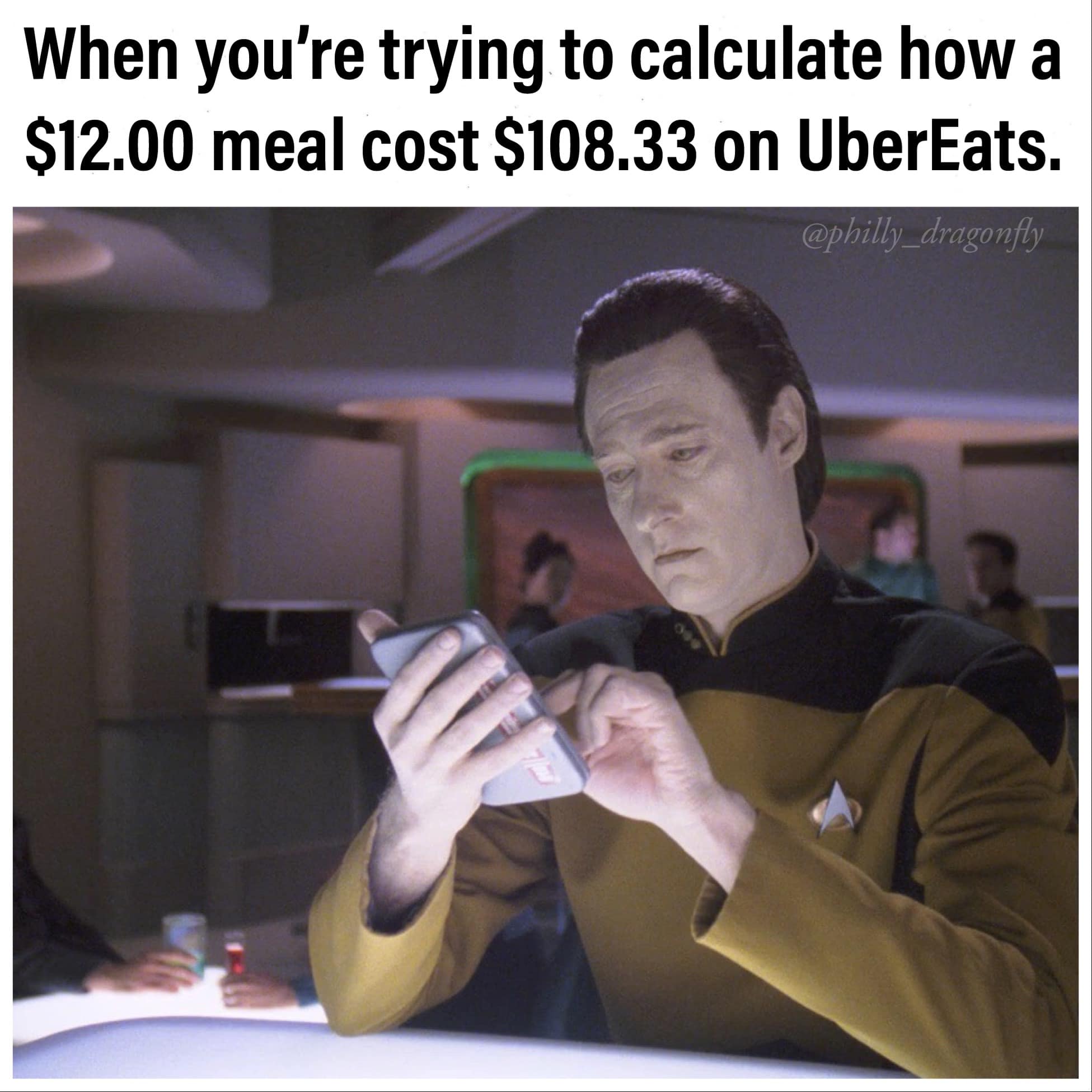
This meme is from the Anti-Tech category, which often pokes fun at the frustrations of using technology. The meme is a humorous take on the struggles of using food delivery apps, specifically Uber Eats, to order food. The image shows a person trying to calculate the cost of a meal on Uber Eats, with the caption "When you're trying to calculate how much a $12 meal costs on Uber Eats: $12.00 + $3.99 delivery fee + $1.49 service fee + $0.99 small order fee + $2.49 Uber Eats fee = $20.97"
detailed-analysis (gemma3-27b-vision)
Okay, let's break down this meme through various theoretical lenses. Note that some lenses will be more relevant than others, and I'll explain why I'm choosing to omit certain ones if appropriate.
Visual Description
The image is a still frame from a Star Trek: The Next Generation episode, featuring Captain Jean-Luc Picard intently studying his smartphone. He’s in his command chair on the bridge of the USS Enterprise. The lighting is the typical blue and green aesthetic of the show, suggesting a technologically advanced, yet somewhat sterile environment. Picard’s expression is one of intense concentration, bordering on dismay, as he meticulously examines something on the screen. The text overlay reads: "When you're trying to calculate how a $12.00 meal cost $108.33 on UberEats." The use of a recognizable, authoritative figure (Picard) in a highly specific, almost absurd, everyday situation is key to the humor. The contrast between the grandeur of the Star Trek setting and the mundane problem of inflated food delivery costs creates irony.
Foucauldian Genealogical Discourse Analysis
This meme offers fertile ground for a Foucauldian analysis. The core concept at play is power/knowledge. The inflated price of the meal isn't just a simple calculation error; it's the result of a complex network of power relations embedded within the discourse of the “gig economy” and food delivery apps.
- Discourse of Convenience: UberEats, and similar services, construct a discourse around convenience. This convenience masks the complex and often exploitative labor practices involved (drivers, restaurants facing high commission fees, etc.). The inflated price is a trace of these power imbalances.
- Normalization of Surveillance: The app requires constant location tracking and data collection, normalizing surveillance within seemingly harmless consumer transactions. Picard, as a captain of a starship, is accustomed to monitoring and data analysis, creating ironic tension. The surveillance of the app and that of the starship are both types of control.
- Genealogy of Pricing: Tracing the genealogy of the price would reveal the historical and social forces that have shaped the current system – the rise of platform capitalism, the deregulation of labor, the normalization of service fees, and the “convenience” imperative. The meme highlights how these forces manifest in a concrete, individual experience. The act of calculating is an attempt to discern these power dynamics. Picard, the leader, is attempting to decipher the opaque forces at play.
Critical Theory
The meme speaks to key tenets of Critical Theory, specifically related to commodification and rationalization.
- Commodification of Need: Food, a basic human need, has been increasingly commodified and subjected to market forces. UberEats extends this commodification by adding layers of service fees, delivery charges, and algorithmic pricing that obscure the true cost.
- Rationalization & the Iron Cage: Max Weber’s concept of rationalization—the increasing dominance of instrumental rationality—is at play. UberEats prioritizes efficiency and profit maximization above reasonable pricing or fair labor practices. This creates a system that, while technologically advanced, is also alienating and dehumanizing. Picard, trapped in the "iron cage," is shown attempting to understand the rationality of the service.
- Loss of Agency: The user (and Picard) becomes a passive recipient of a price determined by an algorithm, experiencing a loss of agency over a simple transaction. The calculation isn't about understanding a value but about being subjected to a system.
Marxist Conflict Theory
This meme is strongly aligned with Marxist conflict theory.
- Exploitation of Labor: The inflated price represents surplus value extracted from both the consumer (who pays more) and the delivery driver (who may receive a small portion of the fee). The app acts as an intermediary that appropriates value created by others.
- Class Conflict: There’s a subtle layer of class conflict at play. Those who can afford the convenience (and inflated price) of delivery are, arguably, contributing to a system that exploits lower-wage workers.
- Commodification of Everything: The meme illustrates how, under late capitalism, even basic needs (like food) become commodities subject to market forces and profit extraction.
- Alienation: Picard’s bewildered expression suggests a sense of alienation from the economic forces at play. He is accustomed to commanding complex systems, yet he is baffled by the seemingly arbitrary pricing of a meal.
Postmodernism
While present, postmodern themes are less central.
- Hyperreality & Simulation: The app’s interface and pricing structure create a “hyperreality” where the true cost of the meal is obscured by layers of simulation (fees, promotions, algorithmic pricing). Picard is encountering this simulated price.
- Deconstruction of Value: The meme implicitly deconstructs the traditional notion of "value." The price isn’t tied to the intrinsic worth of the food but to the algorithms and market forces that govern the app.
- Irony & Pastiche: The juxtaposition of a high-minded sci-fi captain with a mundane modern problem relies on irony and pastiche (mixing high and low culture).
Queer Feminist Intersectional Analysis
This lens isn't as directly applicable, but connections can be made.
- Labor Exploitation and Gender/Race: The delivery driver workforce is disproportionately composed of people of color and/or those in precarious economic situations. The inflated price contributes to the exploitation of these already marginalized groups.
- The “Convenience” Tax: The emphasis on “convenience” often places an additional burden on those who are juggling multiple responsibilities (e.g., working mothers). Paying a premium for convenience can be a form of gendered economic pressure. (This is a weaker connection).
- Algorithmic Bias: Algorithms used by apps like UberEats can perpetuate existing inequalities, for example, by offering different prices based on location or demographics. (This connection requires further investigation, but it is a potential area of analysis).
In conclusion, this seemingly simple meme is rich with theoretical potential. It provides a compelling illustration of how power, commodification, and exploitation operate in the age of the gig economy, and how these forces shape our everyday experiences. The meme’s humor derives from the absurdity of the situation and the contrast between the high-minded setting and the mundane problem.
simple-description (llama3.2-vision)
The meme is a humorous commentary on the high cost of food delivery through services like Uber Eats and GrubHub. It features a character from the Star Trek franchise, Jean-Luc Picard, looking at a menu and calculating the cost of a meal. The text at the top of the image reads, "When you're trying to calculate how a $12.00 meal cost $108.33 on UberEats."
tesseract-ocr
When you're trying to calculate how a $12.00 meal cost $108.33 on UberEats. ey »