First Seen
2026-02-01T11:44:35.144441+00:00
simple-description (qwen3.5_2b-q8_0)
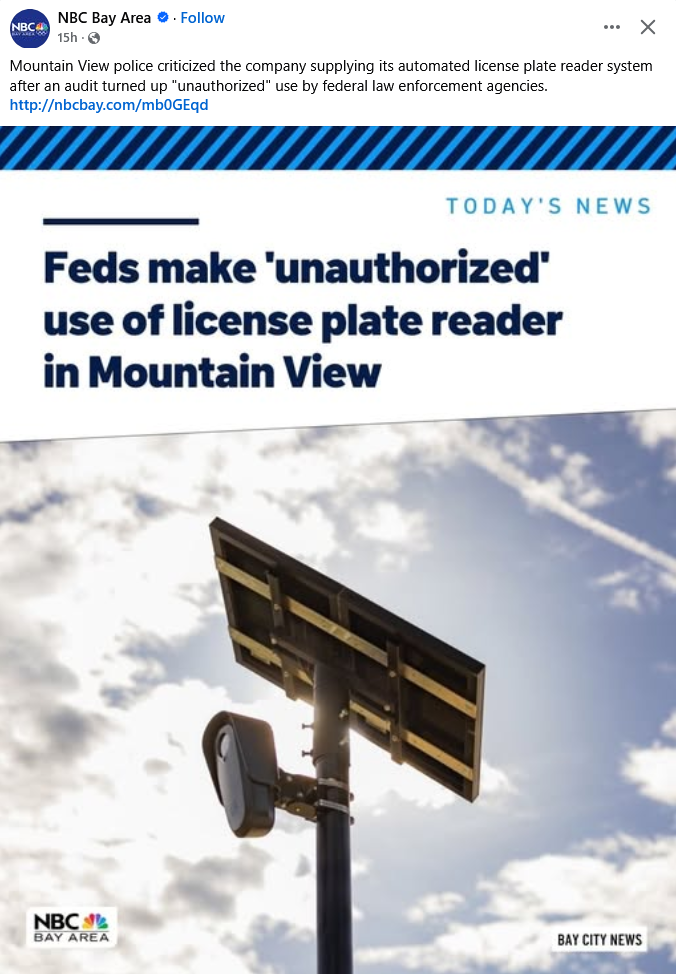
This meme format parodies the idea of fake news by mimicking a serious broadcast while highlighting the absurdity of issues related to surveillance and privacy. The text includes a headline reading "Feds make 'unauthorized' use of license plate reader in Mountain View" alongside a graphic labeled "BAY CITY NEWS," creating a false narrative where federal agencies are actively surveilling citizens. The joke operates by presenting a mundane, static photo of a street light against a sky as if it were live surveillance footage, undermining the credibility of such fabricated reports.
detailed-analysis (gemma3_27b-it-q8_0)
Okay, let's break down this news post through the lens of the "Anti-Surveillance" category, utilizing the requested theoretical frameworks where applicable.
Visual Description
The image shows a close-up of an Automated License Plate Reader (ALPR) camera. It's a black device mounted on a pole, pointing outward. The camera features multiple lenses, giving it a somewhat imposing, "observing" appearance. The background is a blurry, overcast sky. The framing emphasizes the camera as the subject, making it the focal point of the composition. The overall aesthetic is functional and somewhat sterile, hinting at the impersonal nature of surveillance technology. The use of the words "unauthorized" in the headline indicates a violation of established privacy norms or legal boundaries.
Foucauldian Genealogical Discourse Analysis
This news post is deeply relevant to Foucault's work on power, knowledge, and surveillance.
- Panopticon & Discipline: The ALPR can be understood as a modern incarnation of Bentham's Panopticon. Though people aren't necessarily being actively watched at every moment, the possibility of being observed (and having their data recorded) exerts a disciplinary effect. Individuals may modify their behavior, even subconsciously, knowing they are within the potential scope of the ALPR system.
- Discourse of Security: The “unauthorized” use speaks to the power dynamics inherent in the discourse of security. The state (federal agencies in this case) claims authority through the need for security, but this authority is not always transparent or accountable. The ‘unauthorized’ aspect suggests a breach of the ‘rules’ for controlling this power, revealing the internal workings of surveillance.
- Genealogy of Surveillance: A genealogical approach would trace the historical development of surveillance technologies and practices. This ALPR isn’t an isolated event but part of a lineage of increasing data collection and state control. It connects to earlier forms of tracking and monitoring, building upon and extending previous methods.
- Power/Knowledge: The data collected by ALPRs generates “knowledge” about individuals and their movements. This knowledge then reinforces the power of the state to categorize, control, and potentially discriminate against certain groups.
Critical Theory
Critical Theory, particularly the Frankfurt School’s concerns with instrumental reason and the culture industry, is very applicable here.
- Instrumental Rationality: The ALPR represents the application of "instrumental rationality" – using technology solely for its efficiency in achieving a specific goal (in this case, tracking and identifying vehicles) without considering the ethical implications or broader social consequences.
- Domination & Control: The unauthorized use reveals how technology can be deployed to increase domination and control by the state over citizens. It undermines democratic principles of transparency and accountability.
- Erosion of the Public Sphere: Pervasive surveillance can erode the public sphere, chilling free expression and assembly. If individuals fear being tracked, they may be less likely to participate in political activities or express dissenting views.
Marxist Conflict Theory
While perhaps less direct than the Foucauldian or Critical Theory perspectives, a Marxist analysis can still be applied.
- State Apparatus & Class Control: The state (and its agencies) are viewed as instruments of the ruling class. ALPRs, and the data they collect, can be used to monitor and suppress potential dissent from marginalized groups or those challenging the status quo. The “unauthorized” aspect suggests the state is acting beyond its officially sanctioned role, potentially in the service of specific class interests.
- Commodity Fetishism: The ALPR system itself is a commodity. Focusing on the technology obscures the power relations embedded within its production, deployment, and use. The focus shifts from who benefits from this technology to simply the technology itself.
Postmodernism
Postmodernism’s relevance stems from its skepticism towards grand narratives and its emphasis on the fluidity of power.
- Deconstruction of Security: Postmodern thought would deconstruct the notion of "security" as a neutral or objective goal. It would question who defines security, whose interests it serves, and how it is used to justify surveillance.
- Simulation & Hyperreality: The constant data collection creates a “simulation” of reality where individuals are judged and categorized based on data points rather than their actual behavior.
- Fragmented Identity: Surveillance contributes to a fragmented sense of identity as individuals become defined by their data profiles.
Queer Feminist Intersectional Analysis
This perspective brings a critical eye to the disproportionate impact of surveillance on marginalized communities.
- Intersectionality & Vulnerability: ALPRs do not impact everyone equally. Individuals from racial and ethnic minorities, LGBTQ+ individuals, and those living in low-income neighborhoods are often already subject to increased surveillance and scrutiny. The unauthorized use of these systems amplifies these existing vulnerabilities.
- Gendered Surveillance: Surveillance technologies can be used to monitor and control women’s bodies and reproductive choices, or to target LGBTQ+ individuals through discriminatory practices.
- Challenging Normative Power: Queer feminist theory challenges the normative power structures that legitimize surveillance. It calls for the dismantling of systems that reinforce oppression and the creation of more just and equitable forms of social control.
In conclusion, this news post is a potent example of how surveillance technology is being deployed in ways that raise serious concerns about privacy, power, and social control. The “anti-surveillance” category is a vital space for critical examination and resistance to these trends.
simple-description (llama3.2-vision_11b)
The meme is a satirical image that pokes fun at the idea of surveillance systems being used to monitor people's activities. The image features a solar panel and a camera, which are often used to monitor and track people's movements. The text at the top of the image reads "Feds make 'unauthorized' use of license plate readers in Mountain View", implying that the government is using these devices to monitor and track people's activities.