First Seen
2025-05-19T03:10:48.204635+00:00
detailed-analysis (gemma3_27b-it-q8_0)
Okay, let's analyze this post from the perspective of an "Anti-Slavery" category, broken down into relevant theoretical sections. It’s important to note that multiple theoretical lenses apply here, and there’s overlap. I'll prioritize those most pertinent and offer a robust analysis.
Overall Argument: This post is a direct critique of the commodification of plantation spaces and a call for their repurposing as sites of historical accountability and remembrance, specifically focused on acknowledging the brutality of slavery. It actively pushes against a romanticized, nostalgic view of plantation life.
---
1. Visual Description
The image is a stark contrast. It presents a dramatic, black-and-white photograph of the Whitney Plantation in Louisiana. The main house is looming, almost gothic in its appearance, set against a backdrop of bare trees, creating a sense of solemnity and perhaps even dread. Several figures are walking toward the house, appearing small in scale relative to the architecture, emphasizing the power dynamics inherent in the plantation system. The visual cues evoke a sense of history, but one that is not celebratory or idyllic. It subtly communicates the weight of suffering embedded in the site. The starkness is intentional - it’s not offering a pretty picture to be "enjoyed."
---
2. Foucauldian Genealogical Discourse Analysis
This post is directly engaged in challenging a specific discourse - the discourse of the "romantic plantation." Michel Foucault’s genealogical method helps us understand how this discourse came to be, and how power operates through it.
- Historical Construction: The idea of plantations as picturesque, sites of Southern charm, and desirable wedding/event locations is not natural or inevitable. It's a historically constructed discourse that emerged after the Civil War, serving to sanitize the horrific realities of slavery and maintain a particular social order. It functioned to erase the memories of trauma inflicted on enslaved people.
- Power/Knowledge: The romanticization of plantations is a demonstration of power/knowledge. Those with power (historically, white landowners, then those controlling the tourism industry) were able to construct knowledge about these places that served their interests. This knowledge obscured the brutal exploitation at the heart of the plantation system.
- Counter-Discourse: The Whitney Plantation and the post itself represent a counter-discourse – an attempt to disrupt the dominant narrative and offer a different, more truthful, account of plantation history. By refusing to host celebrations, the plantation actively resists perpetuating the harmful discourse.
- Truth Regime: The post seeks to challenge the “truth regime” surrounding plantations, exposing how the dominant narrative serves to mask the underlying violence and exploitation. By highlighting the suffering of enslaved people, it attempts to establish a new truth regime based on historical accuracy and accountability.
---
3. Critical Theory
Applying Critical Theory (drawing heavily from the Frankfurt School), we can see how this post challenges ideologies that maintain societal inequalities.
- Ideology Critique: The romanticization of plantations is an ideological move. It serves to mask the continuing effects of slavery and racism by presenting a sanitized past. This ideology functions to justify present-day power imbalances. The post deconstructs that ideology, exposing its underlying function.
- Commodification of Suffering: Turning plantations into event spaces is a form of commodification of suffering. It takes a site of immense pain and trauma and turns it into a source of profit. Critical Theory would argue this is inherently unethical and perpetuates harm.
- False Consciousness: The appeal of having a wedding at a plantation likely stems from a kind of “false consciousness” – a lack of awareness of the site's true history and the ways in which it’s connected to systemic oppression. The post aims to disrupt this false consciousness.
---
4. Marxist Conflict Theory
From a Marxist perspective, this post highlights the ongoing class and racial conflicts inherent in the historical and present realities of plantations.
- Material Conditions & Exploitation: Plantations were fundamentally built on the material exploitation of enslaved people. They were sites of extreme economic inequality. Even today, the legacy of this exploitation continues to shape racial wealth gaps and power dynamics.
- Class Struggle: The post implicitly acknowledges the ongoing “class struggle” in the context of historical memory. Those who benefit from the romanticization of plantations (e.g., tourism industry) are in conflict with those who demand a more honest reckoning with the past.
- Superstructure & Ideology: The romantic plantation narrative is part of the “superstructure” (cultural institutions, ideologies) that supports the economic base (the power structures that benefit from inequality). The post aims to challenge the superstructure to dismantle the economic base of inequality.
---
5. Postmodernism
Postmodernism comes into play by challenging grand narratives and notions of objective truth, though with caveats in this context.
- Deconstruction of Narrative: The post deconstructs the dominant narrative of the "charming plantation." It demonstrates that this narrative is not a neutral representation of the past but a constructed story that serves particular interests.
- Rejection of Essentialism: It rejects the idea that plantations can be neutrally understood or enjoyed. Their inherent association with slavery fundamentally alters their meaning.
- Truth as Situated: It suggests that truth is not absolute but is always situated within a specific historical and social context. The post calls for a reckoning with the truth of the plantation’s past, acknowledging the suffering of enslaved people and resisting any attempt to gloss over that history.
---
In conclusion, the post is a powerful statement against the erasure of historical trauma and a call for a more accountable and ethical engagement with the legacy of slavery. It skillfully employs a multi-theoretical framework to expose the harmful ideologies and power dynamics at play in the romanticization of plantation spaces. It’s a direct challenge to the status quo, urging a shift from celebration to remembrance and education.
simple-description (llama3.2-vision_11b)
The meme is a screenshot of a Facebook post from the "The Other 98%" page, which appears to be a satirical or humorous account. The post is a commentary on the lack of historical context and education about the true horrors of slavery at the Whitney Plantation in Louisiana. The post describes the plantation's mission to educate visitors about slavery and its legacy, but criticizes the lack of honesty and authenticity in the museum's approach, suggesting that it is more focused on entertainment and tourism rather than education and truth.
detailed-analysis (gemma3-27b-vision)
Okay, here's an analysis of the image and the accompanying text, broken down into sections based on the theoretical lenses you requested. I'll only include sections where the lens genuinely applies to the content.
Image and Text Overview:
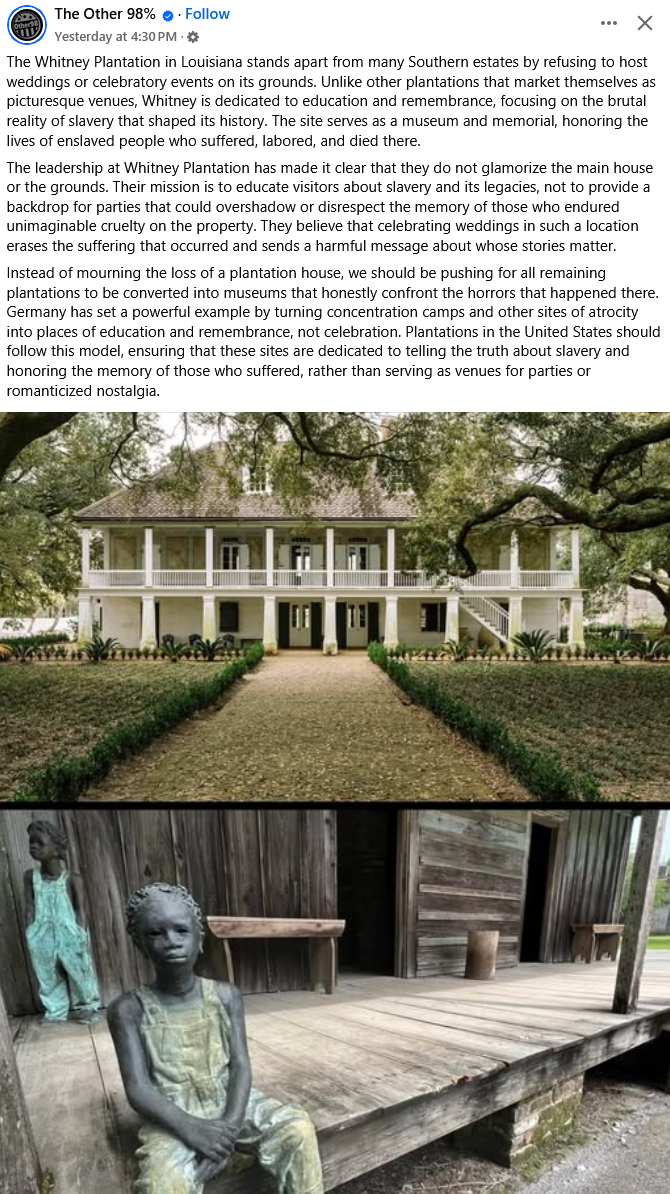
The image shows a grand, white plantation house, a classic image often associated with the Antebellum South. The text is a social media post from “The Other 98%” about the Whitney Plantation in Louisiana. The post praises the Whitney Plantation for refusing to host weddings or celebratory events, and instead dedicating itself to education and remembrance of the enslaved people who lived and died there. It argues that turning sites of trauma into celebratory venues is disrespectful and erases the suffering of those who endured hardship there.
---
Visual Description
The image presents a conventional, picturesque view of a plantation house. It's a large, two-story white building with a prominent front porch featuring columns. The landscaping appears well-maintained and idyllic. The lighting is bright, suggesting a clear, sunny day. The image initially evokes a sense of beauty and romanticism, a common way plantations are presented in media and popular culture. The scene seems serene, deliberately concealing or downplaying the horrific history that took place on the land. This creates a visual tension with the text, which condemns the romanticization of these sites.
---
Critical Theory
This post lends itself well to a Critical Theory reading, particularly within the framework of challenging dominant narratives.
- Deconstructing the Plantation Myth: Critical Theory, rooted in the Frankfurt School, seeks to expose the power structures and ideologies that maintain inequality. The post directly challenges the traditional, romanticized image of the plantation as a symbol of Southern charm and hospitality. It exposes this image as a carefully constructed ideology designed to obscure the brutal realities of slavery.
- Power and Representation: The post implicates the continued use of plantations for weddings and celebrations as perpetuating a system of power that denies the suffering of enslaved people. By rejecting these events, Whitney Plantation is attempting to reclaim the narrative and represent the truth of its history, rather than allowing it to be co-opted by celebrations that ignore or minimize the trauma.
- Ideology Critique: The post suggests that the continued desire to host events on plantations demonstrates a larger ideological issue – a willingness to prioritize aesthetics and tradition over historical truth and ethical considerations. It challenges the viewer to recognize how ingrained this ideology is and to question its continued acceptance.
---
Marxist Conflict Theory
While not as central as the Critical Theory lens, aspects of Conflict Theory are applicable.
- Historical Materialism: Slavery was fundamentally an economic system built on exploitation and the control of labor. The post highlights how the physical structure of the plantation itself – the house, the land – represents the material conditions of that system.
- Class Conflict & Legacy: The power dynamics inherent in slavery (enslavers vs. enslaved) have lasting implications for contemporary society. The continued celebration of plantations can be seen as a perpetuation of this historical inequality, a reinforcement of the privileges enjoyed by those who benefited from slavery. Whitney Plantation’s stance can be seen as an attempt to disrupt these power dynamics and acknowledge the ongoing effects of historical oppression.
- Resource Control: Plantations were centers of resource control, exploiting both land and human beings. The conflict lies in the present-day desire to continue profiting from these spaces, even while ignoring their horrific history.
---
Foucauldian Genealogical Discourse Analysis
This lens is useful for understanding how the meaning of the plantation has been constructed over time.
- Discourse & Power: Foucault argued that knowledge is not neutral, but is always produced within power relations. The discourse surrounding plantations has historically been dominated by those who benefited from slavery, presenting a sanitized and romanticized version of its history. Whitney Plantation is attempting to disrupt this discourse and introduce a counter-narrative that centers the experiences of the enslaved.
- Genealogy of the Plantation Myth: A genealogical approach would trace the historical development of the plantation image and how it has evolved over time. How did the plantation become a symbol of Southern gentility? What historical events and social forces contributed to this transformation? The post challenges the viewer to question the origins of this image and to recognize its problematic nature.
- Disciplinary Power: Plantations were sites of intense control and discipline. By refusing to host celebrations, Whitney Plantation is disrupting the normalization of this history and challenging the idea that these spaces can be simply repurposed for pleasure and entertainment. It’s a form of resistance against the disciplinary power that historically governed these sites.
---
In Summary:
The image and post work together to offer a strong critique of the romanticization of plantation history. It employs elements of Critical Theory, Foucauldian discourse analysis, and, to a lesser extent, Marxist conflict theory to expose the power dynamics, ideologies, and historical forces that have shaped our understanding of these sites. The post argues that acknowledging the full truth of slavery is essential for creating a more just and equitable future.
Let me know if you'd like me to elaborate on any of these points or analyze the post through a different theoretical lens!
simple-description (llama3.2-vision)
The meme is an image of a large, white plantation house with a long, covered porch and a large lawn. The text above the image reads, "The Whitney Plantation in Louisiana stands apart from many Southern estates by refusing to host weddings or celebrate events." Below the image is a quote from the website's "About" page, which states, "The Whitney Plantation in Louisiana stands apart from many Southern estates by refusing to host weddings or celebrate events." The image is accompanied by a quote from the website's "About" page, which states, "The Whitney Plantation in Louisiana stands apart from many Southern estates by refusing to host weddings or celebrate events."