First Seen
2023-05-10T21:03:34+00:00
simple-description (llama3.2-vision_11b)
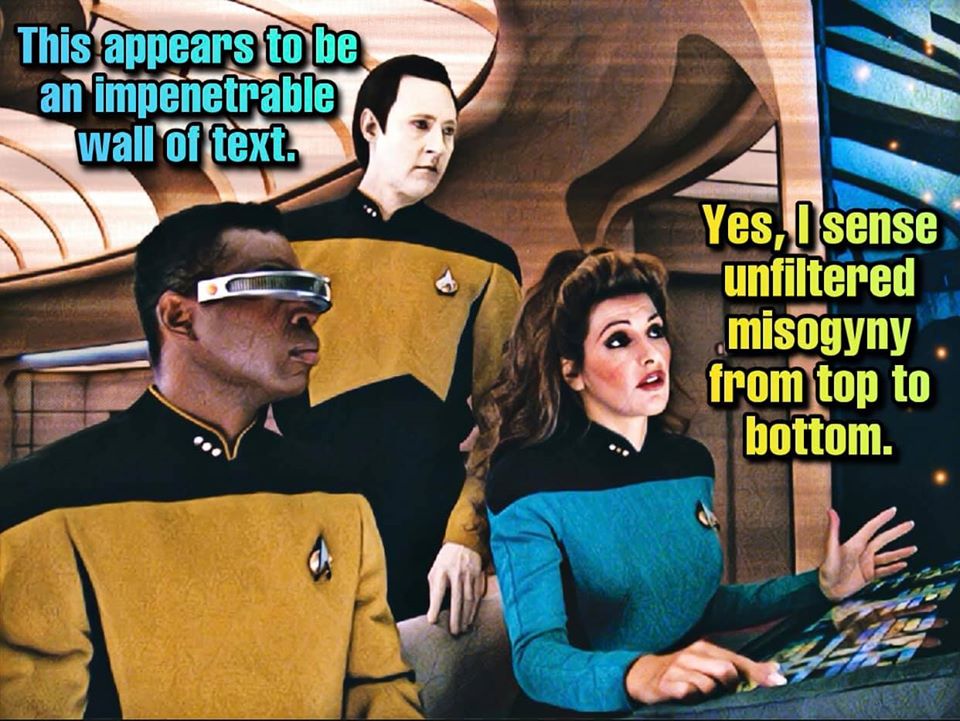
The meme is a screenshot from the TV show Star Trek: The Next Generation, where the character of Captain Jean-Luc Picard is explaining the concept of the "Hegemonic Masculinity" of the ancient Sumerian "Hamm-er-ly-thing" inscription. The meme is a humorous take on the concept of "Hegemonic Masculinity" being used to describe the ancient Sumerian "Hamm-er-ly-thing" inscription, with the caption "This appears to be an impenetrable wall of text."
detailed-analysis (gemma3-27b-vision)
Okay, here's an analysis of the image, broken down by the requested theoretical lenses. Note that some lenses really stretch to apply to this meme, while others find more fertile ground. I'll indicate where things are weaker interpretations.
Visual Description
The image is a still from the television series Star Trek: The Original Series. Specifically, it features Captain James T. Kirk, Spock, and Uhura gathered around what appears to be a holographic display or viewport on the bridge of the USS Enterprise. Kirk is wearing a futuristic visor and looking intently at the display, while Uhura expresses concern and looks toward Kirk. Spock stands slightly behind and to the side, appearing analytical as usual. Text has been superimposed onto the image: "This appears to be an impenetrable wall of text" is above Kirk, and “Yes, I sense unfiltered misogyny from top to bottom” is above Uhura. The background is the characteristic chrome and light of the Enterprise bridge. The image quality is slightly grainy, consistent with the age of the show.
Foucauldian Genealogical Discourse Analysis
This meme engages directly with discourse as defined by Michel Foucault. The “impenetrable wall of text” immediately suggests the overwhelming, often exclusionary, nature of many authoritative discourses (like scientific, philosophical, or legal texts). These texts aren’t just about something; they actively construct knowledge and power relations.
The added text about misogyny layers on a critique of how these discourses have historically been produced with a specific bias. The genealogy aspect enters here – the meme implies that the "wall of text" isn't neutral, but rather is built upon historical power structures that privilege masculine perspectives and silence or marginalize women.
The “sensing” by Uhura suggests that these biases aren’t merely contained within the text but are felt, embodied, and experienced. It is a direct acknowledgement of the power that language wields.
Critical Theory
Critical Theory, broadly, examines how power structures are embedded in culture and knowledge. This meme embodies a critique of the traditionally masculine dominated realms of knowledge and technology, as represented by the Star Trek setting (though with a twist, as Uhura is a vital communications officer).
The "impenetrable wall of text" is a metaphor for the exclusionary language of these realms, often dense, jargon-laden, and inaccessible to those outside the dominant group. The recognition of misogyny, voiced by Uhura, cuts to the heart of how these power structures often reinforce gender inequalities.
The meme subtly highlights the lack of women's voices in the creation and dissemination of knowledge. Uhura is positioned as a detector of this underlying bias—a necessary voice to challenge the prevailing narratives.
Marxist Conflict Theory
This lens requires some stretching, but it’s possible. One could interpret the "impenetrable wall of text" as representing the ideological superstructure that serves to maintain the existing power relations (in this case, patriarchal ones). The "text" can be seen as the means through which the ruling class (broadly construed as men in this context) perpetuates its dominance.
Uhura's statement becomes a recognition of the class struggle inherent in gender dynamics. She’s identifying the ways in which patriarchal ideology oppresses women. The meme, therefore, can be read as a call for resistance against this oppressive system.
Postmodernism
Postmodern thought deconstructs grand narratives and emphasizes the subjectivity of knowledge. This meme plays with the idea of deconstruction by highlighting the hidden biases within what might appear to be objective or neutral "text". It suggests that no text is truly neutral and that all language is shaped by power dynamics.
The meme’s ironic juxtaposition of the futuristic Star Trek setting with the persistent issue of misogyny is characteristically postmodern. It challenges the idea that progress necessarily means the eradication of social inequalities. This is a world of technology, yet old problems remain.
Queer Feminist Intersectional Analysis
This meme finds its strongest resonance within a Queer Feminist Intersectional framework. The recognition of "unfiltered misogyny" directly addresses the systemic oppression of women. Uhura, as a Black woman in a sci-fi setting that was somewhat progressive for its time, adds a layer of intersectionality.
Her experience as a woman of color means she is uniquely positioned to identify the ways in which gender inequality intersects with racial bias. The “impenetrable wall of text” can be interpreted as the silencing of marginalized voices—the ways in which dominant discourses fail to acknowledge or address the experiences of women of color.
This meme implicitly demands a centering of marginalized perspectives and a dismantling of the patriarchal structures that perpetuate oppression. It acknowledges that misogyny doesn't exist in isolation, but is interwoven with other forms of discrimination.
Let me know if you'd like me to elaborate on any of these interpretations or explore a different theoretical lens!
simple-description (llama3.2-vision)
This meme is a screenshot from the TV show Star Trek: The Next Generation, featuring the crew of the USS Enterprise in a futuristic setting. The image is captioned with a quote from the show's character Data, which reads: "This is a very... interesting... wall of text." The meme is a humorous commentary on the idea that some people's writing style is so convoluted and impenetrable that it's like a physical wall.
tesseract-ocr
- > * x: i xh Wises il | es FT aa Ge La /; a MECH, r Daas el <== a es,{lisense . en ee So) \ fa Mtr a aS .e we ~~? wt rw i* TOG gin ts: ihe y: E> a, Ce : , i) . \ oe Oy i be TZ iy Ep Od = Pu cs ee ad = ‘ ze Fate hg