First Seen
2026-04-03T16:56:43+00:00
simple-description (qwen3.5_2b-q8_0)
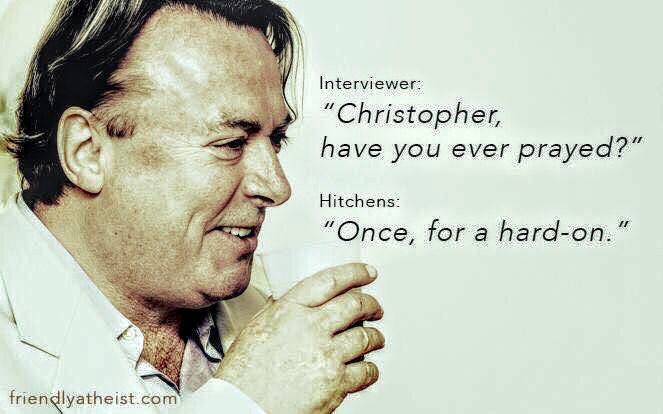
This meme mocks religious hypocrisy by quoting Richard Dawkins (Hitchens) in a conversation with Michael J. Fox, the famous actor often associated with the Christian community. The interaction asks if "Christopher," a fictional son of Hitchens' own name, has ever prayed, before he jokes that the real Christopher admitted to doing it just once for a hard-on. As an anti-religious joke, it implies that religious practice was purely an excuse for physical stimulation rather than a genuine spiritual connection.
detailed-analysis (gemma3_27b-it-q8_0)
Okay, let's break down this meme, "Christopher Hitchens on Prayer," through the lens of the "Anti-Religion" category, and incorporating the requested theoretical frameworks where relevant.
Image Description
The image is a medium shot of Christopher Hitchens, a renowned author and outspoken atheist, captured mid-gesture. He's slightly turned, looking to the right, with a sly smirk playing on his lips. His hands are clasped together in a pose mimicking prayer, but it's clearly not reverent. The color scheme is somewhat desaturated, giving the image a slightly worn, intellectual feel. The background is a blurry neutral tone. Below the image, the dialogue between the interviewer and Hitchens is displayed. The website "friendlyatheist.com" is stamped on the lower right corner.
Foucauldian Genealogical Discourse Analysis
This meme is excellent fodder for a Foucauldian analysis, particularly focusing on the discourse surrounding prayer and religion. Michel Foucault was interested in how knowledge and power are intertwined, and how discourses shape our understanding of reality.
- Genealogy of Prayer: Historically, prayer has been presented as a practice rooted in piety, supplication, and connection with a divine power. This discourse serves to normalize the authority of religious institutions and to create a framework for social control (through moral codes, etc.).
- Disrupting the Discourse: Hitchens’ response actively disrupts this established discourse. By reinterpreting "prayer" as a request for sexual gratification (“for a hard-on”), he exposes the potential absurdity and base impulses that can underlie even seemingly sacred practices. He’s deconstructing the lofty meaning assigned to prayer.
- Power/Knowledge: The humor in the meme derives from the subversion of power. Religion historically holds power through its claim to authoritative knowledge (about the divine, morality, meaning, etc.). Hitchens’ comment, delivered with his characteristic wit, challenges that claim and highlights the human, and even carnal, elements at play.
Critical Theory
The meme aligns strongly with the principles of Critical Theory, particularly the Frankfurt School's emphasis on demystification and critique of ideology.
- Ideology Critique: Prayer, as traditionally presented, functions as part of a larger religious ideology that can be seen as serving the interests of dominant groups. It promotes acceptance of hierarchical structures (God > priests > believers) and can discourage critical thinking about social injustices.
- Exposing Rationalization: Hitchens’ statement acts as a critical exposure of the rationalization within religious practices. It forces us to question the underlying motivations and assumptions behind the act of prayer, stripping away the veneer of spiritual meaning.
- Emancipation: This meme, in a small way, contributes to an emancipatory project. By challenging the sanctity of religious belief, it opens up space for more rational and secular modes of thought.
Marxist Conflict Theory
While not as direct as the other frameworks, a Marxist reading is possible.
- Religion as "Opium of the People": Karl Marx famously described religion as the “opium of the people," a tool used by the ruling class to pacify the oppressed and justify social inequalities. Prayer, in this view, is a mechanism of ideological control.
- Critique of Superstructure: Religion (and prayer) falls into Marx's concept of the “superstructure”—the cultural and ideological institutions that serve to legitimize the economic base. Hitchens’ jab can be interpreted as a critique of that superstructure.
- Class Consciousness: Challenging religious dogma (like the perceived necessity of prayer) can potentially contribute to the development of class consciousness – the awareness of one’s social position and the need for collective action.
Postmodernism
Postmodernism is arguably implicit in the meme's subversion.
- Deconstruction of Meaning: The meme embodies a postmodern dismantling of fixed meanings. Hitchens' response denies the inherent sanctity of "prayer" and re-assigns it a very different, worldly meaning.
- Rejection of Metanarratives: The meme subtly rejects the grand narratives of religion, particularly the idea of a benevolent, all-powerful God who answers prayers.
- Irony and Playfulness: The meme's effectiveness relies on irony and a playful attitude towards traditional authority. This embodies a postmodern sensibility.
In summary, the meme operates as a potent expression of anti-religious sentiment. It’s not simply a joke but a pointed critique of the assumptions, power dynamics, and ideologies embedded within religious belief systems. Its success stems from its ability to expose the potential absurdity of religious practices and to provoke thought about the nature of faith and belief.
simple-description (llama3.2-vision_11b)
This meme features a famous quote from the late British author and the