First Seen
2026-01-13T20:32:51.127171+00:00
simple-description (qwen3.5_2b-q8_0)
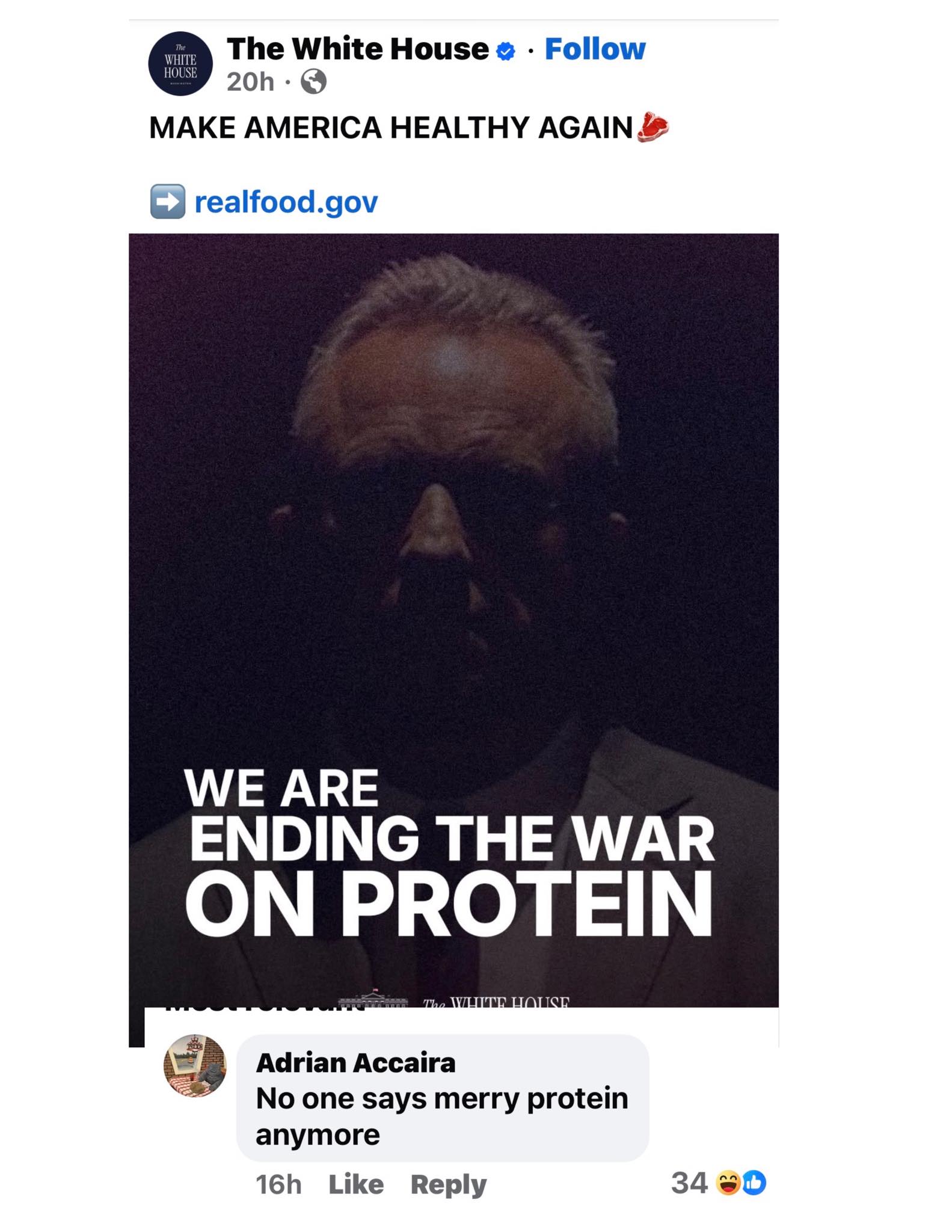
This anti-reactionary meme mocks the White House for appearing to launch an official "War on Protein," featuring a President with serious, over-shadowed text that suggests they are merely trying to change their slogan to sound more aggressive. The caption underneath adds irony by pointing out the absurdity that nobody actually says "merry protein."
detailed-analysis (gemma3_27b-it-q8_0)
Okay, let's break down this meme from an "Anti-Reactionary" perspective, utilizing relevant theoretical frameworks where applicable. Given the meme's specific context and imagery, the analysis will lean heavily into historical and cultural critiques of reactionary movements.
Overall Framing: The Anti-Reactionary Lens
The "Anti-Reactionary" category fundamentally opposes ideologies seeking to return to a perceived idyllic past, often associated with hierarchies, traditional gender roles, racial essentialism, and nationalism. It views such ideologies as attempts to roll back progressive gains, often masking power grabs and oppression under the guise of "restoration." This meme is read as a coded gesture that references reactionary tropes, and critiques the undercurrents that fuel them.
Visual Description
The meme features a highly stylized, dramatic black-and-white image of Donald Trump. The lighting and composition evoke a "strongman" aesthetic, reminiscent of mid-20th-century authoritarian figures. The text "WE ARE ENDING THE WAR ON PROTEIN" is displayed prominently in bold white font. The accompanying comment reads, “No one says merry protein anymore.” The starkness and hyper-masculine presentation of Trump in this image contribute to an overall tone of forceful, almost aggressive assertion.
Foucauldian Genealogical Discourse Analysis
From a Foucauldian perspective, the phrase "War on Protein" isn't about literal dietary restrictions. Instead, it is a manufactured discourse, a problem constructed by reactionary forces to mobilize a specific political base. This is the genealogy:
- Historical Roots: The “war on protein” rhetoric appears to reference anxieties among certain segments of the population, particularly those associated with “traditional masculinity,” about changing dietary trends (e.g., increased vegetarianism/veganism, plant-based diets), and perceived attacks on "traditional" ways of life.
- Power/Knowledge: This rhetoric creates a binary – "us" (those who embrace protein = strength, masculinity, tradition) versus "them" (those who promote alternative diets = weakness, effeminacy, modernity). This binary is a power dynamic, where protein consumption becomes a marker of identity and a tool for social control.
- Disciplinary Practices: The "war on protein" narrative subtly disciplines behavior. It encourages consumption patterns and reinforces normative ideals of masculinity, strength, and "natural" eating.
- Discourse as Construction: The meme reveals the absurdity of the "war on protein" by presenting it as an issue the White House is actively addressing. It highlights that the ‘problem’ is manufactured, not inherent. The comment, “No one says merry protein anymore,” subtly implies that the whole premise is ludicrous and performative.
Critical Theory
The meme can be analyzed through the lens of Critical Theory, specifically focusing on the concept of instrumental reason.
- Instrumentalization of Biology: The emphasis on "protein" reduces the human body and dietary needs to purely instrumental terms – maximizing strength and productivity. This ignores the complex social, ethical, and environmental considerations around food.
- Commodification of Masculinity: The focus on protein is inextricably linked to a hyper-masculine ideal. This masculinity is not natural but is constructed and commodified through products (meat, protein supplements, etc.) and narratives.
- Ideological Function: The meme serves an ideological function by reinforcing a specific worldview: that strength and traditional values are essential for societal stability.
Marxist Conflict Theory
From a Marxist perspective, the meme hints at a conflict between classes and the underlying economic forces at play.
- Meat Industry Interests: The push for "protein" aligns with the interests of the meat and agricultural industries, which benefit from high levels of meat consumption. It can be seen as a defense of capitalist production in this sector.
- Hegemony and False Consciousness: The "war on protein" rhetoric can be interpreted as an attempt to create a "false consciousness" among the working class, diverting attention from systemic economic inequalities and focusing instead on a manufactured cultural "war."
Postmodernism
The meme engages with postmodern themes, albeit in a subversive way.
- Hyperreality & Simulation: The image is a highly stylized representation of Trump, a simulation of power and authority. The "war on protein" is itself a simulation of a conflict, an artificial construct given legitimacy through the weight of the White House brand.
- Irony and Parody: The meme is arguably ironic. It exaggerates a fringe anxiety (the supposed "war on protein") to expose the absurdity of reactionary thought.
Queer Feminist Intersectional Analysis
While not the primary focus of the meme, this framework is relevant.
- Reinforcement of Gender Norms: The association of protein with strength directly reinforces traditional, patriarchal gender roles. Masculinity is equated with physical power, while femininity is implicitly excluded.
- Exclusionary Discourses: The "war on protein" narrative can be seen as exclusionary towards those who choose plant-based diets, including individuals with ethical, religious, or health-related motivations. This also touches on the marginalization of communities who may have less access to protein-rich foods due to economic disparities.
In Conclusion
From an Anti-Reactionary perspective, this meme is not simply about food. It's a coded message that exposes the anxieties, power dynamics, and ideological underpinnings of reactionary movements. It critiques the use of manufactured "culture wars" to distract from real issues, and highlights the attempts to reinforce traditional hierarchies and control through the manipulation of discourse. The meme is meant to be read against the grain, recognizing that the "war on protein" is a symptom of a larger struggle over power, identity, and the direction of society. The comment on the post adds a layer of biting sarcasm, reinforcing the idea that the meme is mocking the ideology it references.
simple-description (llama3.2-vision_11b)
This meme is a screenshot of a Facebook post from the official White House Facebook page, featuring a photo of President Joe Biden with a caption that says "We are ending the war on protein." The post is accompanied by a comment from a user named Adrian Accaira, who says "No one says merry protein anymore." The post is likely a joke or a satirical comment, as the phrase "merry protein" is not a real thing and it's unlikely that anyone would say it. The post is likely intended to be humorous or ironic, and it's not clear what the point of the post is or what it's trying to say.