First Seen
2026-03-31T22:16:54+00:00
simple-description (qwen3.5_2b-q8_0)
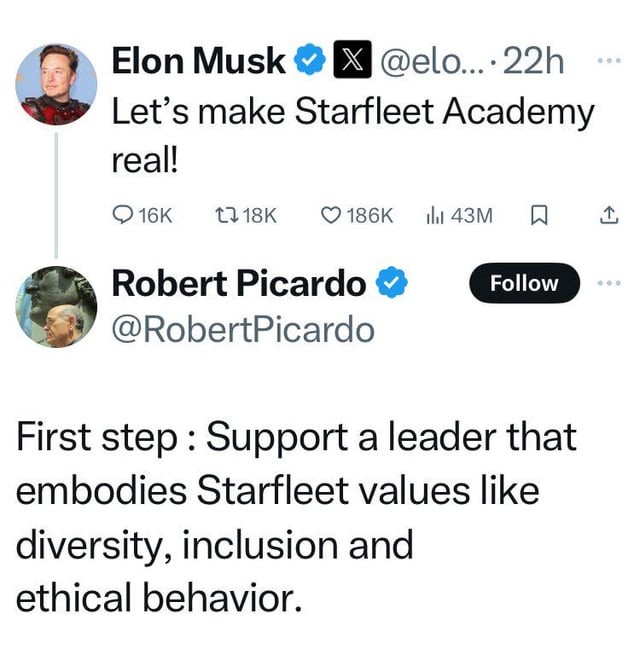
This meme plays on the idea of repurposing a futuristic sci-fi concept for social good. By using Elon Musk’s announcement of "Starfleet Academy"—which often represents forward-thinking innovation—it humorously pivots to a call for active support of diversity and inclusion as a core value of exploration and leadership. The second message explicitly frames Starfleet values like diversity, ethical behavior, and inclusion as the first step toward supporting progressive leaders.
detailed-analysis (gemma3_27b-it-q8_0)
Okay, let's break down this meme from an "Anti-Reactionary" perspective, utilizing relevant theoretical frameworks where applicable. The core of "Anti-Reactionary" thought centers on a rejection of attempts to return to idealized pasts, often perceived as inherently hierarchical, exclusionary, and rooted in oppressive power structures. It typically champions progress, inclusivity, and a critical examination of existing societal norms.
Visual Description
The meme presents a screenshot of a Twitter (now X) exchange. Elon Musk's tweet declares a desire to "make Starfleet Academy real!". Below this, a response attributed to an account styled as "Robert Picardo" (the actor who played the holographic Doctor on Star Trek: Voyager) states: "First step: Support a leader that embodies Starfleet values like diversity, inclusion and ethical behavior." The contrast between the two accounts, and the pointed nature of Picardo’s response, is key. Musk’s profile pic displays a blue checkmark confirming his verification. The image in Musk’s tweet also highlights the fact that he's paying for X Premium, formerly Twitter Blue. The fact that Picardo is also verified underscores the sarcasm of the comment.
Foucauldian Genealogical Discourse Analysis
From a Foucauldian perspective, Musk’s call to “make Starfleet Academy real!” isn’t a simple nostalgic yearning, but an attempt to re-articulate power. Starfleet, in the Star Trek universe, is often presented as a meritocratic, progressive institution, but it is also inherently a military hierarchy—a system of discipline and control. Musk's statement can be seen as an attempt to discursively construct an idealized image of power and leadership, drawing on the cultural capital of Star Trek while simultaneously ignoring its complexities.
Picardo’s response is a direct challenge to that discursive construction. He points to the values associated with Starfleet—diversity, inclusion, and ethical behavior—as a necessary condition for leadership, implicitly (and powerfully) suggesting that Musk fails to meet those criteria. It’s a deconstruction of the simplistic, potentially authoritarian impulse behind Musk’s statement. This is particularly astute given Musk's documented behaviors that often clash with these values (e.g., issues surrounding worker treatment, content moderation policies on X, potentially reckless public statements). Picardo is drawing attention to the power dynamics inherent in claiming to embody the ideals of a system.
Critical Theory
Within a Critical Theory framework, this meme highlights the danger of uncritically adopting cultural narratives to justify existing power structures. Star Trek is often held up as a vision of a better future, a post-scarcity utopia, but it still operates within certain ideological constraints. Musk’s statement potentially weaponizes that utopian imagery to legitimize his own leadership and influence.
Picardo's response aligns with the Critical Theory’s emphasis on unveiling underlying power dynamics. He's refusing to allow the nostalgic appeal of Star Trek to be used as a smokescreen for potentially harmful leadership. The 'values' he highlights serve as a critique of Musk's behavior and a call for a more just and ethical approach to power. The meme implies that merely talking about a progressive future isn't enough; it requires demonstrable adherence to those values in the present.
Marxist Conflict Theory
A Marxist interpretation would view this exchange through the lens of class and control. Musk, as a billionaire and owner of significant technological infrastructure (X, SpaceX, Tesla), represents the capitalist class. His desire to "make Starfleet Academy real!" can be seen as a desire to control and shape the narrative of progress—to define what a 'better future' looks like from a position of immense power. The "Academy" metaphor is particularly apt, as academies traditionally serve to reproduce elite structures.
Picardo’s response, framed as a requirement for ethical leadership, can be interpreted as a subtle challenge to that control. By emphasizing diversity and inclusion, he’s implicitly advocating for a redistribution of power and a questioning of the existing hierarchy. This fits within a Marxist framework's focus on class struggle and the need for systemic change. The implication is that any future modeled on Starfleet must address issues of inequality and power imbalances, not simply replicate a technologically advanced but potentially unjust system.
Postmodernism
The meme engages with postmodern themes of simulation and hyperreality. Musk's statement feels like an attempt to simulate a utopian ideal (Starfleet Academy) without addressing the complexities of achieving it. It’s a surface-level appropriation of a cultural icon.
Picardo’s response functions as a deconstruction of this simulation. He’s pointing out the gap between the sign (Starfleet Academy) and the signified (the values it supposedly represents). By insisting on the importance of ethical behavior, diversity, and inclusion, he’s challenging the notion that merely appearing progressive is sufficient. The meme highlights the constructed nature of reality and the importance of critical engagement with cultural narratives.
Queer Feminist Intersectional Analysis
While not explicitly central, an intersectional analysis adds another layer. Star Trek has historically had issues with genuine representation, particularly regarding queer and feminist perspectives (though later iterations attempted to address these issues). Musk’s history on X and his stances on social issues are often viewed as problematic from a queer and feminist standpoint.
Picardo’s call for diversity and inclusion can be read as a demand for genuine, not tokenistic, representation of marginalized groups in leadership and future-building endeavors. It’s a recognition that a truly progressive future must be actively anti-oppressive and inclusive of all identities. The meme implicitly critiques the potential for “futuristic” visions to simply replicate or even exacerbate existing inequalities.
In conclusion: From an Anti-Reactionary perspective, this meme is a clever and pointed critique of attempts to co-opt progressive ideals for potentially self-serving purposes. It leverages the cultural capital of Star Trek to expose the hypocrisy of those who claim to champion a better future without demonstrating a commitment to the values that underpin it. It’s a call for critical engagement with narratives of progress and a rejection of simplistic solutions to complex social and political problems.
simple-description (llama3.2-vision_11b)
This meme is a satirical take on the Star Trek: The Next Generation episode "The