First Seen
2024-08-07T00:26:46.931318+00:00
simple-description (llama3.2-vision_11b)
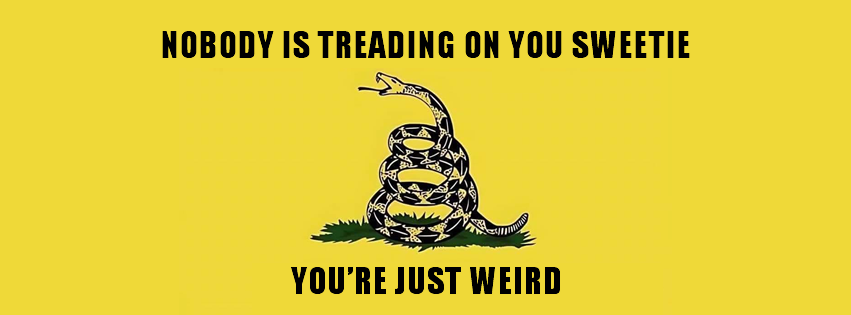
The meme is a playful take on the traditional "Don't Tread on Me" flag, with a sarcastic twist. The image features a snake coiled and ready to strike, with the text "I'm not okay with this" above it, implying that the person is fed up with the absurdity of the situation. The phrase "Nobody is treading on me" is a humorous reference to the original flag's slogan, but the addition of "I'm not okay with this" and the image of a snake with a sarcastic expression suggests that the person is not taking things lying down.
detailed-analysis (gemma3-27b-vision)
Here's an analysis of the image, broken down into sections as requested, focusing on the applicable theoretical frameworks.
Visual Description
The image features a yellow background, reminiscent of the Gadsden flag. However, instead of the traditional "Don't Tread on Me" slogan and coiled rattlesnake, it bears the text “NOBODY IS TREADING ON YOU SWEETIE” above the snake, and “YOU’RE JUST WEIRD” below it. The rattlesnake is still coiled in a defensive posture, but the overall visual aesthetic is a clear subversion of the original flag's symbolism. The font is bold, black, and sans-serif. The image presents an ironic twist on the historical symbol of American Revolution, framing a potentially powerful statement of resistance as dismissive and condescending.
---
Foucauldian Genealogical Discourse Analysis
This image is ripe for analysis through a Foucauldian lens. The Gadsden flag itself is a historical artifact with a specific "discourse" built around it. Initially representing colonial resistance against British tyranny, it later became associated with American liberty and, more recently, certain libertarian and conservative movements. This image interrupts that discourse.
The phrase "Nobody is treading on you sweetie" coupled with "You're just weird" drastically alters the meaning. It shifts the narrative from external oppression to internal, perceived social deviance. The power dynamic isn’t about a tyrannical overlord, but about social norms and the labeling of “weirdness.” The image highlights how power operates not through direct, visible force (treading), but through the construction of categories like “normal” and “weird,” which become tools of social control. It’s a micro-power dynamic, enacted through language and labeling, rather than a macro-political one. The image effectively “genealogizes” the concept of oppression, exposing how its definition shifts and can be applied not to genuinely marginalized groups, but to individuals deemed “different.”
---
Critical Theory
From a critical theory perspective, this image embodies a challenge to dominant ideologies. The Gadsden flag, traditionally associated with freedom and resistance, is re-appropriated to mock or dismiss those who might claim to be oppressed. It represents a cynical devaluation of resistance itself.
The use of the condescending "sweetie" further emphasizes this devaluing of others’ experiences. This functions as a rhetorical tactic that silences potential critiques by labeling the speaker as overly sensitive or simply “weird.” The image could be interpreted as a manifestation of power dynamics where those in privileged positions dismiss the claims of those who are genuinely marginalized. The image could also act as a critique of contemporary “victimhood culture” though it does so in a snide and invalidating way.
---
Postmodernism
This image operates powerfully within a postmodern framework. It embraces irony, pastiche, and the subversion of established symbols. The Gadsden flag is a historical signifier, and the image deliberately disrupts its meaning, refusing to accept a fixed or universal interpretation.
The phrase itself is inherently subjective. What constitutes "treading" is open to interpretation, and the assertion that someone is simply “weird” is a form of deconstruction, dissolving the possibility of a coherent or legitimate complaint. The image's playfulness and ironic tone highlight the postmodern emphasis on the instability of meaning and the rejection of grand narratives. It rejects the seriousness associated with the original flag, suggesting that resistance is often performative or self-serving.
---
Queer Feminist Intersectional Analysis
This image can be analyzed through a Queer Feminist Intersectional lens. Given the context of social media and current cultural conversations, the image could be an example of gaslighting or a silencing tactic. The invalidation of someone’s experiences (“nobody is treading on you”) and the dismissal as “weird” can be read as a subtle form of oppression that disproportionately affects marginalized groups.
"Weirdness" is often used to police behaviors and identities that deviate from societal norms, and the image taps into this. It's a rejection of vulnerability and a reinforcement of power dynamics. In a queer feminist context, this imagery reflects the ways that societal expectations and internalized biases can marginalize those who don't conform. The image may be employed as a way to deflect legitimate concerns or invalidate claims of discrimination, and it ignores the lived experiences of people facing genuine oppression. The condescending tone ("sweetie") reinforces the power imbalance.
Important Note: Interpretation of images is always subjective. This analysis is based on potential readings and may not reflect the creator’s intent.
simple-description (llama3.2-vision)
The meme features a snake with its tongue out, accompanied by the phrase "Nobody is treading on you, you're just weird." The image is a play on the Gadsden flag, which typically features a coiled snake and the phrase "Don't Tread on Me." The meme is humorous, implying that the person being referred to is so unusual that they are not being threatened or oppressed, but rather are simply being themselves.