First Seen
2026-01-23T21:39:40.071248+00:00
simple-description (qwen3.5_2b-q8_0)
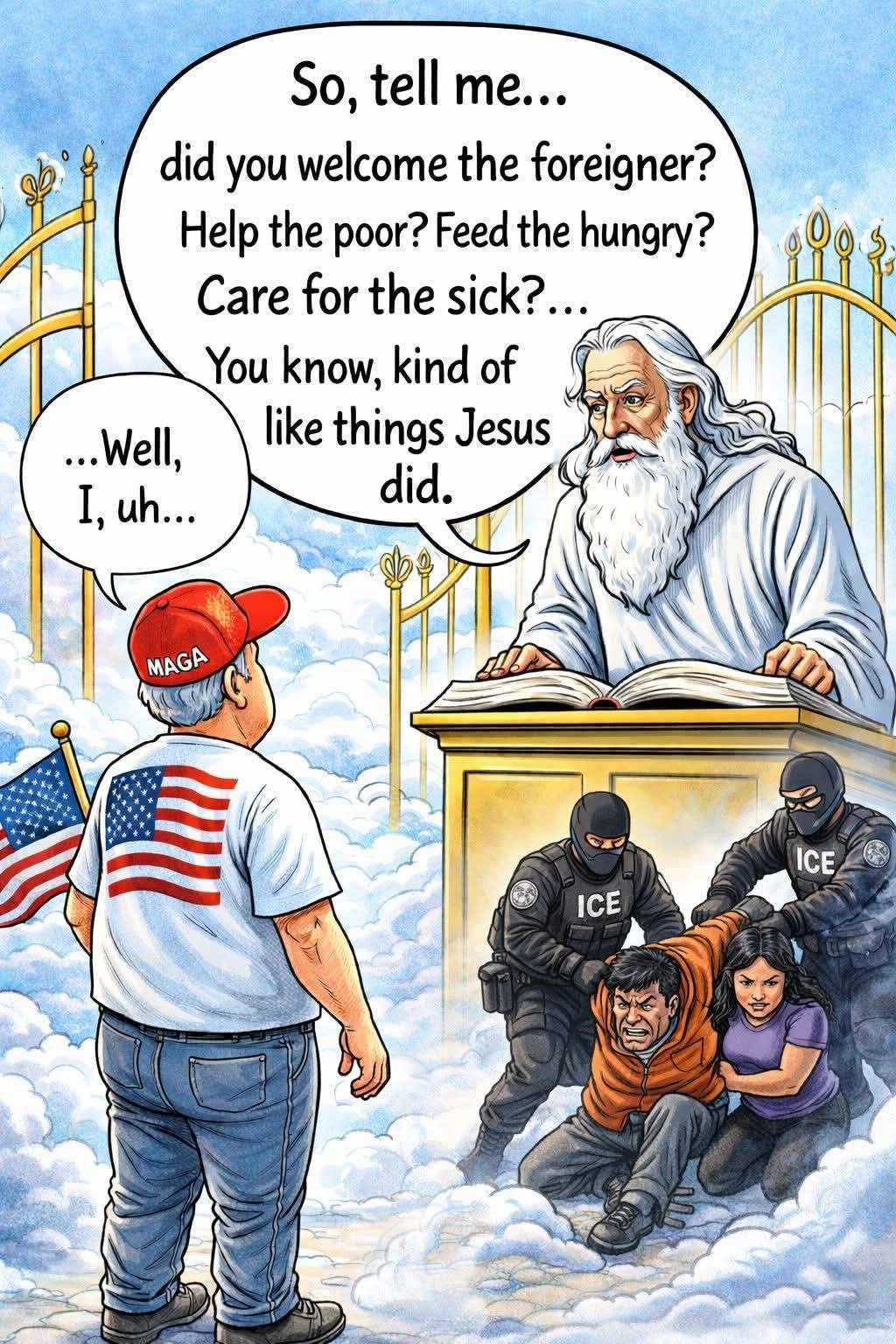
This meme satirizes the reactionary argument that refusal to help humanity is based on a lack of knowledge rather than a moral choice. When God asks if the character has ever fed the hungry or welcomed strangers, the man in the MAGA hat simply says "uh...", suggesting that refusing to accept human rights and global aid is a political position rather than a theological truth. The presence of ICE agents implies that he hasn't actually done any good deeds yet in his current life, playing on the idea that people claim not to have had bad times while ignoring ongoing suffering abroad.
detailed-analysis (gemma3_27b-it-q8_0)
Okay, let's break down this meme from an "Anti-Reactionary" perspective, utilizing the requested theoretical frameworks where applicable. An "Anti-Reactionary" stance generally opposes movements seeking to return to a perceived past "golden age" and is critical of conservative ideologies. It often champions social justice, progressive values, and challenges power structures.
Visual Description
The image depicts a scene of divine judgment. A large, rotund man wearing a “MAGA” hat and an American flag-patterned shirt is being questioned by Jesus at the pearly gates. The questions posed by Jesus are centered on acts of compassion – welcoming foreigners, feeding the hungry, caring for the sick. Juxtaposed against this heavenly scene is a harsh, earthly one: ICE (Immigration and Customs Enforcement) agents are arresting a terrified-looking person and, seemingly, a child. The contrast between the heavenly questioning and the earthly enforcement is stark. The man's posture and expression are hesitant, stammering ("...Well, I, uh..."), hinting at an inability to answer positively.
Foucauldian Genealogical Discourse Analysis
This meme effectively critiques the discourse surrounding morality and national identity, specifically as constructed by contemporary reactionary movements. Michel Foucault’s genealogical method examines how concepts we take for granted—like “American values” or “Christian charity”—are not timeless truths but are constructed through historical power relations.
The meme deconstructs the rhetoric used to justify harsh immigration policies. Reactionary ideologies often selectively invoke Christian values (like family or national pride) while simultaneously abandoning core tenets of compassion and welcome central to the Christian narrative. The question “did you welcome the foreigner?” exposes this hypocrisy.
The power dynamic here is evident. The ICE agents represent the disciplinary power Foucault described, enforcing norms and borders through surveillance, control, and punishment. This contrasts sharply with the supposed moral authority of Jesus, revealing the discursive shift away from compassion toward exclusionary policies. The man's struggle to answer showcases the internal dissonance when these conflicting discourses clash. He cannot reconcile his outward display of patriotism (MAGA hat, flag shirt) with the actual practices of compassion expected by religious doctrine.
Critical Theory
From a critical theory perspective, the meme functions as a critique of ideology. It highlights how dominant ideologies (in this case, a blend of right-wing nationalism and a selective interpretation of Christianity) obscure the realities of power and oppression.
The man in the image represents the willing participant in an ideological system that justifies cruelty. His hesitation suggests an underlying guilt, a subconscious awareness of the contradiction between his proclaimed beliefs and the actions of the state (represented by ICE). The meme isn’t merely pointing out individual hypocrisy; it's illustrating how ideology functions to normalize harmful practices. The questions posed by Jesus disrupt the ideological narrative by forcing a confrontation with fundamental ethical principles.
The meme also taps into the Frankfurt School’s notion of the “culture industry.” Reactionary ideologies often utilize emotionally resonant imagery (like the flag and appeals to tradition) to manufacture consent and suppress critical thinking. The meme subverts this by exposing the dark reality behind the patriotic façade.
Marxist Conflict Theory
From a Marxist standpoint, the meme exposes the inherent contradictions within capitalist society. The ICE agents, as representatives of the state, are enforcing the boundaries necessary to maintain a cheap labor supply and protect the interests of the ruling class. Immigration control is, from this perspective, not about national security but about economic exploitation.
The "foreigner" being arrested represents the working class, vulnerable to exploitation and subject to state repression. The questioning by Jesus represents the moral critique of exploitation inherent in socialist thought. It asks a fundamental question: Can a society based on profit and competition truly claim to be just or compassionate?
The man in the MAGA hat represents the false consciousness of a segment of the working class, those who have been convinced to identify with the interests of the ruling class rather than their own. He is upholding a system that ultimately harms his own class interests.
Postmodernism
A postmodern reading would focus on the deconstruction of grand narratives, specifically the narratives of American exceptionalism and Christian morality. The meme challenges the idea that there is a single, coherent “American” identity or a monolithic interpretation of “Christian values.”
The juxtaposition of the sacred and the profane, the heavenly and the earthly, undermines the authority of both. Jesus is no longer presented as a distant, abstract figure but as a direct questioner of individual ethics. The ICE agents are not seen as neutral enforcers of the law but as actors in a complex power struggle.
The meme also utilizes irony and pastiche, blending religious imagery with contemporary political symbols to create a jarring effect. This highlights the arbitrary nature of meaning and the constructedness of reality.
Queer Feminist Intersectional Analysis (While not immediately central, it’s relevant)
While the image doesn’t explicitly focus on gender or sexuality, an intersectional lens can illuminate the vulnerability of those targeted by ICE. Immigrants, especially women and LGBTQ+ individuals, face heightened risks of violence, exploitation, and discrimination within the immigration system. The child in the image adds another layer of vulnerability. The meme implicitly raises questions about the ethical implications of a system that disproportionately harms marginalized communities. The forced separation of families (suggested by the child’s presence) is a core issue for queer feminist activists.
In conclusion: The meme operates as a powerful anti-reactionary statement by deconstructing the rhetoric of contemporary conservative ideologies. It uses a blend of religious imagery, political symbolism, and satirical humor to expose the hypocrisy and moral failings of policies that prioritize nationalism and exclusion over compassion and justice. It challenges viewers to critically examine their own beliefs and complicity in systems of oppression.
simple-description (llama3.2-vision_11b)
This meme uses satire to critique the anti-immigrant rhetoric of certain political groups. It juxtaposes a biblical story with a modern-day issue, implying that the biblical figure's response to a migrant would be a critique of the current immigration policies and the treatment of migrants. The text in the image reads: "So, tell me... did you welcome the foreigner? Help the poor? Feed the hungry? Care for the sick?... You know, kind of like things Jesus did."