First Seen
2026-03-28T19:49:41+00:00
simple-description (qwen3.5_2b-q8_0)
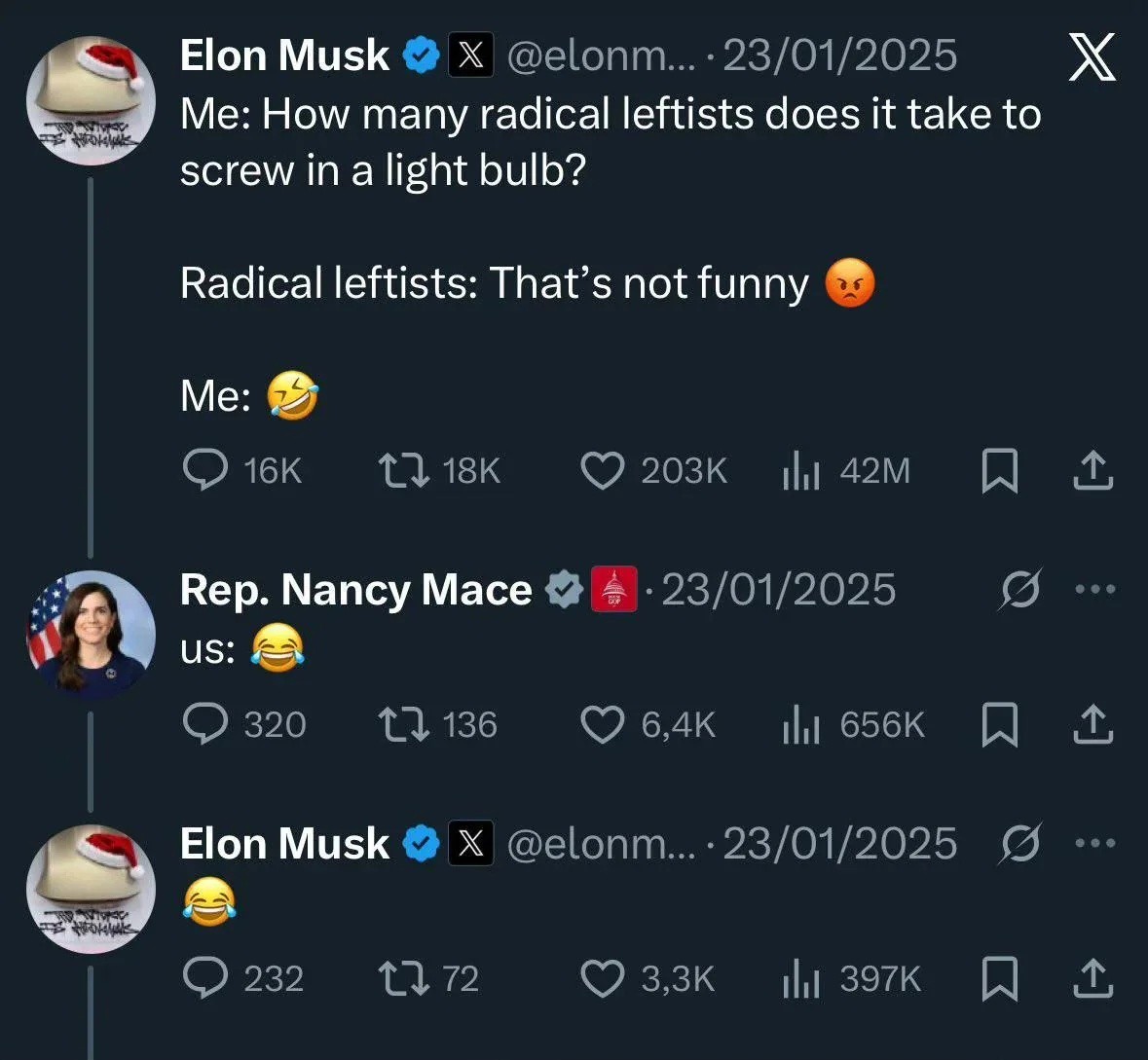
This thread uses the idiom "screw in a light bulb" to playfully mock traditional views where repairing a broken system is the only way forward. Elon Musk asks how many people need to be on the side of radical leftists to perform this destructive act, joking that they would likely just reply, "That’s not funny," implying he finds his approach to changing things amusing. Meanwhile, Rep. Nancy Mace laughs because she understands that screwing in means building on top of an existing foundation rather than fixing it; her laughter signals that for the establishment, this act is a sign of failure and that you only succeed by repairing systems from below.
detailed-analysis (gemma3_27b-it-q8_0)
Okay, let's break down this Elon Musk tweet from an "Anti-Reactionary" perspective, using the requested theoretical frameworks where applicable. The Anti-Reactionary lens generally focuses on resisting what it perceives as nostalgic, authoritarian, and hierarchical tendencies in political and social thought. It’s a current within broadly left-wing thought. This framework will highlight how Musk is leveraging (and simultaneously misrepresenting) left-wing discourse to uphold reactionary power dynamics.
Visual Description
The image shows a screenshot of a Twitter (now X) exchange. Elon Musk, verified, asks a rhetorical question: “How many radical leftists does it take to screw in a lightbulb?” The response from “Radical leftists” (presumably a placeholder for a generalized caricature) is “That’s not funny.” Musk then responds with a laughing emoji. Representative Nancy Mace responds with a fire emoji. The engagement metrics (likes, retweets, etc.) are also visible, demonstrating broad reach.
Foucauldian Genealogical Discourse Analysis
Musk's question isn't about lightbulbs. It's about power and the construction of "radical leftist" as a figure of ridicule. A Foucauldian approach (drawing on Michel Foucault) looks at the history and discourse surrounding the term "radical leftist." Musk is participating in a power/knowledge regime that creates the "radical leftist" as a specific type of subject – one that is excessively sensitive, humorless, and fundamentally unreasonable.
The question operates as a "statement" (in Foucault’s terms) that reinforces existing power relations. The joke isn’t funny because it’s a clever observation; it's funny because it confirms a pre-existing negative stereotype. By framing “radical leftists” as being offended by a simple joke, Musk implicitly validates the idea that they are overly concerned with “political correctness” and lack a sense of perspective.
The laughter from Musk and the fire emoji from Mace confirm the success of the statement and consolidate the power dynamic. They signal agreement with the underlying assumptions about “radical leftists.” The discourse works to marginalize and silence dissenting voices by portraying them as inherently incapable of engaging with ordinary social interactions.
Critical Theory
From a Critical Theory perspective (influenced by the Frankfurt School), Musk's tweet exemplifies the use of "instrumental reason" to discredit political opposition. Instrumental reason, in this context, means using logic and apparent rationality (asking a seemingly harmless question) to serve a specific, ideological purpose (undermining the left).
The joke is a form of culture industry production. It’s mass-produced content (a tweet) designed to reinforce dominant narratives and distract from real issues. Musk’s huge platform amplifies this effect, turning a petty “joke” into a widely disseminated propaganda piece.
The response from "Radical leftists" is predictable, and Musk exploits this predictability to further the caricature. The tweet serves to manufacture consent for a broader reactionary agenda by demonizing and ridiculing those who challenge the status quo.
Marxist Conflict Theory
Applying Marxist Conflict Theory, this exchange can be seen as a microcosm of class struggle. Musk, representing the capitalist class, is actively working to delegitimize any challenge to the existing economic order. “Radical leftists,” who often advocate for wealth redistribution, labor rights, and social justice, are targeted as enemies of the established system.
The humor (or lack thereof) is a tool of ideological control. By portraying “radical leftists” as absurd and unreasonable, Musk attempts to undermine their credibility and discourage others from supporting their ideas. The conflict isn't about a lightbulb; it’s about power, resources, and the control of the means of production (including the means of communication, like X).
Mace's fire emoji is indicative of a cross-class alliance against perceived leftist threats, highlighting how reactionary narratives can cut across traditional class lines.
Postmodernism
A postmodern lens would focus on the deconstruction of meaning and the simulacrum. The question about the lightbulb isn't a genuine question; it's a signifier that points to a pre-constructed idea of "radical leftism." There is no real referent beyond the stereotype.
The response “That’s not funny” is equally deconstructed. It isn’t a judgment of the joke’s comedic value, but a performance of outrage that reinforces the caricature. Musk’s laugh and Mace’s fire are performative affirmations of the underlying power dynamics.
The entire exchange highlights the loss of grand narratives. There's no attempt to engage with substantive political issues; instead, everything is reduced to a surface-level performance of emotion and ideological posturing.
In conclusion: From an Anti-Reactionary perspective, Elon Musk’s tweet is a classic example of how reactionary forces utilize rhetoric and social media to discredit and marginalize leftist thought. It's not about humor; it’s about power, control, and the perpetuation of an unjust social order. The theoretical frameworks above illuminate the various ways in which this seemingly harmless “joke” functions as a tool of ideological domination.
simple-description (llama3.2-vision_11b)
This meme is a screenshot of a Twitter conversation between Elon Musk and Rep. Nancy Mace, where they are discussing the number of radical leftists required to screw in a light bulb.
The conversation starts with Musk asking Mace how many radical leftists it takes to screw in a light bulb, to which she responds with a laughing emoji. Musk then jokes that it's not funny, and Mace agrees, also using a laughing emoji. The meme is humorous because it pokes fun at the idea of radical leftists being unable to accomplish even simple tasks, and the exchange between Musk and Mace adds to the comedic effect. The use of laughing emojis emphasizes the absurdity of the situation and the playful nature of the conversation.