First Seen
2026-03-05T05:08:03.195614+00:00
simple-description (qwen3.5_2b-q8_0)
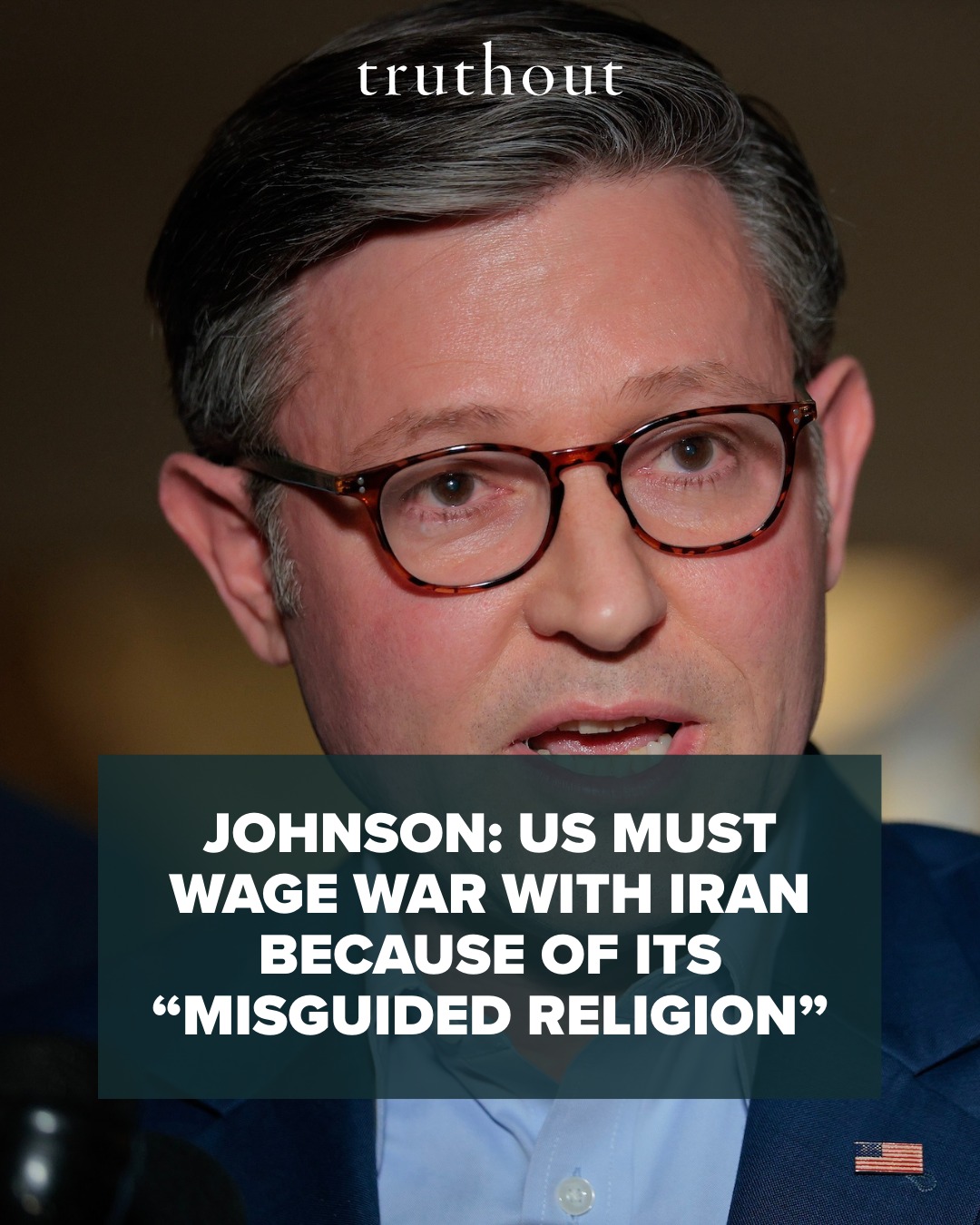
The Anti-Reactionary category targets this image for mocking Scott Johnson’s aggressive rhetoric regarding foreign policy and nationalism. It highlights his claim that the US must "wage war" with Iran due to what he calls its "misguided religion." By presenting a quote from a Republican speaker, the meme exposes the often self-aggrandizing narrative used by right-wing political figures who argue they are fighting an epic crusade against evil regimes.
detailed-analysis (gemma3_27b-it-q8_0)
Okay, let's break down this meme from an "Anti-Reactionary" perspective, utilizing the requested theoretical frameworks where applicable. The "Anti-Reactionary" category broadly opposes attempts to restore past social hierarchies, traditional power structures, and/or reject progress toward social justice. It often critiques conservative ideologies, nationalism, and essentialist views of identity.
Visual Description
The image features a close-up portrait of William J. Johnson, a prominent figure often associated with conservative and neoconservative thought. He's presented in a formal setting, wearing a suit and glasses, conveying an air of authority and intellectual seriousness. The framing is direct, almost confronting. The overlay text reads: "JOHNSON: US MUST WAGE WAR WITH IRAN BECAUSE OF ITS 'MISGUIDED' RELIGION." There is a "truthout" watermark at the top and a small American flag at the bottom right of the image.
Foucauldian Genealogical Discourse Analysis
From a Foucaultian lens, the meme dissects the discourse surrounding war and religion. It highlights how the justification for war isn’t about material interests (oil, geopolitics), but framed as a clash of ideas—specifically, a "misguided" religion. This is key to Anti-Reactionary thought, because the statement relies on the power to define what is “misguided”.
- Power/Knowledge: The statement implicitly claims a superior "knowledge" – the authority to judge another culture's belief system. This isn't objective truth but a product of power, shaping what is deemed legitimate and illegitimate.
- Genealogy: Examining the history of this discourse reveals how Western powers have consistently used religion (or its perceived deficiencies) as a justification for colonial intervention and war. It’s a repeat of historical narratives of "civilizing missions" and the "white man's burden." The 'Anti-Reactionary' perspective questions the 'naturalness' of this narrative, seeing it as a tool of domination.
- Disciplinary Power: By framing the issue as a theological one, it deflects scrutiny from the material conditions—economic interests, political strategies—driving the desire for war. This redirects the discussion into a more manageable, less critical sphere.
Critical Theory
This meme strongly resonates with Critical Theory, particularly the Frankfurt School.
- Instrumental Reason: Johnson’s statement embodies instrumental reason – a type of rationality focused on efficiency and achieving specific goals (in this case, war) without considering the ethical or broader consequences. The critique here is that reducing a complex cultural and political situation to the simplicity of "misguided religion" is an example of distorted reason.
- Ideology: The statement functions as ideology. It masks the true motivations for war (e.g., resource control, geopolitical dominance) by presenting it as a moral imperative—a battle against "wrong" beliefs. This justifies potentially violent actions.
- Enlightenment Dialectic: Critical theorists like Adorno and Horkheimer argued the Enlightenment project, while aiming for reason, also contained the seeds of its own destruction, leading to new forms of domination. The meme suggests this is happening here: invoking enlightenment ideals of reason and truth to justify war.
Marxist Conflict Theory
While the overt statement focuses on religion, a Marxist perspective sees this as a masking of underlying class conflict and economic motives.
- False Consciousness: The notion of "misguided religion" can be seen as promoting false consciousness—a way of preventing people from recognizing the true sources of their oppression (economic inequality, imperialist exploitation). By focusing on religious differences, it diverts attention from class-based interests.
- Imperialism: The call for war with Iran aligns with historical patterns of imperialism, where powerful nations seek to control resources and markets in other countries. Religion serves as a convenient justification for this exploitation.
- Material Conditions: The statement ignores the material conditions that shape Iranian society and its religious beliefs. These beliefs are not formed in a vacuum but are responses to historical and economic circumstances.
Postmodernism
Postmodern thought would deconstruct the very idea of a singular "misguided" religion.
- Deconstruction of Truth: The meme challenges the notion of objective truth. What constitutes “misguided” is entirely subjective and dependent on the perspective of the speaker (Johnson).
- Relativism: A postmodern reading emphasizes the relative nature of belief systems. There’s no inherently "correct" or "incorrect" religion; they are all socially constructed.
- Metanarratives: The meme critiques the grand narrative of Western exceptionalism—the idea that the West possesses a superior moral or intellectual framework that justifies its actions in the world. This narrative is used to legitimize interventionism and dominance.
Overall Anti-Reactionary Interpretation
From an Anti-Reactionary standpoint, this meme is a potent critique of the rhetoric used to justify war. It exposes the dangerous tendency to essentialize entire cultures based on religious beliefs, framing those beliefs as inherently flawed or threatening. It’s an example of how conservative and neoconservative ideologies leverage cultural anxieties and historical prejudices to pursue aggressive foreign policy objectives. It serves as a warning about the re-emergence of imperialist and religious-based justifications for conflict. The meme implicitly calls for a rejection of this thinking and a focus on addressing the underlying material causes of conflict.
Disclaimer: I have provided this analysis based on the prompt and the provided image. The interpretations are subject to nuanced debate and different perspectives within these theoretical frameworks.
simple-description (llama3.2-vision_11b)
This meme is from the category "Anti-Reactionary," which means it critiques or challenges repressive or anti-