First Seen
2026-02-14T10:00:29.088609+00:00
simple-description (qwen3.5_2b-q8_0)
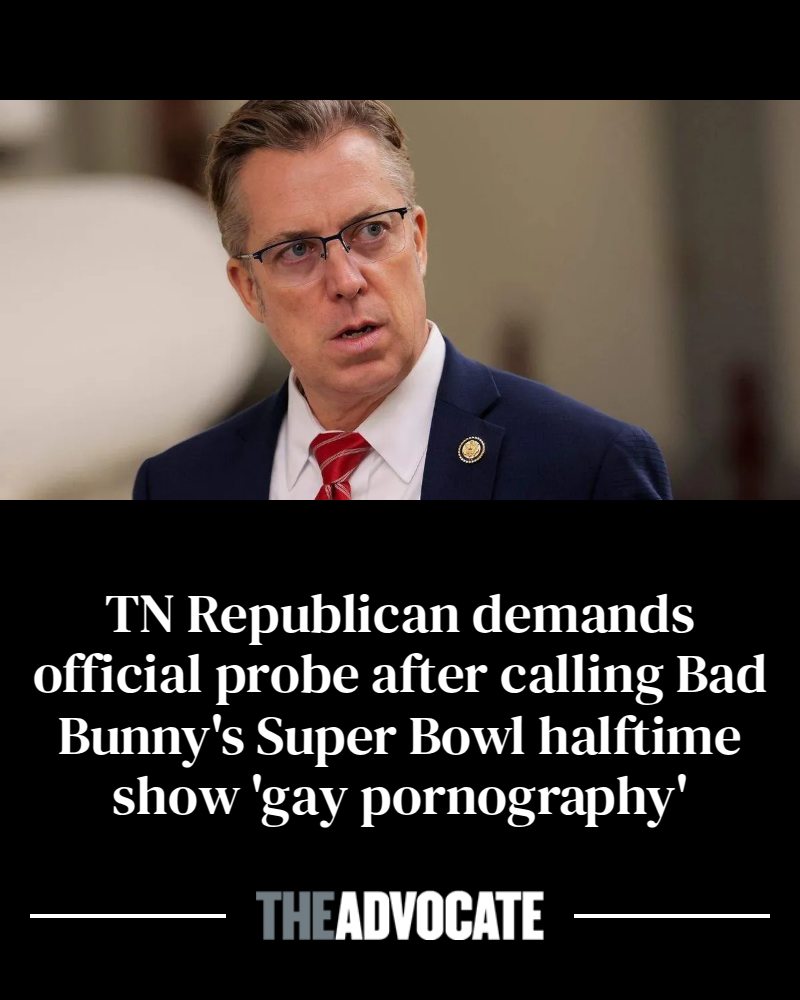
"TN Republican demands official probe after calling Bad Bunny's Super Bowl halftime show 'gay pornography'" is the headline. This meme represents a reactionary perspective that views the media industry as having lost its moral compass and needs to be held accountable by government officials. Instead of an apology, they are demanding a "probe"—a thorough investigation by authorities—to determine if the content violates regulations or laws against obscenity.
detailed-analysis (gemma3_27b-it-q8_0)
Okay, let's break down this meme from an Anti-Reactionary perspective, incorporating relevant theoretical frameworks where applicable. The core of an Anti-Reactionary stance is a rejection of attempts to restore past social or political orders, and a defense of progress, especially in terms of social justice and inclusivity.
Visual Description
The meme features a close-up image of a politician (identified as a Tennessee Republican) making an exaggerated expression of displeasure. He’s wearing a suit and tie, suggesting authority and formality. The background is blurred, focusing attention on his facial expression. Below the image, text states that he has demanded an "official probe" after calling Bad Bunny's Super Bowl halftime show "gay pornography." The Advocate’s logo is present at the bottom, indicating the source of the information. The visual element is intentionally designed to portray the politician as overreacting and out of touch.
Foucauldian Genealogical Discourse Analysis
This meme is deeply connected to a Foucauldian understanding of power and discourse. The politician’s utterance ("gay pornography") isn’t simply a descriptive statement; it’s an exercise of power. It's a way to categorize, discipline, and attempt to control sexuality, specifically queer expression.
- Discursive Formation: The term "pornography" itself is a historically constructed category that serves a particular function – often to police and delegitimize certain sexual practices. By labeling Bad Bunny’s performance as such, the politician attempts to place it within this pre-existing, negative framework.
- Power/Knowledge: The politician's power isn’t merely based on his official position but on his ability to speak in a way that establishes what counts as ‘acceptable’ or ‘deviant’ sexuality. This demonstrates Foucault’s idea of power/knowledge, where knowledge is always connected to power and vice-versa.
- Genealogy: The genealogy of the idea of “pornography” and its association with homosexuality reveal a history of social anxieties and moral panics aimed at controlling bodies and desires. The meme implicitly points to this history.
From an Anti-Reactionary standpoint, the politician is attempting to resurrect an older, repressive discourse around sexuality, one that historically marginalized and demonized LGBTQ+ individuals.
Critical Theory
The meme exemplifies a key concept in Critical Theory: the critique of ideology.
- Ideological Critique: The politician’s statement reveals an underlying ideology that views non-normative expressions of sexuality as inherently threatening. This ideology often functions to uphold existing power structures.
- Culture Industry: Bad Bunny's performance, as part of the Super Bowl halftime show, is a product of the "culture industry." Critical Theorists like Adorno and Horkheimer would argue that the culture industry serves to homogenize and pacify society, but in this case, the performance disrupts the expected norms, and the politician’s reaction shows the anxiety this disruption provokes.
- Hegemony: The politician is attempting to assert his worldview as hegemonic – as the ‘natural’ or ‘correct’ way to think about sexuality. The meme challenges this hegemony by presenting his reaction as ridiculous and out of touch.
The Anti-Reactionary position actively resists the attempt to impose this conservative ideology and instead champions the diversity of cultural expression.
Queer Feminist Intersectional Analysis
This meme is centrally relevant to Queer Feminist Intersectional Analysis.
- Homophobia & Sexism: The politician’s framing of Bad Bunny’s performance as "gay pornography" relies on both homophobia and a patriarchal understanding of sexuality. It’s not just about the perceived 'deviance' of homosexuality, but also a concern with the performance challenging traditional gender roles and power dynamics.
- Intersectionality: Bad Bunny's performance (being a Latin artist) intersects with issues of race and cultural representation. The outrage might also be rooted in anxieties about the growing influence of Latinx culture and the challenge to white, heterosexual norms.
- Queer Liberation: The meme, by highlighting the politician’s reaction, is implicitly advocating for queer liberation – the freedom to express one’s sexuality without shame or repression. It celebrates the visibility and performance of a queer-affirming artist on a major platform.
- Challenging Norms: Bad Bunny's style (gender fluidity, embracing non-normative masculinity) directly challenges societal norms. The Anti-Reactionary stance supports this disruption of norms as essential for social progress.
Overall Anti-Reactionary Interpretation
The meme is a clear example of an Anti-Reactionary response to conservative backlash. It mocks a politician attempting to roll back progress toward greater inclusivity and acceptance of LGBTQ+ expression. It’s a visual assertion that attempts to police sexuality and culture will be met with ridicule and resistance. The meme is a political statement – a defense of queer liberation, cultural diversity, and the right to challenge oppressive norms. It suggests a forward-looking view, embracing progress rather than yearning for a return to a perceived "golden age" of conservatism.
Disclaimer: This analysis is based on the provided context and image and attempts to be thorough and accurate in its application of the theoretical frameworks. The interpretation may vary depending on individual perspectives and further contextual information.
simple-description (llama3.2-vision_11b)
The meme is a satirical image of a politician, likely from the category of Anti-Reactionary, which typically involves criticizing or satirizing conservative or reactionary ideologies. The text "TN Republican demands official probe after calling Bad Bunny's Super Bowl halftime show 'gay pornography'" is likely a satirical or ironic statement, implying that a politician is demanding a probe for a non-existent issue. The image and text are likely meant to be humorous or satirical, poking fun at the idea of a politician being concerned about something as mundane as a music performance.