First Seen
2026-01-27T18:55:49.455924+00:00
simple-description (qwen3.5_2b-q8_0)
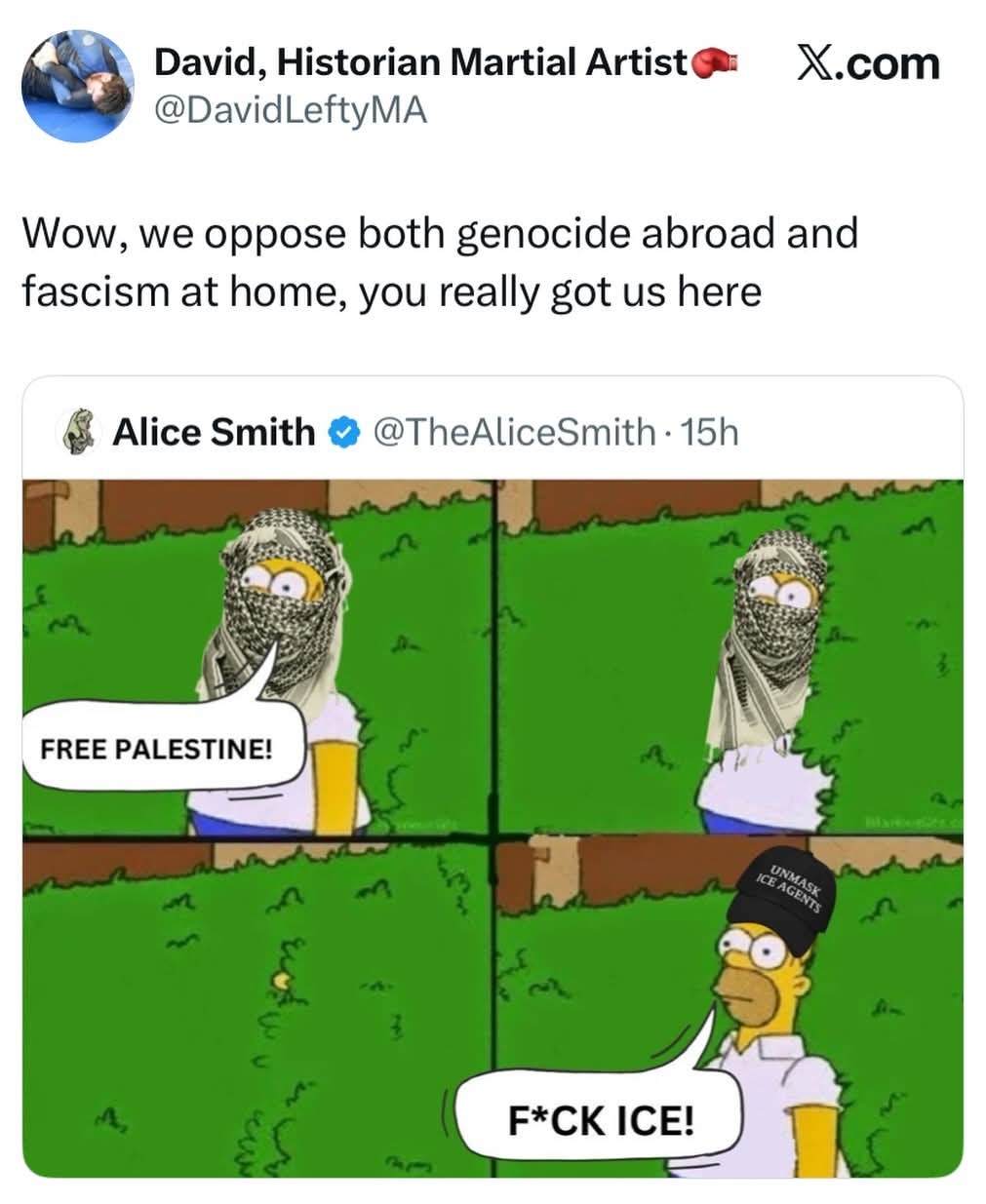
This meme satirizes the hypocrisy of people who wear anti-terrorist gear but then make offensive comments. It depicts a masked figure shouting "FREE PALESTINE!" while another character, wearing a hat labeled "UNMASK ICE AGENTS," yells "F*CK ICE!".
From an Anti-Reactionary perspective, this meme directly counters Alice Smith's tweet which claimed the poster is a "militant" fighting genocide and fascism. The creator uses humor to imply that someone pretending to support Palestinian causes (wearing a mask) is actually engaging in hateful slurs against their own side or authorities, thus debunking her classification of him as a terrorist.
detailed-analysis (gemma3_27b-it-q8_0)
Okay, let's break down this meme from the perspective of an "Anti-Reactionary" category, utilizing the requested theoretical frameworks where relevant.
Overall Framing: Anti-Reactionary Lens
This meme functions as a pointed critique of perceived hypocrisy amongst those who claim progressive values. The "Anti-Reactionary" category, broadly, is concerned with dismantling conservative, authoritarian, and traditionalist movements/thought. It often emphasizes solidarity across seemingly disparate struggles for liberation. This meme is suggesting that support for Palestine and opposition to ICE (Immigration and Customs Enforcement) aren't separate issues, but are connected by a shared rejection of oppressive state power and colonial violence. The humor derives from the abrupt shift in persona – from a historically symbolic fighter for freedom (the knight) to a modern-day activist. This highlights the continuity of struggle across time and context. The meme argues against a fragmented, compartmentalized activism, and suggests that a consistent, principled stance requires opposition to oppression in all its forms.
1. Visual Description
The meme is a two-panel image employing the “Drakeposting” format.
- Panel 1: Shows Drake (the rapper) looking dismissively at an image of a knight in medieval armor holding a banner that reads "FREE PALESTINE!". The setting is a grassy field.
- Panel 2: Shows Drake approvingly looking at a person in modern clothing wearing a baseball cap with the phrase "UNMASK ICE AGENTS" and yelling “F*CK ICE!”. Again, the setting is a grassy field.
The visual contrast is key: medieval chivalry vs. contemporary protest. The knight represents a historical struggle for liberation, while the modern protester represents a current struggle against state violence and immigration enforcement.
2. Foucauldian Genealogical Discourse Analysis
This meme subtly engages with Foucault’s concepts of power/knowledge and discourse.
- Power/Knowledge: The meme challenges the discourse surrounding activism. There's a pervasive narrative (often implicit) that certain issues are more "important" or "legitimate" than others. This meme counters that by showing solidarity between seemingly distant struggles – a medieval conflict and a modern immigration battle. This suggests that the construction of these struggles as separate is a relation of power. Those in power benefit from dividing oppositional movements.
- Genealogy: Foucault's genealogical method seeks to trace the historical development of concepts and practices to reveal how they are contingent and constructed, rather than natural or inevitable. Here, the meme implies a genealogy of resistance. The impulse to fight for freedom – whether against feudal lords or a modern state apparatus – is a recurring element of human history. The knight's banner and the protester's slogan are both expressions of this impulse. It subtly connects resistance against historical oppressive systems with modern day ones.
3. Marxist Conflict Theory
The meme is highly relevant to Marxist conflict theory.
- Class Struggle: While not explicitly about class, the implied critique of ICE connects to the exploitation and control of labor, particularly migrant labor. ICE's actions often serve to suppress wages and reinforce hierarchies of power. The meme recognizes the role of the state in upholding these inequalities.
- Imperialism/Colonialism: The "FREE PALESTINE!" banner directly references an ongoing struggle against colonial occupation. Marxist theory analyzes imperialism as a stage of capitalism driven by the need for new markets and resources. The meme connects this to the broader struggle against all forms of oppression, suggesting that the mechanisms of domination are often similar across different contexts.
- False Consciousness: The meme implicitly criticizes those who selectively engage in activism (e.g., supporting Palestine but remaining silent on immigration issues). This can be seen as a form of “false consciousness,” where individuals fail to recognize their own complicity in systems of oppression.
4. Critical Theory
This meme aligns with aspects of Critical Theory, particularly the Frankfurt School’s critique of instrumental reason.
- Critique of Enlightenment: The knight is presented in contrast to modern activism. It subtly critiques the idea that “progress” necessarily leads to greater freedom or justice. The Enlightenment project, which emphasized reason and individual rights, also paved the way for the modern state and its capacity for violence and control.
- Domination & Emancipation: Critical Theory is concerned with identifying and challenging all forms of domination. The meme directly challenges domination in two distinct forms: colonial oppression (Palestine) and state violence (ICE). It emphasizes the need for a holistic approach to emancipation, recognizing the interconnectedness of various struggles.
5. Postmodernism
The meme exhibits a subtle postmodern quality in its disruption of fixed categories.
- Deconstruction: The juxtaposition of the knight and the protester deconstructs the notion of a clear, linear progression of history. It challenges the idea that modern activism is inherently more “advanced” or “sophisticated” than historical forms of resistance.
- Grand Narratives: Postmodernism critiques “grand narratives” – overarching explanations of history and society. This meme, by linking seemingly disparate struggles, can be seen as rejecting the idea that these issues can be understood in isolation. It resists the urge to compartmentalize resistance movements.
6. Queer Feminist Intersectional Analysis
While not central to the meme, an intersectional reading can enhance understanding.
- Interconnectedness of Oppressions: This meme embraces the core tenet of intersectionality—that systems of oppression (racism, sexism, colonialism, homophobia, transphobia, etc.) are interconnected and cannot be understood in isolation. The implied critique of both ICE and the occupation of Palestine speaks to a commitment to challenging all forms of power imbalances.
- Challenging Normative Categories: The act of linking seemingly unrelated struggles challenges the normative categories that are used to divide and control populations.
In conclusion, this meme functions as a concise, pointed statement of solidarity within an anti-reactionary framework, drawing on various theoretical tools to critique hypocrisy and advocate for a more consistent and expansive approach to resistance.
simple-description (llama3.2-vision_11b)
The meme is a satirical commentary on the intersection of politics and social media, specifically targeting the intersection of anti-reactionary (also known as anti-realist) and anti-fascist (or anti-reactionary) movements. The image features a character from the popular TV show "The Simpsons" (Homer) in a situation where he is confronted with a sign that says "Free Palestine". The character is wearing a mask and has a speech bubble that says "Free Palestine". The image is accompanied by a text that says "Free Palestine".