First Seen
2026-01-23T03:26:59.103731+00:00
simple-description (qwen3.5_2b-q8_0)
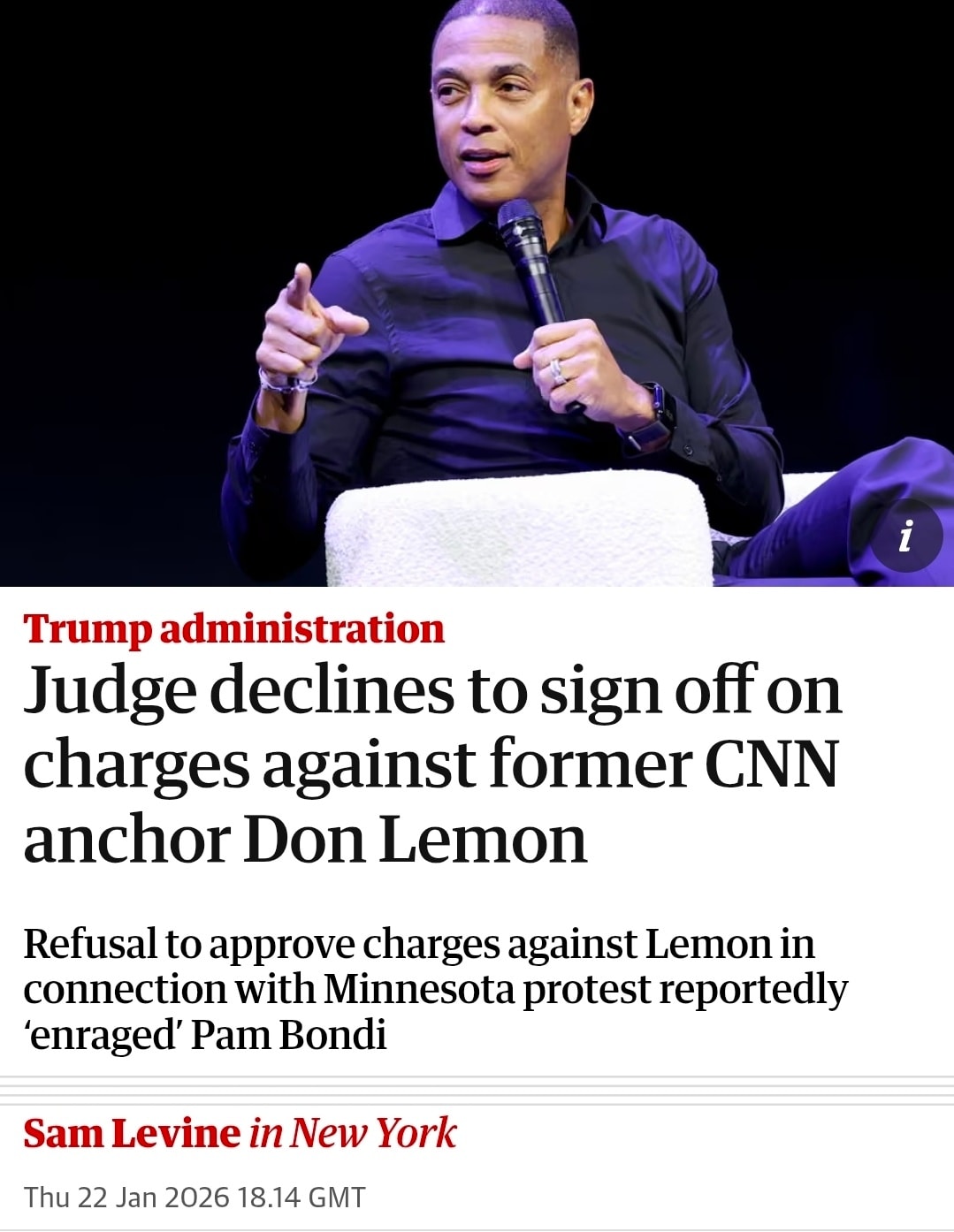
"This image captures Don Lemon, the famous former CNN anchor, standing defiantly on stage while the Trump administration attempts to block him from appearing on air and firing him. To an anti-reactionary view, this serves as comedic irony because a judge has declined to sign off on charges where he is sued by the conservative party for making controversial comments about Donald Trump and his family. It humorously visualizes the 'systemic' political battle between the media icon and the conservative establishment that fired him."
detailed-analysis (gemma3_27b-it-q8_0)
Okay, let's analyze this image and its associated article snippet through the lens of an "Anti-Reactionary" category, delving into applicable theoretical frameworks.
Understanding the "Anti-Reactionary" Category
First, it's crucial to define "Anti-Reactionary." This stance generally opposes attempts to return to a previous social, political, or cultural order perceived as hierarchical, oppressive, or exclusionary. It champions progress, challenges traditional power structures, and often embraces inclusivity and social justice. It’s generally aligned with leftist thought but focuses specifically on dismantling attempts to restore what it sees as a broken or unjust past. Given that context, the image and article will be interpreted as a moment of potential resistance against such reactionary forces.
---
Visual Description
The image features Don Lemon, a former CNN anchor, speaking at a podium. He's presented in a confident, somewhat expressive manner – mid-gesture with hands raised, making eye contact, a slight smile. The dark background and spotlight suggest a position of authority or public speaking. The photo conveys a sense of Lemon being a figure who is unafraid to present his thoughts, even in a possibly contentious setting.
Foucauldian Genealogical Discourse Analysis
From a Foucauldian perspective, the news about the declining of charges is a specific point in an ongoing discourse regarding power, law, and the media. The article touches on the interplay of power relations.
- Power/Knowledge: The "charges" themselves represent a manifestation of state power (the legal system) attempting to regulate behavior. The judge’s refusal to approve the charges represents a shifting or resisting of that power.
- Genealogy of Control: Examining the historical context (Trump administration’s involvement) reveals the genealogy of the charges. They aren't neutral; they arise from a specific political moment characterized by attempts to control narratives and target perceived opponents. Pam Bondi, as representative of that administration, is a figure representing that control.
- Discipline & Punishment: The attempt to charge Lemon can be seen as an exercise in disciplinary power, seeking to punish/silence him. The judge’s decision is a disruption of that disciplinary regime.
The Anti-Reactionary stance here celebrates this disruption. It identifies the original attempt to lay charges as a tool of a regressive, authoritarian impulse—an attempt to silence dissenting voices within the media.
Critical Theory
Critical Theory would examine the image and article within the context of broader social structures and the ideology that supports them.
- Ideology Critique: The attempt to press charges against Lemon could be seen as serving an ideological function – reinforcing a dominant narrative that delegitimizes critical media or specific voices. The judge's decision challenges that narrative.
- The Culture Industry: Lemon, as a figure within CNN, operates within what Critical Theorists (like Adorno and Horkheimer) might describe as the "culture industry." However, his case becomes particularly interesting when he becomes the object of a power struggle, potentially disrupting the industry’s supposed neutrality.
- Hegemony: The event speaks to a battle over cultural hegemony. Reactionary forces attempt to establish a dominant worldview; the judge’s decision challenges this through allowing Lemon to speak without fear of prosecution.
The "Anti-Reactionary" perspective views the judge’s decision as a challenge to this hegemonic order, potentially opening up space for alternative viewpoints.
Marxist Conflict Theory
From a Marxist angle, the situation can be framed as a conflict between competing class interests and the state's role in upholding the dominant class.
- Class Struggle: While not explicitly about economic class, it can be interpreted as a struggle between those who benefit from the status quo (represented by the Trump administration's proponents) and those who challenge it. Lemon, as a media figure, potentially represents a voice critical of power structures, potentially upsetting the balance.
- The State as an Instrument of the Ruling Class: The attempt to charge Lemon represents the state being used as a tool to suppress dissenting voices, thereby protecting the interests of the ruling class.
- False Consciousness: The attempt to charge Lemon can also be seen as a way to spread false consciousness, in an attempt to make people believe Lemon is guilty of wrongdoing and therefore should not be listened to.
The "Anti-Reactionary" position actively supports the disruption of this class dynamic, celebrating the judge’s decision as a victory against the state’s attempts to silence dissent.
Postmodernism
Postmodernism's relevance lies in its deconstruction of grand narratives and emphasis on the relativity of truth.
- Deconstruction of "Truth": The article points to "enraged" reactions to the judge's decision (from Bondi). Postmodernism would question the very notion of objective "truth" in this situation, recognizing that both sides have competing narratives and interpretations.
- Power of Discourse: The framing of the event by the media is crucial. The language used (“declines to sign off,” “enraged,” etc.) shapes perceptions and reinforces certain power dynamics.
- Rejection of Metanarratives: The Anti-Reactionary position rejects the grand narrative of "returning to a better past" that reactionary movements champion. It embraces a more fluid and contested understanding of history and progress.
Queer Feminist Intersectional Analysis
While this image and article don't explicitly focus on gender or sexuality, the context of Don Lemon's identity (a Black, openly gay man) is relevant.
- Intersectionality: Lemon’s experience is shaped by the intersection of race, sexuality, and class. The charges brought against him might be seen as part of a broader pattern of targeting marginalized groups.
- Challenging Norms: Lemon as a visible figure is challenging traditional norms regarding who holds authority in the media and public sphere.
- Subverting Power: The judge’s decision to not sign off on the charges can be seen as an act of subverting the patriarchal and white supremacist power structures that often target marginalized individuals.
The Anti-Reactionary perspective here would emphasize the importance of protecting the voices of marginalized communities and resisting attempts to silence them.
---
Overall Interpretation (From the Anti-Reactionary Perspective)
From an Anti-Reactionary perspective, this news is positive. It signifies a moment where a potential rollback of progress has been resisted. The Trump administration's attempt to punish Lemon is seen as a reactionary effort to silence a critical voice, while the judge’s decision represents a triumph of progressive forces. The Anti-Reactionary would see this as a reminder of the ongoing battle against attempts to reinstate hierarchies of power, oppression, and exclusion. The picture of Don Lemon is a symbol of those forces and the importance of resistance.
simple-description (llama3.2-vision_11b)
The meme is a screenshot of a news article with a headline that reads "Judge declines to sign off on charges against former CNN anchor Don Lemon". The article is from the "Anti-Reactionary" category, which implies that the article is from a source that is opposed to the reactionary movement. The article is likely to be from a left-wing or liberal news source.