First Seen
2026-01-23T21:40:56.934036+00:00
simple-description (qwen3.5_2b-q8_0)
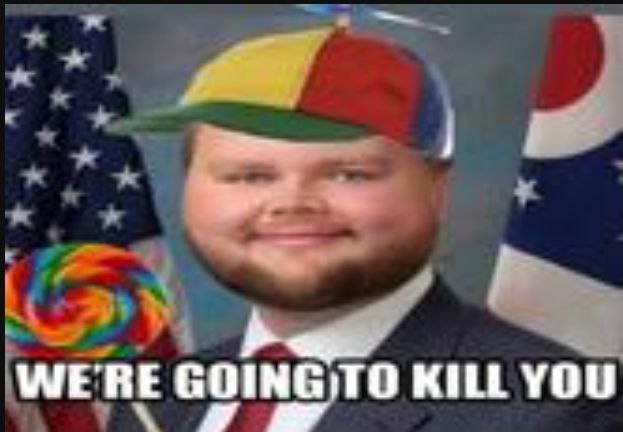
This meme criticizes reactionary political platforms that promote extreme nationalism and anti-immigrant sentiment. A young man in a suit holds a rainbow lollipop, symbolizing the celebration of diversity, while flanked by US and Canadian flags, suggesting a false promise of security for foreign nationals. The text "WE'RE GOING TO KILL YOU" references his 2016 campaign slogan mocking immigrants' rights, serving as a warning against restrictive policies that prioritize border control over community integration.
detailed-analysis (gemma3_27b-it-q8_0)
Okay, let's break down this meme from an "Anti-Reactionary" perspective, utilizing the requested theoretical frameworks where applicable. This is a complex meme, and the analysis is layered.
Understanding the Anti-Reactionary Context
Before diving into the theory, it's important to establish the core of "Anti-Reactionary" thought. It's generally a stance deeply opposed to traditionalism, conservatism, and anything perceived as seeking a return to a romanticized past. It's a rejection of hierarchical structures, often embracing progressive and transgressive ideas. Anti-reactionaries often see reactionaries as invested in maintaining power imbalances and suppressing change, particularly regarding social and cultural norms. Humor is frequently used as a weapon against perceived reactionary forces.
---
Visual Description
The meme features a photograph of a man in a suit, wearing a brightly colored, clownish baseball cap. He is positioned in front of American flags, holding a large, swirled lollipop. Overlaid text reads: "WE'RE GOING TO KILL YOU." The juxtaposition is jarring. The man’s appearance is deliberately unsettling – not threatening, but off, slightly grotesque, and unsettlingly cheerful. The American flags suggest a specific target for the 'threat' and are likely ironic. The lollipop is a symbol of childishness that is in sharp contrast to the violent text.
---
Foucauldian Genealogical Discourse Analysis
This meme is heavily reliant on disruption of discursive norms. Foucault's genealogical approach is useful in understanding how power operates through discourse—the ways we talk about things, create categories, and establish truths.
- Disruption of Power/Knowledge: The meme deliberately mismatches power dynamics. The threat ("WE'RE GOING TO KILL YOU") is delivered by someone who appears utterly powerless, even ridiculous. This undermines the conventional authority associated with threat-making. The juxtaposition destabilizes the "truth" of who is capable of violence and who is not.
- Archaeology of Threat: The meme isn’t about literal threat, but rather about the discourse of threat often employed by reactionaries. Reactionaries often invoke fear and violence as a means of preserving the status quo. This meme mocks that tactic by appropriating the language of threat but applying it through a destabilized, almost absurd, figure.
- Normalization of the Absurd: By presenting this incongruity (violence and childishness), the meme subtly attempts to normalize the idea of resistance through unconventional means. It’s saying, "Our methods of dismantling your power structures might seem strange, even unsettling, but they are a response to the absurdity of your own ideology.”
---
Critical Theory
Drawing on the Frankfurt School's Critical Theory, we can interpret this meme as an example of:
- Negative Dialectics: The meme operates through contradiction. It presents a thesis (reactionary ideology, which implicitly relies on threats) and an antithesis (the ridiculous figure making the threat). The synthesis isn’t resolution, but rather the highlighting of the inherent contradictions within the reactionary position itself.
- Culture Industry Critique: The bright colors, the American flags, the lollipop, and the meme format itself are all elements of the "culture industry". However, rather than passively accepting these elements, the meme repurposes them. It critiques the culture industry’s role in reinforcing dominant ideologies by subverting its visual language.
- Critique of Instrumental Reason: Reactionary ideologies often rely on a purportedly 'rational' justification for maintaining hierarchies. This meme undermines that 'rationality' by presenting the threat in an irrational, almost nonsensical way, challenging the legitimacy of that reason.
---
Marxist Conflict Theory
From a Marxist perspective:
- Class Struggle (in expanded form): While not explicitly about economic class, this meme operates on the level of ideological class struggle. It can be seen as a representation of a challenge from a marginalized group (those opposing reaction) against a dominant power structure (the reactionary establishment).
- Ideology as False Consciousness: Reactionary ideology, from a Marxist perspective, functions as "false consciousness," preventing people from recognizing their true interests. This meme tries to disrupt that false consciousness by exposing the absurdity and hypocrisy of the ideology.
- Revolutionary Potential: The "WE'RE GOING TO KILL YOU" isn't a literal call to violence but is a metaphorical statement of the total dismantling of the old order, which in Marxist thought, is often necessary to build a new, more equitable society.
---
Postmodernism
- Deconstruction: The meme actively deconstructs the concept of "threat" by removing it from its traditional context. It dismantles the assumptions we have about who makes threats and what those threats mean.
- Simulacra and Simulation: The image is a simulation of a threat. It's not a real threat, but a representation of a representation, a layer of irony that highlights the artificiality of the power dynamics. The figure and the entire scene feel artificial.
- Rejection of Grand Narratives: The anti-reactionary stance rejects the "grand narratives" of tradition, nationalism, and hierarchy. This meme mocks these narratives by presenting them in a trivial and absurd light.
---
Queer Feminist Intersectional Analysis
(This applies depending on who is utilizing the meme and against what reactionary forces.)
- Disruption of Normative Masculinity: The figure's appearance deliberately defies conventional norms of masculinity. This can be interpreted as a challenge to the power structures associated with traditional masculinity.
- Subversion of Power Dynamics: Queer theory is often concerned with dismantling power imbalances. This meme does so by taking a phrase typically associated with authority ("WE'RE GOING TO KILL YOU") and applying it to someone who is perceived as powerless, thereby challenging the very idea of power.
- Intersectionality: If this meme is used in response to reactionary forces targeting multiple marginalized groups (e.g., LGBTQ+ people, people of color, women), it can be understood as an expression of solidarity and a rejection of intersecting forms of oppression.
In conclusion: This meme is a sophisticated example of anti-reactionary communication. It’s not simply about expressing anger; it's about strategically deconstructing power dynamics, disrupting discursive norms, and challenging the very foundations of reactionary ideology through irony, absurdity, and visual dissonance. The layers of meaning allow for multiple interpretations and make it a potent tool for those seeking to dismantle oppressive systems.
simple-description (llama3.2-vision_11b)
The meme is a satirical image of a person with a childish and naive expression, wearing a hat with a flag of a country that has been known for its anti-reactionary policies. The text "We're going to kill you" is a reference to a famous line from the movie "The Matrix" but is used in a humorous and ironic way to comment on the idea of a country's policy of "killing" or "targeting" an enemy. The image is meant to be humorous and satirical, poking fun at the idea of a country's policy of "killing" an enemy.