First Seen
2026-01-08T16:05:21.299280+00:00
simple-description (qwen3.5_2b-q8_0)
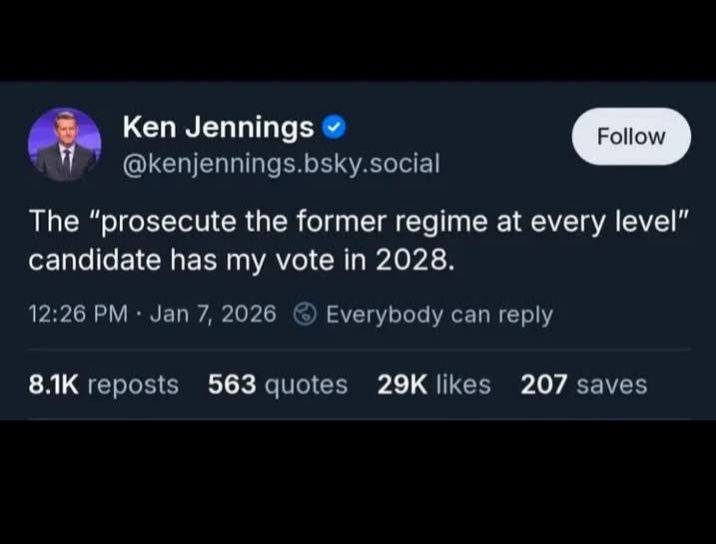
This anti-government meme features Ken Jennings joking that he supports a candidate who wants to file charges against people from the former administration. The joke is in the ridiculousness of the proposed policy: prosecuting "the former regime at every level." It satirizes how extreme political rhetoric can sound absurd while claiming support.
detailed-analysis (gemma3_27b-it-q8_0)
Okay, let's break down this social media post from Ken Jennings through the lens of an "Anti-Reactionary" category, utilizing various theoretical frameworks where applicable.
Understanding the "Anti-Reactionary" Frame
Before diving in, it's vital to define the "Anti-Reactionary" stance. This perspective fundamentally opposes attempts to restore a past perceived as idealized, particularly those movements that seek to undo progressive changes. It often targets nostalgic narratives, authoritarian tendencies, and attempts to re-establish hierarchies deemed unjust. It is characterized by a staunch defense of progressive social justice, inclusivity, and a belief in continuous societal evolution. The “Anti-Reactionary” is often deeply critical of the “New Right” and “Traditionalist” movements.
Visual Description
The image shows a screenshot of a social media post (likely from Bluesky, a decentralized social network). The post features a profile picture of Ken Jennings (known as a game show host) along with the text: “The ‘prosecute the former regime at every level’ candidate has my vote in 2028.” Below the post are statistics displaying engagement: 8.1K reposts, 563 quotes, 29K likes, and 207 saves. The presence of a “Follow” button and a timestamp indicates it's a live social media communication. The simplicity of the image—just text and user info—emphasizes the directness of the message.
Foucauldian Genealogical Discourse Analysis
From a Foucauldian perspective, this post is fascinating. The phrase "former regime" isn’t neutral. It evokes a discourse of power and its historical construction. Jennings isn’t simply talking about a previous administration; he’s establishing a categorical distinction between “us” (those who oppose the regime) and “them” (the regime itself).
A genealogical analysis would examine how this “regime” came to be seen as needing prosecution. What discourses were deployed to demonize it? What power/knowledge structures underpinned its rise and subsequent fall from grace? The call to "prosecute at every level" reveals a desire for totalizing control over the narrative—to not merely defeat the former power but to dismantle its structures of thought and practice.
Importantly, Foucault would point out that the very act of defining a “regime” is an exercise of power. It creates a boundary and an "other," upon which actions can be justified. Jennings is implicitly participating in this power dynamic.
Critical Theory
This post resonates with key themes in Critical Theory. The call for prosecution suggests a rejection of the status quo and an attempt to overcome systemic injustices inherent in the "former regime." This can be viewed as a project of emancipation—liberating society from oppressive structures.
The use of the phrase "at every level" implies a critique of institutions and ideological forces embedded throughout society. Critical Theorists would argue that the "regime" didn't operate solely through government actions; it permeated culture, education, media, and everyday life. Therefore, dismantling it requires a broad, multifaceted approach.
The implicit assumption here is that the “former regime” represents a form of false consciousness – a system of beliefs and values that obscure the true nature of power relations and prevent genuine liberation. By seeking prosecution, Jennings signals a desire to expose these underlying structures and enable a more critical awareness.
Marxist Conflict Theory
From a Marxist perspective, the "former regime" represents a class-based or structurally oppressive power. The call for prosecution isn't about individual wrongdoing, but about dismantling the material conditions that enabled that regime's dominance.
The "prosecution at every level" suggests a desire to dismantle the superstructure—the legal, political, and ideological institutions—that serve to uphold the interests of the ruling class (represented by the "former regime"). The post suggests that existing power structures are fundamentally unjust and need to be overthrown and replaced with a more equitable system.
The intense engagement (reposts, likes) suggests a level of class consciousness and a willingness among a segment of the population to actively challenge existing power dynamics. The year 2028 suggests a future orientation towards systemic change, and the desire for a candidate dedicated to this goal.
Postmodernism
A postmodern reading complicates the seemingly clear-cut "us vs. them" dynamic. It would question the very notion of a monolithic "regime" and the possibility of a totalizing prosecution. Postmodernism emphasizes the fluidity of meaning and the deconstruction of grand narratives.
The “former regime” is not a fixed entity but a constructed narrative. It’s a story we tell ourselves. Postmodernism would push back against the idea of a complete “dismantling,” arguing that power operates in dispersed, capillary ways and cannot be eradicated entirely. It also would suggest that prosecution itself is a performative act, contributing to the ongoing construction of reality, and that any attempt at a definitive "victory" is illusory.
Conclusion
This seemingly simple social media post is laden with political and theoretical weight. From an "Anti-Reactionary" perspective, it represents a commitment to challenging oppressive power structures, defending progressive values, and actively working toward a more just future. However, the theoretical lenses reveal the complexities and potential contradictions inherent in such a commitment—the exercise of power through discourse, the limitations of systemic change, and the elusiveness of complete liberation. The high engagement suggests this message resonates deeply with a segment of the online population, demonstrating the ongoing struggle against perceived reaction and the pursuit of social transformation.
simple-description (llama3.2-vision_11b)
The meme is a tweet from a satirical account, implying that the "prosecute the former regime at every level" quote is a 2028 election campaign slogan. The tweet is likely from a satirical account, and the quote is a joke about the 2028 election.