First Seen
2025-08-17T20:24:13.155308+00:00
simple-description (qwen3.5_2b-q8_0)
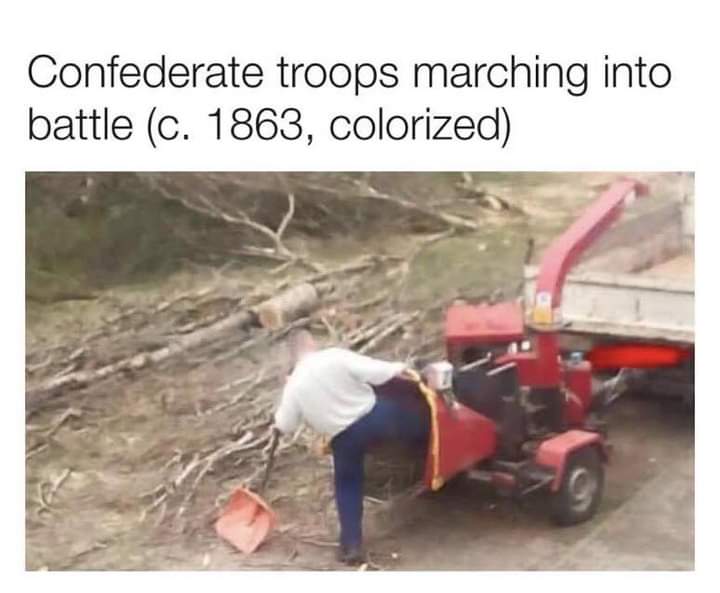
The meme plays on the absurdity of the Confederate military by replacing "soldiers" with mundane suburban housekeeping laborers hauling wood chips into battle. In the image, a person is shoveling a pile of yard waste and branches from a red machine, implying that their serious historical occupation involves just hauling off dead trees. The text clarifies the ridiculous nature of the image, identifying it as "Confederate troops" marching in 1863 while actually filling up woodchips.
detailed-analysis (gemma3_27b-it-q8_0)
Okay, let's dissect this meme from an "Anti-Reactionary" perspective, utilizing the requested frameworks where applicable. The meme is deeply layered, deploying irony and disruption to challenge reactionary nostalgia and Confederate apologia.
Understanding the "Anti-Reactionary" Context
Before diving into the specific analysis, let’s define the “Anti-Reactionary” stance. This perspective fundamentally opposes attempts to restore a perceived ‘golden age,’ particularly when that “golden age” is based on hierarchies of oppression. It critically examines nostalgia, conservatism, and traditionalism, viewing them as tools used to maintain power structures that perpetuate inequality. Anti-reactionary thought is often aligned with progressivism, social justice movements, and a rejection of essentialist ideas. It's a posture that actively dismantles arguments for the status quo, and especially those that advocate for a return to past oppressive conditions.
Visual Description
The meme depicts a man dressed in what appears to be a historical costume, ostensibly representing a Confederate soldier from around 1863. However, instead of marching into a battlefield, he is walking towards a large, modern wood chipper. He’s carrying a brown paper bag, seemingly about to feed it into the machine. The image is captioned "Confederate troops marching into battle (c. 1863, colorized)." The incongruity – the anachronism of the wood chipper – is immediately striking.
Foucauldian Genealogical Discourse Analysis
This meme powerfully employs a genealogical approach in the style of Michel Foucault. It doesn’t attempt to find the “true” history of the Confederacy. Instead, it disrupts the discursive construction of Confederate identity.
- Power/Knowledge: The dominant discourse around the Confederacy relies on romanticized narratives of bravery, honor, and states’ rights, often obscuring the foundational role of slavery. This narrative is a form of power/knowledge – a way of framing history that serves to legitimize certain ideologies and maintain power structures.
- Archaeology of Knowledge: The meme performs an “archaeology” by excavating the underlying violence inherent within the Confederate project. It doesn't engage in a respectful historical presentation. Instead, it violently rejects the romanticized historical narrative and forces a confrontation with its brutal consequences.
- Genealogical Disruption: By placing a Confederate soldier on the verge of being "processed" by a wood chipper, the meme rejects the idealized image of the Confederate soldier. It transforms the soldier into a figure about to be dismantled, deconstructed, and obliterated. It suggests that the ideology the soldier represents – white supremacy, slavery, treason – is also subject to the same destructive force. The wood chipper functions as a metaphor for the dismantling of these harmful ideologies.
Critical Theory
The meme is a potent example of critical theory’s emphasis on exposing the ideological underpinnings of power.
- Ideology Critique: The core function of the meme is ideological critique. It challenges the narrative of the "Lost Cause," the romanticized myth that the Confederacy was fighting for noble principles rather than the preservation of slavery. It exposes the inherent brutality and illogicality of the Confederate project.
- Negative Dialectic: The juxtaposition of the historical figure with a modern machine can be seen as a form of negative dialectic (influenced by thinkers like Theodor Adorno). It highlights the contradictions and failures of history, refusing a simple reconciliation between past and present. The image doesn’t offer a resolution; it emphasizes the continued, unresolved trauma of the past.
- Unmasking the Apparatus: The wood chipper can be seen as an “apparatus” (Agamben) – a technological and institutional arrangement that regulates and controls life. In this case, the meme suggests a desire to employ similar apparatuses (albeit metaphorically) to dismantle and eliminate the problematic ideologies associated with the Confederacy.
Marxist Conflict Theory
From a Marxist perspective, the meme embodies the ongoing class and ideological struggle.
- Historical Materialism: The Confederacy was fundamentally rooted in a specific economic system – plantation slavery. The meme, by exposing the violent core of that system, highlights the material conditions that gave rise to the conflict.
- Class Consciousness: The meme can be seen as an attempt to raise class consciousness, particularly among those who are critical of systems of oppression. It encourages viewers to recognize the historical roots of contemporary inequality.
- Revolutionary Impulse: The image of the wood chipper hints at a desire for radical change and the dismantling of oppressive structures. It’s a visual expression of the need to actively challenge and overthrow the legacy of the Confederacy.
Postmodernism
Postmodernism’s principles of deconstruction and pastiche are at play.
- Deconstruction of Narrative: The meme fundamentally deconstructs the traditional narrative of the Confederacy. It refuses to treat it as a sacred or unchallengeable historical account.
- Irony and Parody: The humor relies heavily on irony and parody. The incongruity of the wood chipper is deliberately jarring, undermining the seriousness typically associated with historical depictions.
- Simulation & Hyperreality: The “colorized” label is subtly ironic. The image isn’t a genuine restoration of the past, but a simulation of it. It reflects the postmodern condition where representations of reality often become more real than reality itself.
In conclusion:
The meme is a multi-layered critique that resonates strongly within an “Anti-Reactionary” framework. It is not a neutral observation about the past, but a forceful intervention in contemporary debates about history, identity, and power. By employing irony, disruption, and a dismantling of dominant narratives, the meme serves as a powerful anti-Confederate statement. It suggests not merely a rejection of the past, but a desire to actively dismantle the ideologies that continue to haunt the present.
Disclaimer: My analysis is based on the provided image and the context of "Anti-Reactionary" thought. Interpretations of memes are inherently subjective.
simple-description (llama3.2-vision_11b)
The meme is a humorous take on the idea of Confederate soldiers being "colorized" in modern times. The image shows a person in a historical reenactment costume, but instead of being in a battle, they are using a modern tool, a wood chipper, to "chip" wood. The text "Confederate soldiers: now with more modern technology" is a play on the idea of updating historical reenactments to include modern technology.