First Seen
2025-03-01T20:13:47.317991+00:00
simple-description (llama3.2-vision_11b)
The meme features a photo of a dog playing with a beach ball, but with a twist: a giant beach ball is hovering above the dog, and the dog is running away from it. The text "I can smell the desperation" is overlaid on the image. The meme is a commentary on the absurdity of a situation where a dog is running away from a beach ball that's not even there, implying that the dog is desperate for attention.
detailed-analysis (gemma3-27b-vision)
Okay, here's an analysis of the image, broken down into sections as requested, covering relevant theoretical frameworks where applicable.
Visual Description
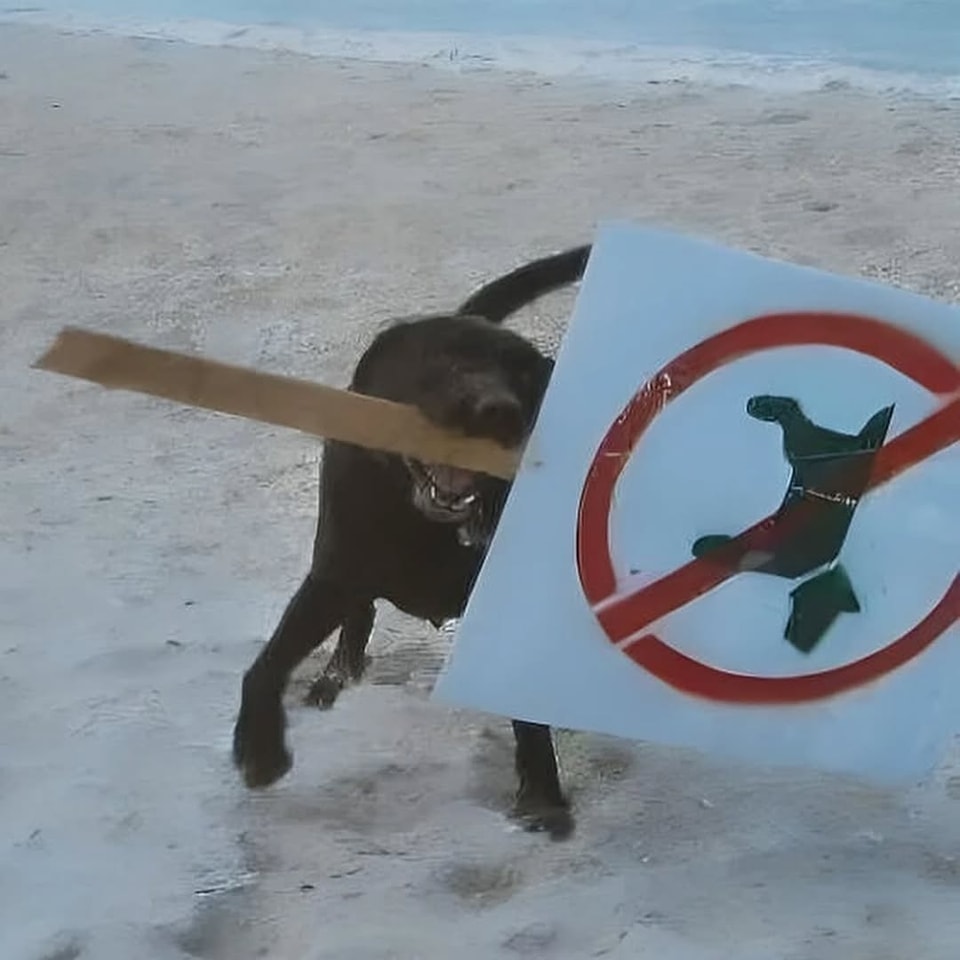
The image depicts a dark-colored dog – likely a Labrador or similar breed – on a sandy beach. The dog is partially obscured by a rectangular wooden board that covers its head and upper body. To the right of the dog is a white sign displaying a red circle with a diagonal line through it – the universal symbol for "prohibited." Within the circle is a graphic depicting a dark-colored dog defecating (a pile of poop). The background consists of sand and a hazy, pale sky. The image appears to be a candid snapshot, perhaps taken with a smartphone, with a slightly tilted angle.
---
Foucauldian Genealogical Discourse Analysis
This image lends itself to analysis through a Foucauldian lens. The sign prohibiting dog waste isn't merely about hygiene; it’s a discourse about control, societal norms, and the regulation of bodies (both human and animal).
Power/Knowledge: The sign represents power operating through knowledge. It defines* what is acceptable behavior on the beach (cleanliness) and implicitly defines what is not (allowing dogs to defecate). This definition isn't based on natural law but on a social construction. The sign creates a framework for judging and disciplining both dog owners and the dogs themselves.
Discipline & Panopticism: The prohibition subtly implies surveillance. While we don't see a patrolling authority, the sign functions* as a constant, silent enforcer. Owners, knowing the rule, self-regulate their dogs' behavior, internalizing the norm. This operates as a form of micro-power, similar to the Panopticon—the constant possibility of being watched shapes behavior.
Genealogy of the Rule: A genealogical approach would ask how* this rule came to be. What historical and social conditions led to the need for such a sign? Perhaps increasing beach use, concerns about public health, or a shift in societal attitudes towards cleanliness and animal waste. It wasn’t always this way.
* The Obscured Dog: The wooden board obscuring the dog is very interesting. It might represent a silencing of the animal. The animal can’t communicate its needs or desires beyond the instinctive act of defecation, which is then prohibited.
---
Critical Theory
From a critical theory perspective, the image highlights the ways in which societal norms are imposed on both humans and animals, often serving to maintain existing power structures.
* Domination & Control: The sign represents a form of domination – the imposition of human order onto a natural process. The dog’s natural bodily functions are deemed unacceptable within a specific social space.
* Ideology: The rule is not simply practical; it embodies an ideology about cleanliness, order, and the “proper” use of public spaces. This ideology reinforces a certain worldview—one that values aesthetic perfection and control over natural processes.
Instrumental Reason: The prohibition can be viewed through the lens of instrumental reason – a focus on efficiency and control, often at the expense of other values. The sign seeks to manage* the beach, not to recognize or accommodate the natural messiness of life.
---
Marxist Conflict Theory
While less directly applicable, there's a subtle layer of analysis here.
* Class and Access: Beaches, as public spaces, are subject to rules governing their use. These rules, even seemingly innocuous ones about dog waste, can impact access and enjoyment based on social class. For example, owning a dog might be more common among certain socioeconomic groups, and compliance with the rule could require purchasing poop bags, adding a small economic burden.
* Control of Space: The regulation of the beach represents a broader control of public space. Those who define and enforce the rules (local authorities, park management) exercise power over how that space is used and by whom.
---
Postmodernism
Postmodernist interpretation could focus on the instability of meaning and the constructed nature of reality.
Deconstruction of the Sign: The sign itself is a symbol whose meaning is not inherent but assigned. We accept it as “prohibition” because of social convention. A postmodern reading would question that convention, asking who benefits from this definition and what* other meanings could be attached to dog waste (e.g., a natural part of the ecosystem, a form of artistic expression, etc.).
* The Obscured Dog as Fragmentation: The obscured dog could represent a fragmentation of the animal’s identity and agency. The board deprives it of a complete visual presence, mirroring the postmodern emphasis on the constructed and incomplete nature of subjectivity.
* Irony/Absurdity: The image has an element of absurdity. The simple act of a dog doing its business is prohibited by a formal sign, creating a contrast between natural behavior and social regulation.
---
Queer Feminist Intersectional Analysis
This is the most nuanced area of interpretation, but relevant.
* Animal Agency/De-centering the Human: Queer and feminist thought often challenge anthropocentric (human-centered) views. The obscured dog could be seen as a metaphor for the silencing of non-human voices and the denial of animal agency. The dog's 'natural' act is policed in favour of human comfort.
Regulation of Bodies: The sign indirectly regulates animal bodies, dictating what they can and cannot do* with their bodies in public space. This resonates with feminist concerns about the policing of female bodies and the control of reproductive functions.
* Intersectionality: The image invites consideration of how rules are applied and experienced differently. For example, a person with disabilities might have more difficulty cleaning up after their dog, adding a layer of complexity to their experience of the rule.
I hope this detailed analysis covers the requested theoretical frameworks and provides a thought-provoking interpretation of the image! Let me know if you'd like me to elaborate on any specific point.
simple-description (llama3.2-vision)
This meme features a photo of a dog on a beach, but its attention is focused on a sign in the foreground. The sign displays a "no dogs" symbol, but the dog is enthusiastically trying to get to the beach despite the sign. The text on the sign reads "No dogs allowed".