First Seen
2023-05-10T21:03:33+00:00
simple-description (llama3.2-vision_11b)
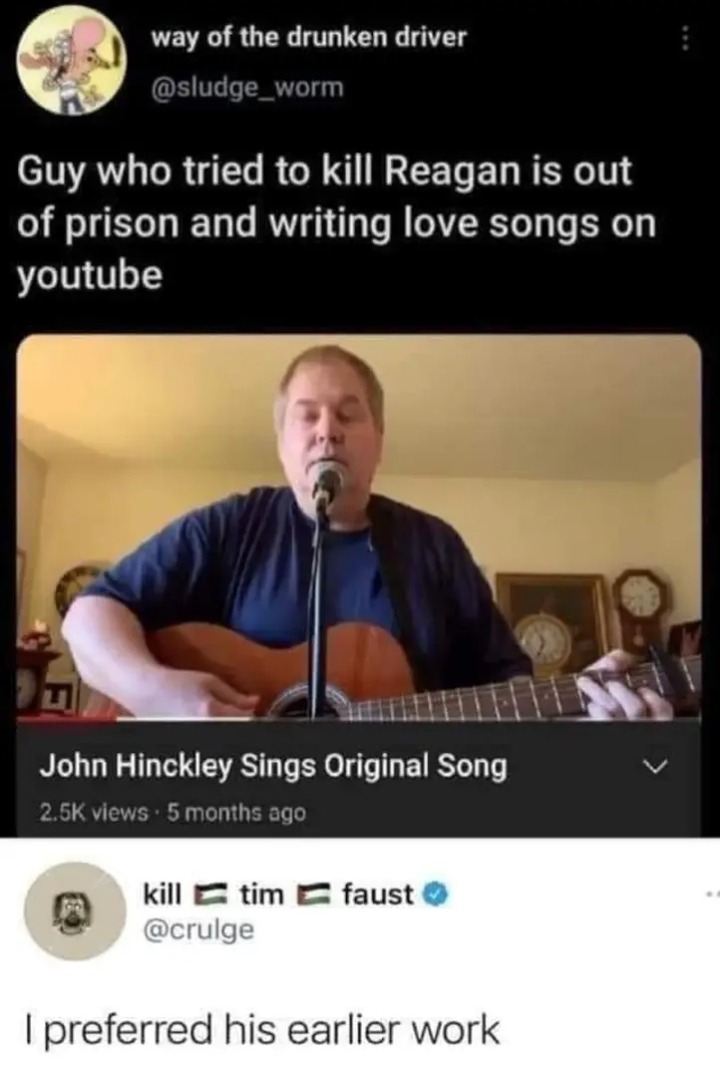
The meme is a screenshot of a YouTube video where a user is playing a song called "I'm a Ck" by a user with a similar name to the one in the question. The song's lyrics are about being a male prostitute. The user who created the song is a user on the "I'm a Ck" subreddit, which is a community for people who have been convicted of sex crimes.
detailed-analysis (gemma3-27b-vision)
Okay, here's an analysis of the image and accompanying text, broken down into the requested theoretical frameworks. I'll indicate where a framework doesn't apply to avoid unnecessary repetition. I'll prioritize depth in the relevant sections.
Visual Description
The image is a screenshot of a YouTube video. It depicts John Hinckley Jr. seated and singing into a microphone. He appears to be in a home setting, likely a living room. He’s a middle-aged man with short white hair, wearing a dark blue t-shirt. He's holding a guitar and appears to be recording. The background is somewhat cluttered with furniture, a clock on the wall, and a general sense of domesticity. The YouTube video information beneath the image reads "John Hinckley Sings Original Song," with stats indicating 2.5k views and being posted 5 months ago. The image and video convey a sense of mundane normalcy contrasting sharply with Hinckley's past.
Foucauldian Genealogical Discourse Analysis
This is where the post is most potent for analysis. Foucault's genealogy traces the historical construction of knowledge, power, and discourse. Here's how it applies:
Discipline and Punishment: Hinckley’s incarceration itself is a manifestation of disciplinary power, the institutions (prison, law) that control bodies and regulate behavior. The fact that he’s out* and creating content signifies a shifting discourse around rehabilitation, punishment, and societal reintegration. The shift suggests a change in how society understands and manages dangerous individuals.
Normalization: The video normalizes the formerly "abnormal" (an attempted assassin). Hinckley is now presented as a musician, a creative individual. The everyday setting (living room recording) actively works to desensitize us to his past. This normalization isn't necessarily good or bad* but is a key mechanism of power according to Foucault; it reshapes how we perceive and categorize individuals.
The Production of Truth: The discourse around Hinckley is not simply about "truth" (did he try to assassinate Reagan?). It's about how that "truth" is constructed and circulated* through media, legal systems, and public opinion. The YouTube video contributes to this construction, presenting an alternative narrative.
Power/Knowledge: The power to define Hinckley – as a criminal, a madman, a rehabilitated artist – is tied to the knowledge* we have about him, and the way that knowledge is produced and disseminated.
Critical Theory
Critical theory, stemming from the Frankfurt School, examines how power structures are embedded in cultural products.
* Culture Industry: The YouTube video could be seen as part of the “culture industry”, even in its relative obscurity. The platform and content are participating in the production and consumption of cultural experiences.
* Commodification of Trauma/Transgression: While it's a stretch, one could argue that Hinckley's artistic expression is a commodification of his past transgression. The act of posting on YouTube and receiving views turns his notoriety into a form of content.
* Ideology: The normalization implicit in the video subtly reinforces the ideology of rehabilitation and forgiveness. It potentially masks the deeper societal issues (mental health, celebrity obsession, political violence) that contributed to Hinckley's actions.
Marxist Conflict Theory
This is less directly applicable, but we can find a connection.
* Power and Control: The legal system and the power to grant parole represent the dominant class controlling and regulating individuals considered threats to social order. Hinckley's release reflects the shifting interests and priorities of that class.
* Representation and Marginalization: Hinckley's story, like many others, can be viewed as an example of how individuals are marginalized and controlled within a capitalist system. Although a strange example, his actions can be seen as a distorted form of protest or rebellion against the dominant power structures.
Postmodernism
The post and video are profoundly postmodern.
* Simulacra and Simulation: The YouTube video is a simulation of normalcy. It’s a representation of a person attempting to present themselves as an ordinary artist, masking the extreme reality of their past. It’s a hyperreality where the distinction between "real" and representation is blurred.
* Deconstruction: The post itself deconstructs the traditional narrative of a political assassin. By framing Hinckley as a musician, it undermines the simplistic categorization of "criminal" and challenges viewers to reconsider their assumptions.
* Irony and Parody: The juxtaposition of Hinckley's past and present creates a sense of irony and even parody. The comment “I preferred his earlier work” is a sardonic statement playing on the shock value of Hinckley’s history.
Queer Feminist Intersectional Analysis
This is the least applicable framework here. It's difficult to apply Queer Feminist Intersectional Analysis in a meaningful way without significant additional context. However, we could briefly consider:
* Social Construction of Masculinity: Hinckley’s actions, though extreme, could be seen as a distorted expression of societal expectations around masculinity (e.g., pursuing an unattainable object of affection, seeking power and control). However, this is a tenuous connection.
In Summary:
The image and post are rich with layers of meaning and lend themselves well to analysis through Foucauldian, postmodern, and critical theory lenses. They highlight the ways in which power operates, knowledge is constructed, and narratives are deconstructed in contemporary society. The post functions as a commentary on media, celebrity, and the complex relationship between the past and the present.
simple-description (llama3.2-vision)
This meme is a humorous comparison between a YouTube video of a man singing a song about John Hinckley, the man who attempted to assassinate President Ronald Reagan, and a tweet that implies the singer is a "guy who tried to kill Reagan" who is now out of prison and making music. The tweet says "I preferred his earlier work" in a sarcastic tone, implying that the singer's music is not as good as his previous work.
tesseract-ocr
& ps! way of the drunken driver wo Guy who tried to kill Reagan is out of prison and writing love songs on youtube , v a | . da \ cal \ ] hs vnc 7 WAS John Hinckley Sings Original Song v K vi 5 Tests] @ kill = tim E= faust Dcrulge | preferred his earlier work