First Seen
2025-10-02T19:37:20+00:00
simple-description (qwen3.5_2b-q8_0)
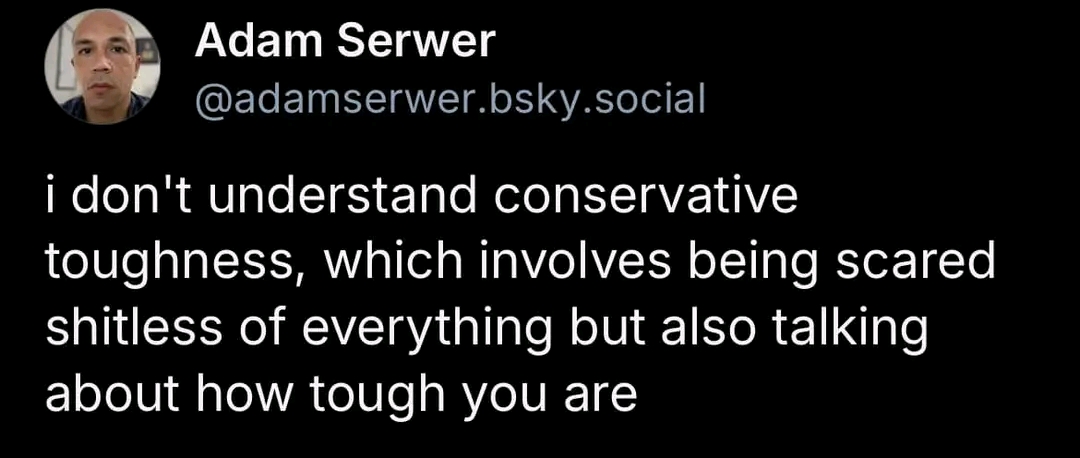
This anti-reactionary joke mocks the stereotype that conservatives are inherently "tough" but actually scared. It humorously suggests that reactionaries hide their true feelings behind a fake image of strength, remaining paralyzed by fear while still acting as if they can't be wrong about anything, all in reference to the tweet text: "i don't understand conservative toughness, which involves being scared shitless of everything but also talking about how tough you are."
detailed-analysis (gemma3_27b-it-q8_0)
Okay, let's break down this meme through the lens of an "Anti-Reactionary" perspective, and the associated theoretical frameworks where relevant. This is a complex meme, so a layered explanation is needed.
Overall Framing: Anti-Reactionary Stance
The core of the “Anti-Reactionary” stance is a rejection of attempts to revert to perceived past glories, often involving a romanticization of tradition, hierarchy, and resistance to social change. It's often a direct response to the "New Right" or "Reactionary" movements that seek to roll back progressive gains. This meme operates by exposing what Anti-Reactionaries see as a core hypocrisy within that reactionary ideology. It’s not about ‘winning’ an argument with conservatives, but rather diagnosing the inner contradictions that reveal its core weakness.
---
Visual Description
The meme features a profile picture of Adam Serwer, a writer known for critical analyses of race, politics, and right-wing ideology. The profile picture establishes the source as someone with a proven track record of dissecting conservative thought. This isn’t just a random tweet; it’s coming from someone embedded in the intellectual critique of the Right. The presentation is minimalist – just text on a background. This contributes to the tone of dry, pointed observation rather than emotional outrage.
---
Foucauldian Genealogical Discourse Analysis
This meme is heavily informed by a Foucauldian approach. Michel Foucault’s genealogical method looks at how concepts (like "toughness") aren’t timeless, universal truths but are historically constructed through power relations.
- Discourse of Toughness: The meme highlights that “toughness” isn't an inherent quality, but a discourse created and maintained by conservative thought. It's a performance of strength to establish dominance.
- Power/Knowledge: The assertion that conservatives are "scared shitless" is a disruption of the power/knowledge dynamic. The Right attempts to define what strength is, and wields that definition as power. Serwer’s meme undermines this by revealing the underlying fear driving the performance. It exposes the construction of this “toughness” as a defense mechanism.
- Genealogy of Fear: A Foucauldian reading would ask: What historical anxieties are fueling this need to appear tough? What are the historical shifts (demographic changes, loss of social control, etc.) that are prompting this reactive posturing? The meme doesn’t spell this out, but it implies that the display of toughness is a response to a perceived (and potentially fabricated) threat.
- Normalization: The Anti-Reactionary perspective, using Foucault, would see this performative toughness as part of a normalization process – attempting to make anxieties about social change seem natural and acceptable, and to justify a return to hierarchical structures.
---
Critical Theory
From a Critical Theory perspective (drawing on the Frankfurt School), the meme critiques the instrumentalization of masculinity and the authoritarian personality.
- False Consciousness: The "toughness" is seen as a form of false consciousness. The conservative is not actually empowered by this performance, but is instead trapped in a cycle of fear and reactive behavior that serves the interests of maintaining existing power structures.
- Authoritarian Personality: The need to project strength while secretly being terrified points to characteristics of the "authoritarian personality" identified by Adorno et al. This personality type relies on dominance, suppression of weakness, and a rigid adherence to traditional values.
- Critique of Enlightenment Reason: The meme implicitly critiques the instrumentalization of reason. The Right often claims to be rational and logical, but this rationality is used to justify reactionary policies. The “toughness” is a tool in that project, obscuring the underlying insecurities and anxieties.
---
Marxist Conflict Theory
While less direct than the Foucauldian/Critical Theory lenses, a Marxist reading can be applied.
- Ideology as False Consciousness: The “toughness” discourse can be seen as an ideology – a set of beliefs that masks the underlying class contradictions and power imbalances in society. It distracts from systemic issues (economic inequality, lack of social mobility, etc.) by focusing on abstract threats to "traditional values".
- Maintaining the Status Quo: The performance of “toughness” serves to reinforce hierarchical structures and protect the interests of the ruling class. The fear expressed is often fear of losing privilege and control.
- Class Anxiety: The anxieties driving this reactionary "toughness" can be linked to the anxieties of sections of the working class who feel threatened by social and economic changes.
---
Postmodernism
A postmodern analysis would focus on deconstructing the very notion of “toughness” and its claims to objectivity.
- Deconstruction of Binary Oppositions: The meme challenges the binary opposition of “tough/weak”. It demonstrates that “toughness” is often a façade concealing vulnerability.
- Rejection of Metanarratives: The anti-reactionary impulse, strongly tied to postmodern thought, rejects the “metanarrative” of a glorious past that can be restored. The meme exposes the contradictions within the reactionary attempt to construct a coherent narrative of strength and tradition.
- Subjectivity and Representation: The meme understands "toughness" as a socially constructed performance rather than an inherent quality. How "toughness" is represented is key, and the meme is actively dismantling that representation.
---
Queer Feminist Intersectional Analysis
The meme implicitly speaks to how this performative “toughness” is often used to justify oppressive social structures and behaviors.
- Patriarchal Authority: "Toughness" is often linked to patriarchal ideals of masculinity, used to justify male dominance and control over others.
- Intersectionality of Oppression: The anxieties driving reactionary “toughness” often stem from a fear of losing power in a society that is becoming more inclusive and equitable. This fear is amplified when it comes to challenging the privileges associated with race, class, gender, and sexuality.
- Critique of Violence: The meme implicates the performative toughness as often being a precursor to, or justification for, violence against marginalized groups.
In conclusion: The meme isn’t a simple joke. It is a sophisticated and layered critique of a reactionary ideology, deployed from an anti-reactionary perspective and using a variety of critical theoretical tools to expose its internal contradictions and underlying anxieties. It's about deconstructing a performance, revealing the fear at its core, and undermining its claims to legitimacy.
simple-description (llama3.2-vision_11b)
The meme is a humorous commentary on the concept of "conservative" or "right-wing" politics, specifically the idea that a person's emotional response to a situation is not a reliable indicator of their actual politics. The meme pokes fun at the idea that a person's emotional response to a situation is not a reliable indicator of their actual politics. The text reads: "I don't understand conservative [toughness], which involves being scared shitless of everything but also talking about how tough you are."