First Seen
2023-05-10T21:03:33+00:00
simple-description (llama3.2-vision_11b)
The meme features an image of a snake eating a mouse, with the caption "I live to eat" in a playful, tongue-in-cheek manner. From the perspective of the Anti-Reactionary category, this meme is a humorous take on the idea that one's purpose in life is to enjoy and savor the things that bring them joy, rather than focusing on the mundane and the serious. The meme is a lighthearted and irreverent way to poke fun at the idea of living life to the fullest.
detailed-analysis (gemma3-27b-vision)
Okay, here's an analysis of the image, broken down into the requested theoretical frameworks, with sections only included when relevant.
## Visual Description
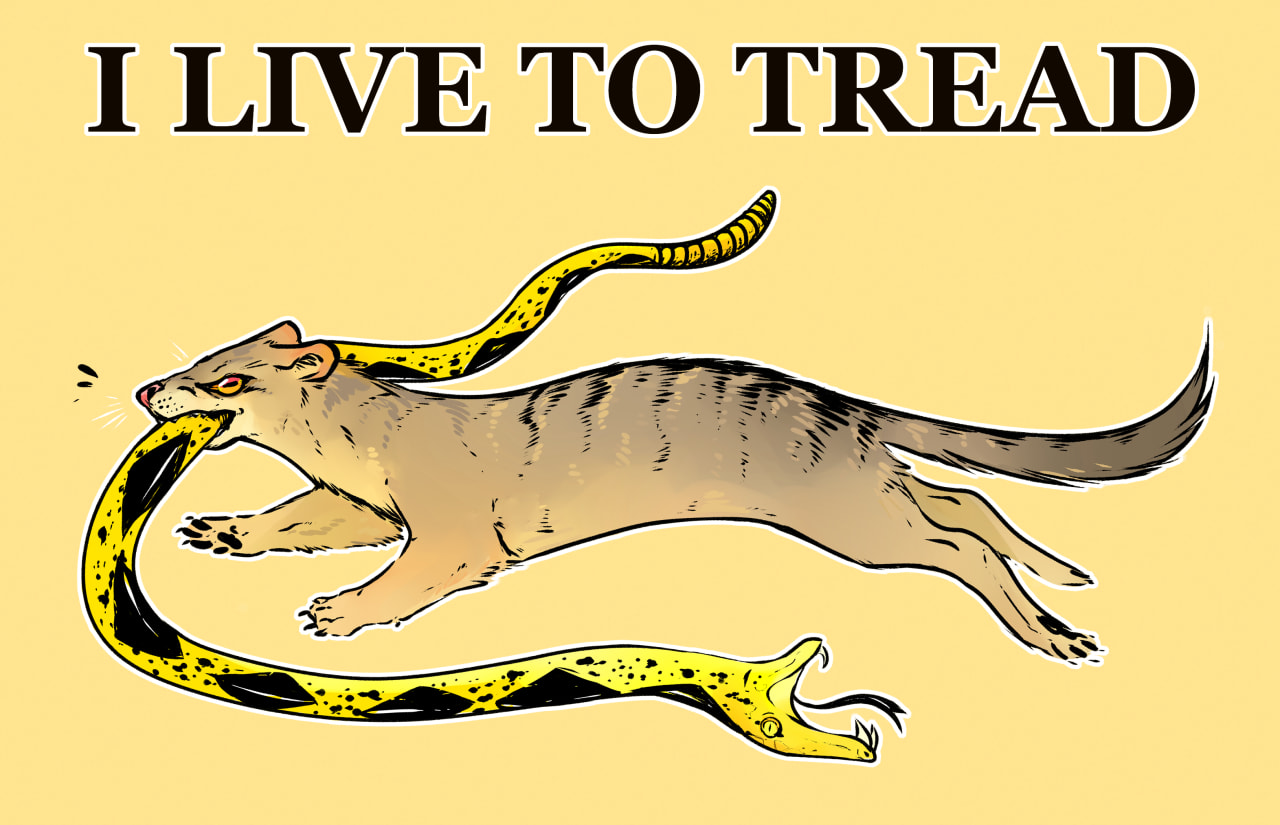
The image depicts a mustelid (likely a weasel or similar creature) in mid-stride, powerfully bounding forward. A large snake is being actively consumed by the mustelid – its head disappearing into the animal’s mouth, and the snake's body extending behind, seemingly dragged along by the creature's momentum. The creature is drawn with a somewhat rough, illustrative style, with visible linework emphasizing its muscular build and focused expression. The color palette is limited, using shades of brown and yellow over a pale yellow background. The text "I LIVE TO TREAD" is placed boldly above the image in black block letters. The overall impression is one of relentless energy, predatory instinct, and a certain disregard for the vulnerability of the prey.
## Foucauldian Genealogical Discourse Analysis
This image lends itself well to a Foucauldian analysis centered on power dynamics and the construction of knowledge around predation and control.
Discourse of the Predator: The image visualizes a specific discourse of "predation." This isn't simply about an animal eating another, but a performance of power. The "I LIVE TO TREAD" inscription highlights a purposeful, even ecstatic, assertion of this power. It's not survival* depicted, but a celebration of the act of dominating. This taps into historical discourses of hunting (as a demonstration of nobility or skill) and colonial expansion (conquest and resource extraction).
Genealogy of "Treading": We can trace a genealogy of the phrase "to tread." Originally meaning simply to walk or step, it develops connotations of oppression, crushing, or dominating. "Treading on" someone implies a disregard for their well-being. The phrase invokes power over the environment and other living things. In the image, the mustelid isn't merely walking; it is treading on, over, and through* its prey.
Power/Knowledge: The image shows power enacted through a physical, biological act, but it is presented through the text as a self-proclaimed philosophy. This is a demonstration of how power and knowledge work together. The mustelid’s act of predation becomes justified as a natural, inherent part of its being ("I LIVE..."). The image is therefore not just about what is happening physically but how this act is understood and legitimized.*
## Critical Theory
A Critical Theory approach would focus on the image’s potential as a metaphor for broader social structures and power imbalances.
* Domination and Control: The image can be read as a symbolic representation of domination and control. The mustelid represents a dominant force (potentially representing a ruling class, empire, or a dominant ideology), and the snake represents the oppressed or marginalized.
Instrumental Reason: The unwavering focus on "treading" (consuming) speaks to a logic of instrumental reason – a purely calculating rationality that prioritizes efficiency and achieving a goal (in this case, consumption) without regard for ethical considerations. The mustelid doesn't appear to feel remorse or empathy; it simply acts*.
Critique of Naturalization: The text "I LIVE TO TREAD" is a key element. It attempts to naturalize the predatory act – to present it as an inherent part of the creature's identity. Critical Theory challenges this naturalization, arguing that power dynamics are socially constructed and not inevitable. The image invites us to question why* this creature "lives" to tread and what ideology underpins this drive.
## Marxist Conflict Theory
Within a Marxist framework, the image can be interpreted as a representation of class struggle and exploitation.
* Predator/Prey as Oppressor/Oppressed: The predator/prey dynamic directly mirrors the relationship between the bourgeoisie (the mustelid, possessing the means of 'production' – its predatory ability) and the proletariat (the snake, exploited for its 'labor' – its existence as prey).
* Material Basis of Power: The mustelid's power stems from its physical attributes and predatory instincts - its material capacity to consume. This aligns with Marxist emphasis on the material conditions that shape power relations.
* Exploitation and Consumption: The image depicts a brutal act of consumption, where one entity literally devours another. This can be seen as a metaphor for the capitalist system, which relies on the exploitation of resources (and, metaphorically, labor) for the benefit of a few. The "I LIVE TO TREAD" inscription reinforces this, highlighting the prioritizing of self-interest over the wellbeing of others.
Let me know if you’d like me to delve deeper into any of these analyses, or explore other theoretical frameworks!
simple-description (llama3.2-vision)
The meme is a humorous image of a cartoon tiger, with the phrase "I can smell the fear" from the movie "The Lion King" appearing above it. The tiger is depicted with a comically exaggerated expression of fear, and its body is surrounded by a "fear" aura, symbolizing the tiger's ability to sense fear in others.
tesseract-ocr
o y \ Wr . 7 z 3 ' ' x ee = Sa: wy \ <r YN. . Bo - a _Z7) AS a hy)