First Seen
2023-05-10T21:03:33+00:00
simple-description (llama3.2-vision_11b)
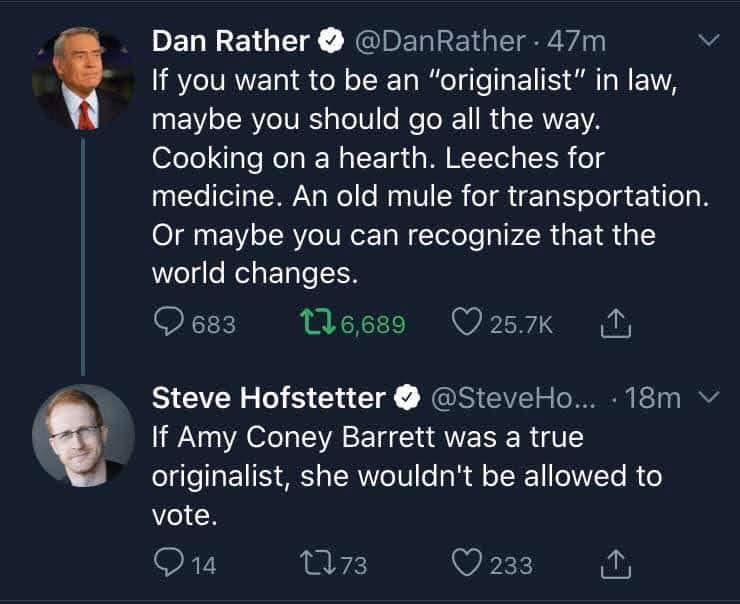
The meme is a screenshot of a Twitter conversation between two users, Dan Rather and Steve Hufstedt, where they engage in a humorous exchange about the definition of "originalist" in the context of the Supreme Court's interpretation of the Constitution. The conversation starts with Dan Rather's tweet, where he jokingly defines "originalist" as someone who cooks on a hearth, uses leeches for medicine, and rides an old mule for transportation. Steve Hufstedt responds with a witty remark about the definition of an "originalist" being someone who doesn't get to vote.
detailed-analysis (gemma3-27b-vision)
Okay, here's an analysis of the provided Twitter exchange, broken down into sections addressing the requested theoretical lenses. It's worth noting that fitting complex theoretical frameworks to a short social media exchange requires interpretation and focusing on key aspects.
Visual Description
The image shows two Twitter posts.
- Dan Rather's Post: Features a headshot of Dan Rather in a suit and tie, next to a text post. The text contains a rhetorical challenge to those who claim to be "originalists" in law. He presents a series of archaic practices (cooking on a hearth, using leeches, riding a mule) as examples of things that have changed over time, implying that legal interpretation should also evolve. The post has a high number of retweets, likes, and comments.
- Steve Hofstetter's Post: Includes a headshot of Steve Hofstetter and a declarative statement claiming that Amy Coney Barrett, if a true originalist, would be ineligible to vote. The post has a low number of retweets, likes, and comments.
Both posts are visually structured as typical Twitter content with user profile photos and text. The contrast between the high engagement with Rather's post and the low engagement with Hofstetter's post is noticeable.
---
Foucauldian Genealogical Discourse Analysis
This exchange lends itself well to a Foucauldian analysis. Dan Rather's post is precisely a deployment of a genealogy. He’s not arguing about the ‘correct’ legal interpretation, but rather revealing the historical contingency of practices we once considered essential or natural.
- Power/Knowledge: The assertion of "originalism" as a legal philosophy is a claim to knowledge about what the law is. Rather disrupts that claim by demonstrating that “original” conditions are inherently unattainable and subject to change. This is a power play—challenging the authority of originalists by undermining the very foundations of their claim.
- Discourse & Practices: The examples of hearth cooking, leeches, and mules are illustrative of practices that were once normalized and considered essential. Their obsolescence reveals how discourses and practices are historically situated and constantly in flux. The idea of a fixed, “original” meaning of the law is presented as equally susceptible to change.
- Archaeology/Genealogy: Rather’s post isn’t just about history (archaeology), but about how those historical changes came about, the power relations embedded within them, and the effects of those changes on the present. He is suggesting that law, like these practices, is shaped by power, contingency, and a continuous process of alteration.
---
Critical Theory
The exchange demonstrates a clash between two different approaches to law and societal change.
- Ideology Critique: Originalism, as presented, can be seen as an ideology that seeks to legitimize existing power structures by appealing to a supposedly fixed and timeless past. Rather's post critiques this ideology by exposing its inherent contradictions.
- Domination & Emancipation: The conflict is essentially about who controls the interpretation of the law. Originalists seek to maintain a particular order, while Rather implicitly advocates for a more flexible, adaptable, and ultimately emancipatory approach that acknowledges the need for change.
- Reason & Enlightenment: While seemingly abstract, the debate touches on the Enlightenment ideals of reason and progress. The idea that the law should evolve with society is rooted in the belief that human reason can guide us towards a better future. Originalism, by contrast, appears to deny the possibility of genuine progress.
---
Marxist Conflict Theory
While the exchange isn't explicitly about class conflict, a Marxist reading can identify underlying power struggles.
- Superstructure & Base: The legal system is part of the superstructure—the institutions and ideologies that maintain the base (the economic relations) of society. Originalism can be seen as a tool used by those in power to protect their interests by upholding existing social and economic arrangements.
- Hegemony: The idea of a fixed, “original” meaning of the law is a form of ideological hegemony—a dominant worldview that is accepted as natural and inevitable. Rather's post challenges this hegemony by exposing the historical contingency of legal interpretation.
- Class interests: Those who champion originalism could be seen as representing the interests of dominant groups who benefit from maintaining the status quo. Those who advocate for a more flexible approach to the law might be seen as representing the interests of marginalized groups who seek to challenge the existing power structure.
---
Postmodernism
A postmodern reading emphasizes the instability of meaning and the rejection of grand narratives.
- Deconstruction: Rather’s post implicitly deconstructs the idea of a fixed, “original” meaning of the law. He demonstrates that meaning is not inherent in the text but is constructed through historical and social processes.
- Rejection of Metanarratives: Originalism can be seen as a metanarrative—a grand story that attempts to provide a universal and timeless explanation of the law. Postmodernism rejects such metanarratives in favor of a more fragmented and localized understanding of reality.
- Relativism & Plurality: Postmodernism embraces relativism and plurality, recognizing that there are multiple valid interpretations of the law. Rather's post suggests that the law should be open to change and adaptation, rather than being rigidly bound by the past.
Important Note: These are just interpretations. The complexity of these theoretical frameworks makes it difficult to provide a definitive analysis of a short social media exchange. The specific lens you choose will shape your understanding of the conflict.
simple-description (llama3.2-vision)
This meme is a Twitter exchange between two users, Dan Rather and Steve Hofstetter. Dan Rather starts with a humorous anecdote about wanting to be an "originalist" in law, but instead of cooking on a hearth, he wants to be an "originalist" in law and cook on a hearth, but also wants to cook on a hearth and have a mule for transportation, and an old mule for transportation, and an old mule for transportation. Steve Hofstetter responds with a joke about Amy Coney Barrett not being able to vote.
tesseract-ocr
5 Dan Rather @ @DanRather - 47m 4 If you want to be an “originalist” in law, maybe you should go all the way. Cooking on a hearth. Leeches for medicine. An old mule for transportation. Or maybe you can recognize that the world changes. © 683 Tlesso O257K {ty Steve Hofstetter @ @SteveHo... -18m v J lf Amy Coney Barrett was a true originalist, she wouldn't be allowed to vote. Orr (ae © 233 iy