First Seen
2025-10-11T01:41:30.881731+00:00
simple-description (qwen3.5_2b-q8_0)
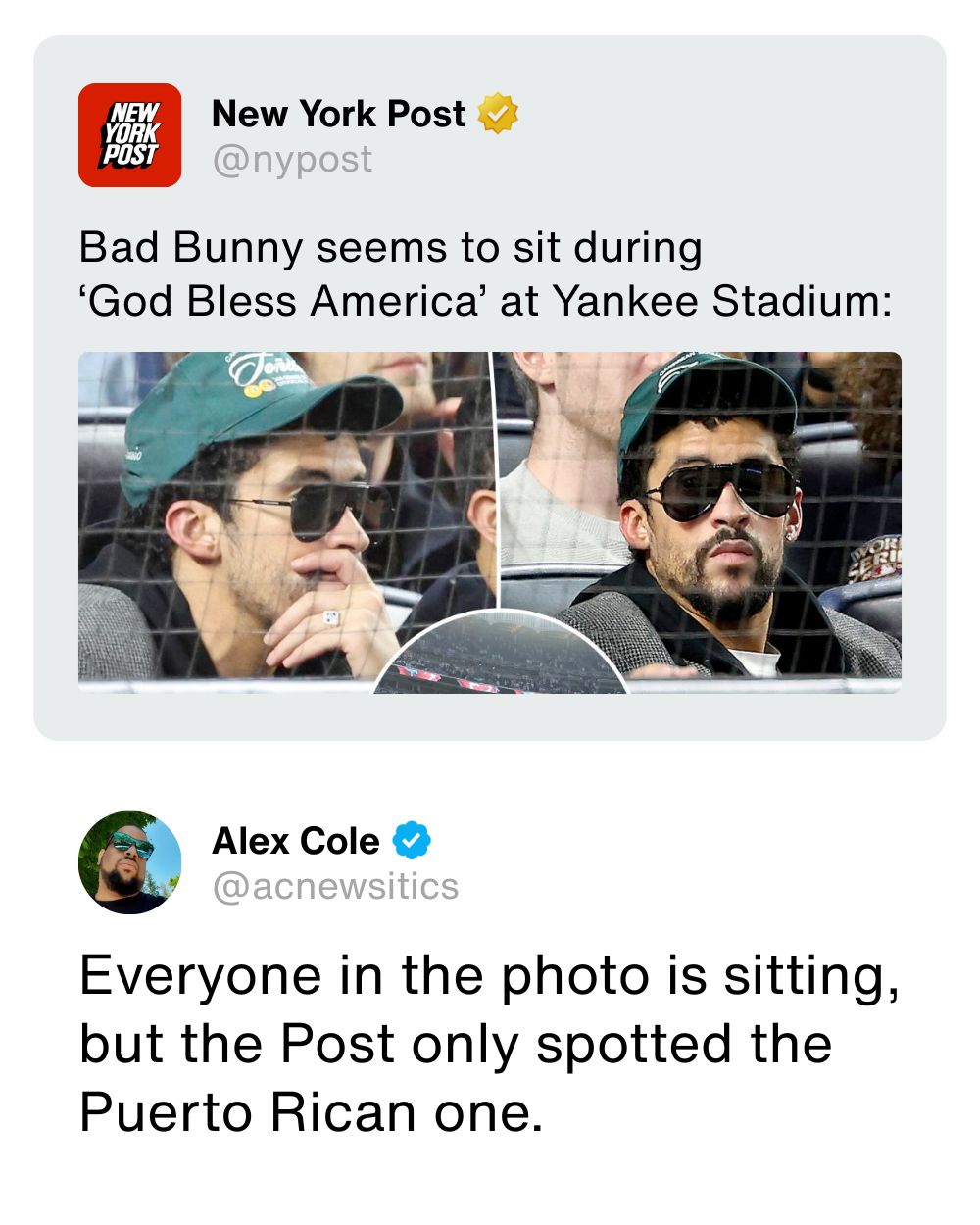
This anti-racist meme uses a photo of rapper Jay-Z wearing a baseball cap and sunglasses at Yankee Stadium to satirize racial dynamics and entitlement. It shows him looking "God Bless America" (while text says he wants to see it), implying that because he is white, he missed the actual diversity of the crowd while others were sitting with Puerto Rican neighbors. In response, another user notes that while everyone in the photo is sitting, the Post only focused on Jay-Z—suggesting a sense of superiority where white figures ignore their surroundings and racial groups present.
detailed-analysis (gemma3_27b-it-q8_0)
Here's an analysis of the meme through the lens of Anti-Racism, broken down into relevant sections.
Visual Description
The meme consists of a tweet from the New York Post reporting that Bad Bunny “seems to sit” during a performance of “God Bless America” at Yankee Stadium. The accompanying image shows Bad Bunny seated while others around him are also seated. A reply from Alex Cole points out the obvious: everyone in the image is sitting, but the Post only highlighted Bad Bunny, who is Puerto Rican. This contrast is crucial to understanding the meme’s critical message.
Critical Theory
This meme functions as a critique of the mechanisms by which dominant ideologies (in this case, American nationalism) are maintained and reinforced through selective representation and “othering.” Critical Theory, particularly stemming from the Frankfurt School, examines how seemingly neutral representations can perpetuate power imbalances. The Post’s framing isn’t a neutral observation; it selectively focuses on Bad Bunny to imply a lack of patriotism or respect.
The meme calls attention to the fact that 'patriotism' is a performance, and that the performative display of standing during a patriotic song is often linked to notions of "true Americanism." Bad Bunny, as a Puerto Rican artist who has publicly engaged with issues of colonialism and Puerto Rican identity, is positioned as an "outsider" whose actions are scrutinized because of his identity. The meme's point isn't that Bad Bunny should have stood, but that his sitting is being singled out and used to implicitly suggest a deficiency in his American identity.
Postmodernism
The meme engages with postmodern themes of deconstruction and the questioning of grand narratives. It dismantles the supposedly objective "reporting" of the New York Post, revealing it as a subjective construction serving a particular agenda. The meme highlights the arbitrariness of the Post's focus, indicating that “truth” isn't simply “what happened” but how it’s presented and who is highlighted.
The implication is that the idea of “American” identity is not fixed but is socially constructed and selectively applied. Bad Bunny's refusal to perform the expected patriotic gesture disrupts this constructed identity, revealing its fragility and the underlying power dynamics at play.
Foucauldian Genealogical Discourse Analysis
Using a Foucauldian lens, we can analyze how the discourse surrounding “patriotism” has been historically constructed. Michel Foucault argued that power operates not just through repression but through the production of knowledge and discourse. The meme points out how the discourse of “God Bless America” and the expectation of standing during its performance are not neutral expressions of national pride but are tied to specific historical power relations.
The Post’s framing taps into existing discourses about national belonging and who is considered a “true American.” By singling out Bad Bunny, the Post’s discourse reinforces an implicit norm: to be American is to perform patriotism in a specific way. The meme challenges this discourse by exposing its constructed nature and the power dynamics embedded within it. It reveals the “genealogy” of this expectation, tracing it back to historical mechanisms of inclusion and exclusion based on identity.
In relation to Anti-Racism
The central point here is how racial bias can manifest in seemingly innocuous observations. The meme underscores the concept of “racial double standard,” where people of color are held to different standards than white individuals. While everyone was sitting, the Post fixated on the Puerto Rican artist, implicitly suggesting that his behavior was noteworthy (and potentially problematic) because of his ethnicity.
This demonstrates a form of subtle racism, where difference is highlighted and interpreted negatively through the lens of dominant cultural norms. The meme is a powerful commentary on the ways racial biases can shape perceptions and media narratives, even in situations where the "evidence" is neutral.
In summary: The meme effectively utilizes irony to expose the ways in which racial bias and nationalist ideologies can be subtly reinforced through media representation. It serves as a critical intervention, prompting viewers to question the narratives presented by mainstream media and to consider the underlying power dynamics at play.
simple-description (llama3.2-vision_11b)
The meme is a satirical commentary on the lack of diversity in media representation. It uses a photo of the New York Post's front page, which is actually a photo of the New York Post's own newsroom, with a headline that says "I don't see any diversity in this photo". The joke is that the photo is actually a photo of the New York Post's own newsroom, which is a commentary on the lack of diversity in the media industry.