First Seen
2023-05-10T21:03:34+00:00
simple-description (llama3.2-vision_11b)
The meme is a commentary on the hypocrisy of using the phrase "I'm just here for the music" (a phrase often used to excuse one's presence at a protest) to justify not participating in an anti-racism protest. The image is a screenshot of a Bible passage (Matthew 24:35) with the phrase "I'm just here for the music" inserted, implying that Jesus would not use such a phrase to justify his absence at an anti-racism protest.
detailed-analysis (gemma3-27b-vision)
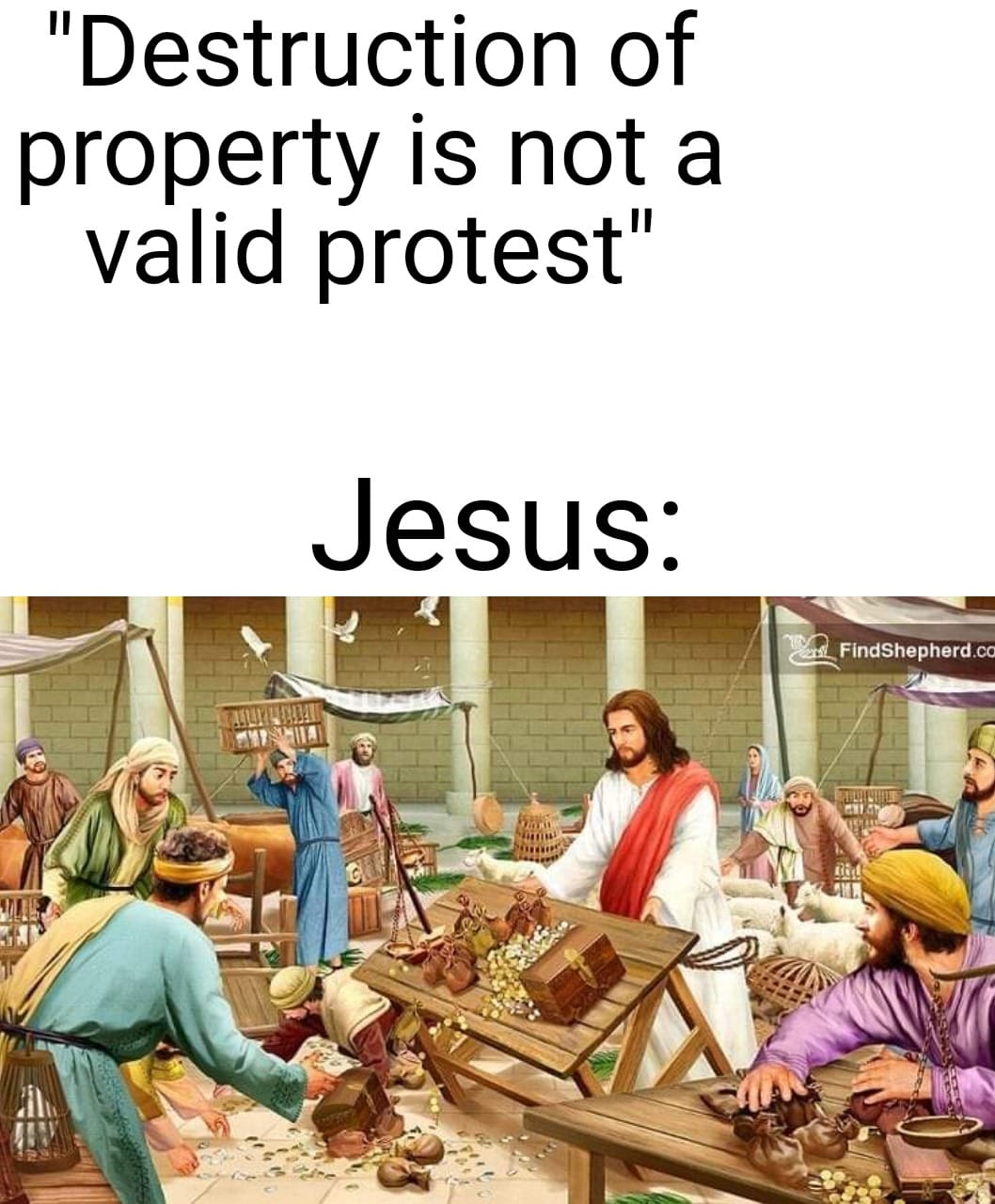
Okay, let's break down this meme – a juxtaposition of the phrase "Destruction of property is not valid protest" and a depiction of Jesus overturning the tables in the Temple – through several critical theory lenses. It's important to note the meme's inherent critique is aiming at contemporary policing and labeling of protest.
Visual Description
The image is a colorful illustration depicting a scene from the New Testament where Jesus enters the Temple and overthrows the tables of the money changers. The scene is crowded, with figures representing various onlookers and those involved in the commercial activity within the temple. Jesus is prominently displayed in a red robe, actively overturning a table. The backdrop suggests a bustling market scene within the courtyard of the temple. The "FindShepherd.com" watermark is overlaid on the top right of the image. The text above the image states, "Destruction of property is not valid protest," creating a clear ironic and challenging relationship with the depicted scene.
Foucauldian Genealogical Discourse Analysis
This meme can be read through a Foucauldian lens as a challenge to the discourse surrounding protest and what constitutes "legitimate" resistance. Foucault argues power operates not just through repression, but through the production of knowledge and normalization.
- Power/Knowledge: The phrase "Destruction of property is not valid protest" is itself an exercise of power. It defines what counts as valid protest, implicitly shaping the boundaries of acceptable political expression. This definition isn't neutral; it reflects the interests of those in power who benefit from maintaining the status quo.
- Genealogy: The historical genealogy of this discourse reveals how the definition of "legitimate" protest has been constructed. Historically, those in power have consistently delegitimized forms of resistance that threaten their control, often framing them as "criminal" or "destructive." The meme juxtaposes this modern claim with a scene from early Christianity, implying a continuity in the power dynamics.
- Discipline: The statement functions as a disciplinary measure, aiming to control and confine protest within acceptable limits. By declaring certain actions invalid, it discourages individuals from engaging in more disruptive or challenging forms of resistance.
Critical Theory
A critical theory reading sees the meme as exposing the inherent contradictions within systems of power.
- Ideology: The statement "Destruction of property is not valid protest" functions as an ideological justification for maintaining the status quo. It disguises the underlying power dynamics and presents the protection of property as a neutral principle, rather than a way to uphold existing hierarchies.
- Hegemony: The phrase taps into hegemonic norms - the prevailing assumptions about what is acceptable and normal. It assumes that property rights are inviolable and that any disruption to the market system is inherently illegitimate.
- Emancipation: The meme implicitly critiques these norms and opens space for alternative forms of resistance. By juxtaposing the statement with the image of Jesus, it suggests that sometimes, challenging the established order requires disrupting the system, even if it means breaking with conventional norms.
Marxist Conflict Theory
From a Marxist perspective, the meme highlights the class-based nature of property rights and the suppression of rebellion.
- Class Conflict: The concept of "property" is fundamentally linked to class relations. The protection of property primarily benefits those who own it – the ruling class – while denying marginalized groups access to resources and power.
- Revolution: The image of Jesus overturning the tables can be seen as an act of resistance against the exploitative practices of the temple authorities, who were essentially profiting from religious piety. From this perspective, the meme suggests that sometimes, radical disruption is necessary to challenge systems of oppression.
- False Consciousness: The statement "Destruction of property is not valid protest" can be interpreted as an attempt to instill false consciousness among the oppressed, discouraging them from challenging the existing power structure.
Postmodernism
A postmodern reading might focus on the deconstruction of meaning and the challenge to grand narratives.
- Deconstruction: The meme deconstructs the idea of a neutral or objective definition of "valid protest." It reveals how such definitions are always constructed, contingent, and tied to specific power relations.
- Relativism: It implies that what counts as valid protest is relative to one's perspective and social location. What may be considered "destructive" by those in power may be seen as a legitimate form of resistance by those who are oppressed.
- Anti-Foundationalism: The meme challenges the idea that there is a fixed or universal standard for judging protest. It suggests that we need to be critical of all such standards and recognize the validity of multiple forms of resistance.
Queer Feminist Intersectional Analysis
This lens examines the meme through the intersection of gender, sexuality, class, and other forms of oppression.
- Disruption of Norms: Both Jesus’s actions and challenging the statement “Destruction of property is not valid protest” disrupt normative expectations about acceptable behavior, particularly for those marginalized by society.
- Challenging Power Structures: The meme implicitly challenges the power structures that reinforce systemic inequalities, such as those that privilege property rights over the needs of marginalized communities.
- Solidarity: While this reading may not be directly apparent in the image, the meme could be seen as a call for solidarity among all those who are fighting against oppression, regardless of their backgrounds or identities.
In conclusion, the meme is a complex and multifaceted statement that can be interpreted in multiple ways depending on the critical lens used. It's a powerful challenge to the dominant narratives about protest and a call for a more nuanced understanding of resistance.
simple-description (llama3.2-vision)
This meme is a humorous commentary on the Bible's account of Jesus Christ's teachings. The image depicts a scene from the Bible, but with a modern twist: Jesus is standing in the middle of a chaotic market, surrounded by people throwing money and goods. The text above the image reads: "Destruction of property is not a valid protest."
tesseract-ocr
"Destruction of property is nota valid protest’ Jesus: | Za | \ | Pe | ese oe ee te Mb on TBNES <A eae lee ae