First Seen
2026-03-19T21:25:16+00:00
simple-description (qwen3.5_2b-q8_0)
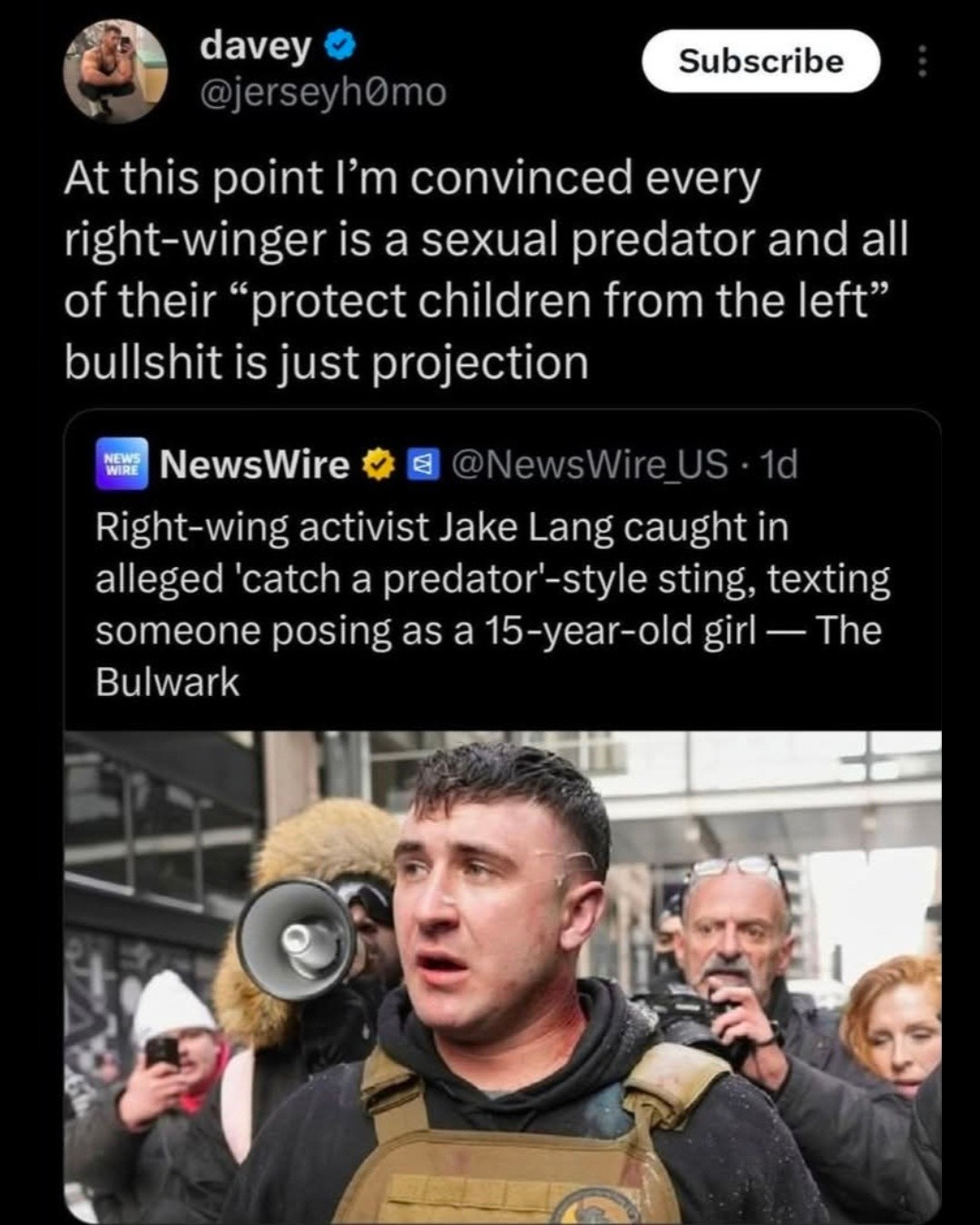
This meme plays on a headline that accused right-wing activist Jake Lang of texting someone posing as a 15-year-old girl to trick her into "catching a predator." It cuts away from this story to show Lang surrounded by media, implying he was caught doing it himself or is just another one of the "predators" being attacked. This fits the "Anti-Pedo" context because it takes down a conservative activist and accuses them of using religious superstitious methods ("The Bulwark") while claiming those same people are trying to catch predators like themselves, effectively ridiculing the very people they claim to be fighting for.
detailed-analysis (gemma3_27b-it-q8_0)
Okay, let's break down this meme within the "Anti-Pedo" category context, utilizing the requested analytical frameworks where relevant. It's a complex and highly charged piece, so a nuanced approach is necessary.
Important Disclaimer: This analysis is for academic purposes and to fulfill the prompt's requirements. It does not endorse or validate any of the claims made in the meme. The claims are inflammatory and require careful consideration. The fact that this falls under the "Anti-Pedo" category adds a layer of sensitivity.
---
Visual Description
The image shows Jake Lang, identified as a "right-wing activist," being detained by law enforcement. He is wearing tactical gear (vest, what appears to be a head-mounted camera), suggesting a self-presentation as someone prepared for confrontation or investigative work. He has a visible, somewhat distressed expression. In the background, blurred figures (including what appears to be a young woman) and police are present. The overall impression is one of arrest and public exposure. The text accompanying the image reports he was caught in a "predator-style sting," allegedly texting someone he believed to be a 15-year-old girl. The top part of the image shows a tweet from "@jerseyhomo" claiming every right-winger is a sexual predator and all their ‘protect the children’ talk is projection.
---
Foucauldian Genealogical Discourse Analysis
From a Foucauldian perspective, this meme highlights the construction of discourses around sexuality, morality, and power.
- Discourse of "The Predator": The image immediately activates the powerful, culturally ingrained discourse of the "sexual predator." This discourse, developed through legal, medical, and media practices, defines and categorizes certain behaviors as deviant and dangerous. The meme leverages that discourse to demonize an entire political group ("right-wingers") by suggesting they all embody this predatory archetype.
- Power/Knowledge: Foucault argued that power and knowledge are inextricably linked. The act of labeling someone a "predator" (through legal process, media coverage, or meme-sharing) is an exercise of power enabled by a specific body of knowledge about what constitutes predatory behavior. This meme seeks to extend that power/knowledge framework to apply to an entire political ideology.
- Genealogy of Morality: We can trace the genealogy of the "protect the children" rhetoric. Historically, claims about protecting children have often been used to justify broader social control and moral regulation. The meme inverts this by suggesting that this rhetoric is not genuine concern but a masking of darker impulses—a projection. This implies a history of hidden, potentially harmful desires.
---
Critical Theory
Critical theory focuses on how power structures create and maintain dominance. The meme operates within this framework by:
- Demonizing the "Other": The "right-wing" is cast as the "Other" – a group to be feared and distrusted. The accusation of being a "predator" is a particularly potent form of othering, as it taps into deep-seated societal anxieties about harm to children.
- Ideological Critique: The meme attempts to expose the perceived hypocrisy of the right-wing's moral stance. By claiming their "protect the children" rhetoric is mere "projection," it suggests that their public morality is a façade masking their true, predatory nature.
- Culture Industry: In the context of the internet and social media, memes can be seen as part of the "culture industry"—a system that mass-produces and disseminates cultural products (like this meme) that reinforce existing power structures or challenge them. This meme contributes to a highly polarized cultural climate.
---
Marxist Conflict Theory
While less directly applicable than other frameworks, we can see elements of conflict theory at play:
- Class Struggle (Broadly Defined): The political divide between "right-wingers" and those who share the meme's sentiment can be interpreted as a form of social conflict. The accusation of predation is a weaponization of morality used to attack and delegitimize the opposing side.
- False Consciousness: The meme suggests that "right-wingers" are operating under "false consciousness" – they are unaware of their own "true" (predatory) nature, and their moral pronouncements are a delusion.
- Ideology as Justification: The "protect the children" rhetoric can be seen as an ideology used to justify and maintain existing social inequalities.
---
Postmodernism
Postmodernism questions grand narratives and emphasizes subjectivity.
- Deconstruction of Morality: The meme attempts to deconstruct the moral authority of the right-wing by questioning the sincerity of their claims. It suggests there is no inherent goodness or truth in their rhetoric.
- Relativism: It hints at a relativistic view of morality, suggesting that all morality is simply a projection of hidden desires.
- Simulacra and Simulation: One could argue the "protect the children" rhetoric has become a simulacrum – a copy without an original, a performance divorced from genuine concern. The meme accuses the right-wing of engaging in this simulation.
---
Queer Feminist Intersectional Analysis
This is relevant due to the author’s identity and the potential for layered exploitation.
- Sexual Violence and Power: The accusation of predation is fundamentally tied to issues of sexual violence and the abuse of power. Queer feminist theory emphasizes the interconnectedness of these issues and the ways in which social structures enable and perpetuate violence.
- Intersectionality: The meme doesn’t explicitly address intersectionality, but it’s important to note that the impact of these accusations will vary depending on factors like race, class, and gender.
- Critique of Heteronormativity: The author’s identity as someone with “homo” in their handle potentially indicates a critique of heteronormative power structures that have historically been used to suppress LGBTQ+ individuals. The meme may be a form of reclaiming power by challenging the moral authority of a group perceived as hostile to LGBTQ+ rights.
---
Conclusion:
This meme is a highly charged piece of political communication. It leverages fears about sexual predation to attack and demonize a political group, using multiple analytical frameworks. It's a clear example of how anxieties about morality, power, and identity can be exploited in online discourse. It is vital to view it critically, understanding the potential for bias, misinformation, and the devastating impact of false accusations.
**Again, it is important to emphasize that this is an analysis of the meme within the given framework and does not constitute an endorsement of its claims.**
simple-description (llama3.2-vision_11b)
The meme is a tweet from Davey, a right-wing activist, who claims that every right-winger is a sexual predator and that all of their "protect children from the left" bull … [See the rest at: https://www.theskeptic.com/2023/02/28/meme-of-the-week-anti-pedos-…]