First Seen
2025-06-29T04:07:31+00:00
detailed-analysis (gemma3_27b-it-q8_0)
Okay, let's break down this meme – “YOUR LACK OF EMPATHY IS NOT A FLEX” – through the lens of an "Anti-Oligarch" category, employing the relevant theoretical frameworks where applicable.
Visual Description
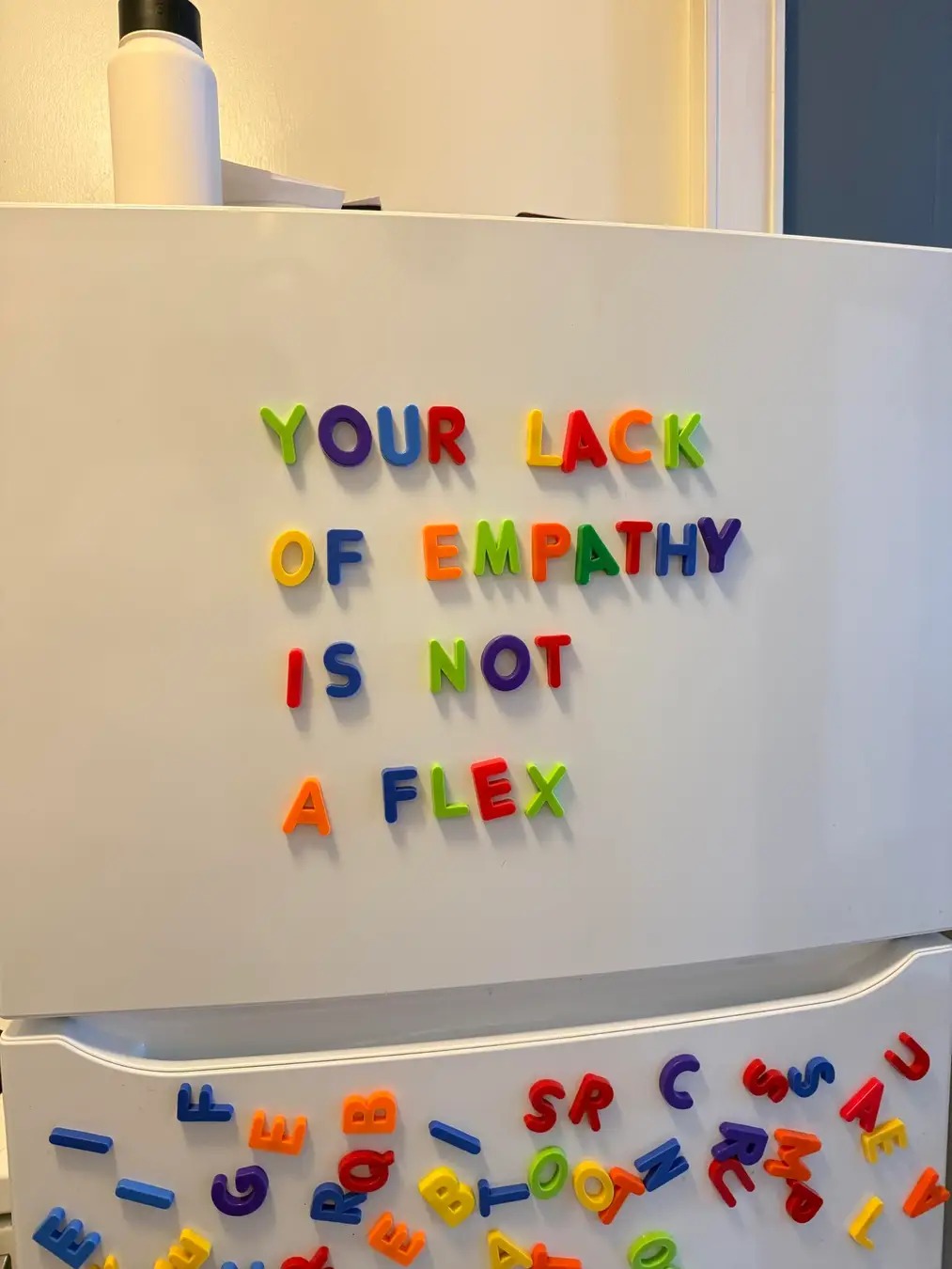
The image is a close-up of a white refrigerator door. The message, "YOUR LACK OF EMPATHY IS NOT A FLEX," is spelled out using colorful, children's magnetic letters. Below the message, more unused letters spill onto the door, suggesting creative potential and an environment of playful resistance. The overall aesthetic is homemade, informal, and purposefully not polished or professional. A bottle is on top of the fridge. The letters are arranged in a relatively straightforward manner, making the message immediately accessible. This simplicity is key; it's a direct message.
Critical Theory
From the anti-oligarch perspective, this meme directly challenges a core tenet of the ruling class – the belief that power entitles one to a lack of concern for others. Critical Theory examines how power structures create and maintain dominance. Oligarchs, by definition, operate within these structures. The "flex" itself embodies a demonstration of power, a flaunting of status. The meme asserts that this flaunting only exists through a disconnect from the lived realities of those without such power, and to celebrate that disconnect is a moral failure.
The meme taps into the idea, central to Critical Theory, that dominant ideologies often normalize practices that are fundamentally unjust. The expectation that those with wealth and power won't need to show empathy is a prime example. This meme is a direct confrontation of this normalization. It refuses to accept callousness as simply a characteristic of success.
Marxist Conflict Theory
Within a Marxist framework, the meme speaks to class consciousness and the inherent conflict between the bourgeoisie (the oligarchs) and the proletariat (the working class). Empathy, in this context, is not merely a feeling but a vital component of class solidarity. An oligarch's “lack of empathy” is a direct result of their position within the capitalist system—their vested interest in maintaining the status quo that exploits the proletariat.
The "flex" represents the overt display of capitalist accumulation, a reminder of the imbalance of power. By calling it not a flex, the meme delegitimizes that display, suggesting it’s built on a foundation of exploitation and social detachment. It highlights the alienation inherent in capitalist structures. The fact that the message is constructed from childlike letters is potent: it suggests that even basic moral understanding is being challenged by those in power.
Postmodernism
While not overtly reliant on Postmodernist tropes, there's a subtle deconstruction happening here. Postmodernism often questions grand narratives and challenges the assumption of universal truths. The meme doesn't argue why empathy is important; it simply asserts that the lack of it isn’t something to be proud of.
The use of informal, everyday materials (magnetic letters) also subtly undermines the authority of traditional communication channels. It's a message created "from below," bypassing the carefully constructed narratives of the oligarchic elite. The playful, slightly amateur aesthetic is a form of resistance, rejecting the polished, sophisticated image cultivated by those in power.
Queer Feminist Intersectional Analysis
This analysis is potentially applicable, though requires a little more inference. An anti-oligarch stance frequently intersects with Queer and Feminist critiques of power because oligarchic systems often reinforce existing oppressions.
Empathy is crucial for recognizing the complexities of lived experience, particularly for marginalized groups. Oligarchs – and their ideology – often actively deny or dismiss the experiences of those who are not privileged (racial minorities, gender non-conforming individuals, etc.). A “lack of empathy” is thus not just a personal failing but a weapon used to maintain hierarchical power structures. The ‘flex’ then becomes a signal of privilege, refusing to acknowledge the systemic barriers faced by others.
Overall:
From an Anti-Oligarch perspective, this meme is a sharp, concise critique of the mindset that enables and perpetuates vast wealth inequality and social injustice. It’s a rejection of the entitlement and detachment that characterize the ruling class, and a call for basic human decency. Its simplicity and accessibility amplify its power, making it easily shareable and adaptable within movements for social change. The use of childlike letters emphasizes the absurdity of needing to state the obvious – that empathy is a good thing.
Let me know if you'd like any of these sections expanded or if you'd like me to explore a different angle!
simple-description (llama3.2-vision_11b)
The meme is a play on the phrase "your lack of empathy is not a superpower" from the Marvel movie "The Avengers," but with a humorous twist. The image shows a fridge with magnets spelling out the phrase "your lack of empathy is not a superpower, but your lack of empathy is not a flex" in a playful, childlike font.
detailed-analysis (gemma3-27b-vision)
Okay, let's break down this image with the requested theoretical frameworks.
Visual Description
The image shows a white refrigerator door covered with magnetic letters. The letters are arranged to spell out the phrase "YOUR LACK OF EMPATHY IS NOT A FLEX." The letters are a variety of bright colors – yellow, orange, blue, green, red, etc. – and appear to be from a child's alphabet learning set. Below this message, a jumble of unused letters is scattered across the lower portion of the refrigerator door. The letters are seemingly haphazardly placed, highlighting the contrast between the deliberate message above and the random scattering below. The fridge itself appears to be a standard appliance within what seems to be a domestic interior, though little of the surrounding environment is visible.
---
Foucauldian Genealogical Discourse Analysis
This seemingly simple message reveals power dynamics through discourse. The statement doesn’t just say something is wrong; it defines a behavior (“lack of empathy”) as problematic and further redefines another behavior (“a flex”) as undesirable when paired with it.
- Discourse & Power: The message participates in a discourse around emotional intelligence and social responsibility. It implies a normative understanding of how one should behave – empathy is good, self-aggrandizement without regard for others is bad. This isn't simply a statement of personal opinion, but rather an enactment of these norms.
- Genealogy of "Flex": Tracing the history of the term “flex” is important. It’s moved from slang for showing off one’s physical prowess (muscle flexing) to a broader display of status or achievement, often performative and online-driven. The message reclaims this term and denigrates it, stripping it of its positive connotations when linked to a lack of empathy. This reveals the power to define and reshape language.
- Disciplinary Power: The message isn’t a direct command, but a subtle form of discipline. It doesn’t punish the lack of empathy directly, but defines it as something undesirable, inviting self-regulation (or, potentially, shame/guilt).
- Subject Formation: This message contributes to the formation of subjects who internalize these norms of emotional intelligence and perceive a lack of empathy as a flaw.
---
Critical Theory
The message lends itself well to a Critical Theory reading, particularly around the critique of ideology and social control.
- Ideology & False Consciousness: The message, while seemingly a straightforward moral statement, reflects an underlying ideology of "emotional labor" and "authenticity." Contemporary society often demands displays of empathy and emotional intelligence. The message subtly reinforces this expectation, potentially masking power imbalances and obscuring structural causes of unempathetic behavior. Someone lacking empathy may not be inherently "bad," but a product of a system that prioritizes individual success over collective well-being.
- Dominant Narratives: The message participates in a dominant narrative that frames empathy as intrinsically good and self-promotion as inherently negative. This narrative can be used to silence critique and maintain existing power structures. For instance, someone who openly pursues their own goals might be labeled as lacking empathy, even if their actions aren’t inherently harmful.
- Repressive Tolerance: The message can be seen as a type of "repressive tolerance." While ostensibly promoting a positive value (empathy), it implicitly condemns those who don’t conform, potentially hindering open dialogue and critical examination of the root causes of unempathetic behavior.
---
Queer Feminist Intersectional Analysis
This message opens up interesting avenues for interpretation through a Queer Feminist Intersectional lens.
- Emotional Labor & Gender: Women and gender non-conforming individuals are often socialized to perform more emotional labor than men. This means they’re expected to manage their own emotions and the emotions of others, often at a personal cost. The message implicitly reinforces this expectation. The condemnation of "lack of empathy" could disproportionately target individuals who don’t conform to traditional gender roles regarding emotional expression.
- Intersectionality & Access to Empathy: The ability to express empathy can be influenced by multiple intersecting identities – race, class, disability, etc. Structural inequalities can create barriers to emotional connection. The message might inadvertently pathologize behaviors that are survival mechanisms for individuals facing systemic oppression.
- Subversion of "Flex" Culture: The reclamation of "flex" is potentially empowering. Historically, displays of dominance (“flexing”) have been linked to patriarchal power structures. Re-framing this term in relation to a lack of empathy disrupts that connection. It suggests that true strength isn’t about self-promotion, but about emotional connection.
- Queering Empathy: The expectation of empathy can be restrictive. Queer theory often challenges norms and embraces ambiguity. A queer approach to empathy might emphasize a refusal of forced emotional connection or a questioning of what constitutes "appropriate" emotional response.
I hope this breakdown provides a nuanced and comprehensive analysis of the image through these different theoretical frameworks! Let me know if you would like me to elaborate on any of these points.
simple-description (llama3.2-vision)
This meme is a humorous take on the concept of empathy. The image shows a refrigerator with a message written in letter magnets: "Your lack of empathy is not a flex." This phrase is a play on the idea that someone's lack of empathy is not something to be proud of or something that should be celebrated. It's a satirical commentary on how people sometimes use their lack of empathy as an excuse or an explanation for their behavior. The image is meant to be humorous and relatable, and it’s meant to be understood as a commentary on the state of society.