First Seen
2025-04-25T19:02:57.900666+00:00
detailed-analysis (gemma3_27b-it-q8_0)
Okay, let's break down this meme through the lens of an "Anti-Oligarch" category. This meme fundamentally targets the illusion of power and authority concentrated in the hands of the wealthy elite, and specifically, a particular expression of that power via Trump.
Visual Description
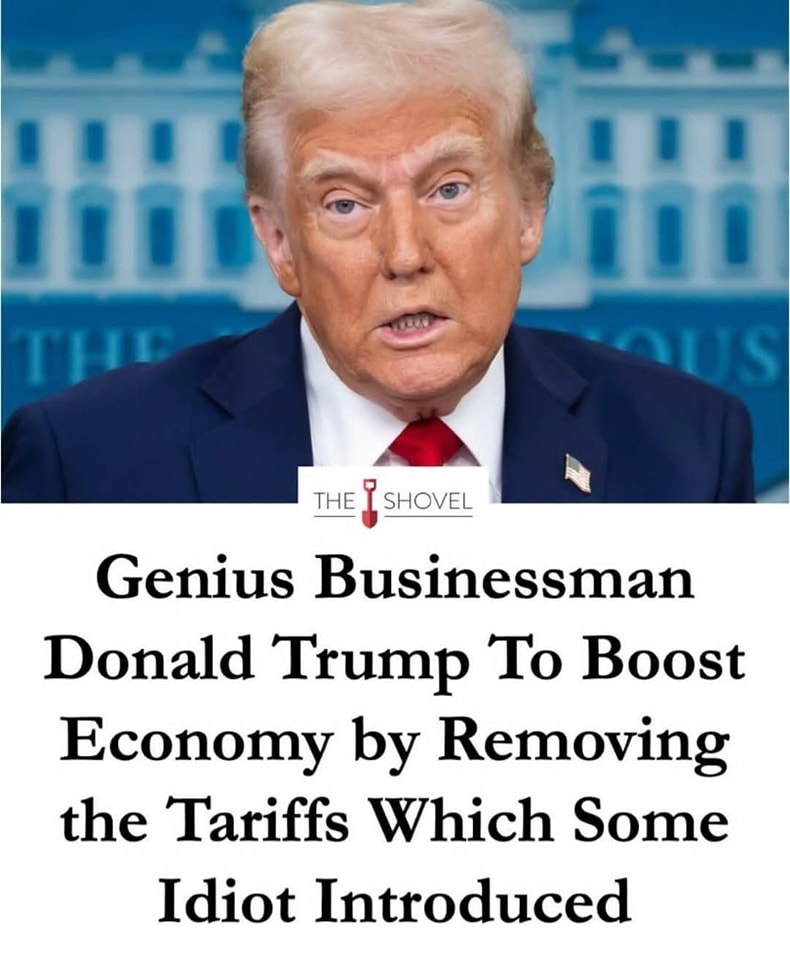
The meme presents a close-up photograph of Donald Trump, seemingly mid-sentence, with a stern expression. He is wearing a dark suit with an American flag pin. The background is blurred, depicting the White House. The key element is the text overlay: "Genius Businessman Donald Trump To Boost Economy by Removing the Tariffs Which Some Idiot Introduced." The logo of "The Shovel" is displayed, a satirical news outlet. The deliberate framing and use of a formal portrait style, juxtaposed with the satirical text, contribute to the ironic and critical effect.
Foucauldian Genealogical Discourse Analysis
From a Foucauldian perspective, the meme is interesting because it deconstructs the discourse around “business acumen” and “leadership.” For decades, dominant discourses have constructed ‘the businessman’ as a symbol of rationality, competence, and economic prosperity. This meme doesn't deny Trump's claimed role as a “businessman,” but it radically downgrades its authority. The term "genius" is presented ironically.
The phrase “Some Idiot Introduced” is particularly important. It doesn't name who that idiot is, but implies it was someone equally positioned within the same power structure. This is important as it does not point blame at an ‘outside’ actor, but keeps it firmly within the realm of elite decision-making. The meme exposes the arbitrariness of such decisions. Who decides what policies are “good” and “bad” and the constant shifts in policy reveal the contingent nature of power. The removal of the tariffs itself becomes secondary to the exposure of the power game being played.
Critical Theory
This meme operates as a critique of the “Enlightenment Subject” – the idea that rationality and objective knowledge are the basis of political decision-making. The use of sarcasm attacks the façade of “rationality” surrounding Trump's economic policies. The meme challenges the idea that economic decisions are based on objective criteria, and suggests they are instead driven by the whims of powerful individuals and the need to maintain an image.
It highlights the "instrumental reason" that Critical Theory critiques - reason used simply to achieve a desired outcome (economic boost), without ethical consideration or accountability. The framing suggests the "boost" is less important than who is perceived as being clever enough to make it happen.
Marxist Conflict Theory
This meme speaks directly to the core tenets of Marxist Conflict Theory. The "genius businessman" (Trump) and the “idiot” who introduced the tariffs represent different factions within the ruling class. The conflict is not necessarily a clash of ideologies, but a struggle for control over capital and the means of production.
The tariffs themselves represent tools utilized by the capitalist class to manage market competition and maintain profits. The meme exposes the internal contradictions of capitalism – the need for state intervention (tariffs) to regulate markets, and the subsequent need to reverse those interventions when they become detrimental to specific interests.
Furthermore, the meme subtly implicates the working class, who bear the brunt of economic policies (both tariffs and their removal), while the elite engage in power plays. It highlights the alienation of labor and the systemic inequalities inherent in the capitalist system. The meme's humour comes from exposing how disconnected these power struggles are from the lives of those affected by them.
Postmodernism
From a Postmodern perspective, the meme's effect comes from its deliberate undermining of "grand narratives" – the overarching stories that justify power structures (e.g., "free market capitalism," “American exceptionalism”). The ironic tone and the use of hyperbolic language ("genius," "idiot") deconstruct the authority of these narratives.
The meme suggests that truth is relative and constructed, rather than objective. There is no inherent “right” policy; it is merely a matter of perspective and power. The ambiguity of "Some Idiot" contributes to this, creating a sense of uncertainty and questioning the validity of any definitive explanation.
The meme also utilizes pastiche (mixing styles) through the combination of a formal portrait with satirical text, creating a playful, unsettling effect.
In essence, this meme is a pointed attack on the illusion of competence and authority surrounding those who wield economic and political power. It operates as a satirical indictment of the power structures themselves, and the self-serving nature of their actions. It's a concise example of how humor can be used to expose and challenge oligarchical tendencies.
simple-description (llama3.2-vision_11b)
The meme features a photo of Donald Trump with a caption that implies he's a "genius" businessperson who will "fix" the economy by eliminating tariffs imposed by his predecessors, a clever play on his reputation for being a master of business and a "genius" who will make the economy "great" again. The image is a humorous commentary on Trump's business acumen and his ability to make the economy "great" again.
detailed-analysis (gemma3-27b-vision)
Okay, let's break down this image and its accompanying text through the lenses you've provided. It's a highly charged image with a specific tone, so the analyses will reflect that.
Visual Description
The image presents a close-up of Donald Trump, likely a photograph or screen capture. He is positioned slightly off-center against a blurred background depicting the White House. The lighting is harsh, casting noticeable shadows and emphasizing his facial features. Trump’s expression is serious, with a slight downward turn of the mouth. The image is cropped to focus on his head and upper chest. Above his shoulder and slightly behind him are parts of words from a news outlet. A logo for "The Shovel" is visible in the bottom-left corner. The overall aesthetic feels direct, intended to immediately draw the viewer's attention to Trump.
Foucauldian Genealogical Discourse Analysis
This image and text are deeply intertwined with power/knowledge formations. Foucault would encourage us to explore how this message is constructed to create a specific understanding of economic policy. The framing of Trump as a "Genius Businessman" isn't presented as a neutral statement of fact, but an assertion seeking to produce a belief.
- Discourse: The text establishes a discourse of economic competence where Trump is positioned as the expert capable of "boosting the economy." This relies on pre-existing discourses of business success and leadership, associating Trump with these positive ideals.
- Power Relations: The text’s dismissive labeling of the prior policy maker as an "idiot" is a clear exercise of power. It devalues the opposing viewpoint, attempting to silence dissent. The statement's implication is that the previous policy maker lacked the necessary intelligence or competence, effectively delegitimizing their approach.
- Genealogy: Tracing the genealogy of the term "businessman" reveals a historical association with patriarchy, capitalism, and a specific conception of "success" rooted in accumulation and control. This image draws on that historical baggage.
- Normalization: Framing the removal of tariffs as a solution inherently normalizes a specific economic ideology, potentially ignoring alternative perspectives or the impact of those tariffs on different groups.
Critical Theory
This image aligns strongly with the themes explored in Critical Theory, particularly its focus on ideology and power structures.
- Ideology: The text promotes an ideology that positions capitalist “business acumen” as the primary solution to economic problems. It suggests that economic success is best achieved through the decisions of a powerful, individual leader—in this case, Trump.
- Hegemony: The image attempts to establish (or reinforce) Trump’s hegemonic position—his dominance in shaping public perception. By portraying him as a “genius businessman,” it seeks to gain consent for his policies.
- Critique of Enlightenment Reason: The stark language ("idiot") and the lack of nuanced economic argument arguably reject Enlightenment ideals of rational debate and evidence-based policymaking.
- Mass Culture: The image and text (being from "The Shovel," a satirical source) are also a product of mass culture, and can be understood as critiquing or reinforcing the dominant political narratives through exaggeration and irony.
Marxist Conflict Theory
From a Marxist perspective, this image embodies class struggle and the dominance of the capitalist class.
- Class Bias: The emphasis on “business acumen” inherently favors the interests of the capitalist class. The image portrays economic policy as being best served through the decisions of business leaders, rather than in the interests of workers or other social groups.
- Capitalism and Economic Policy: The removal of tariffs (likely a trade liberalization measure) can be interpreted as a policy designed to maximize profits for corporations, potentially at the expense of domestic workers or industries.
- Ideological State Apparatus: The media (as represented by the outlet the image originates from) functions as an Ideological State Apparatus, reproducing and legitimizing the capitalist system through the promotion of certain narratives and the denigration of others.
- Exploitation: By ignoring potential negative consequences of tariff removal on workers, the image implicitly supports a system of exploitation where labor is seen as a means of production for the benefit of capital.
Postmodernism
Postmodern analysis would focus on the constructed nature of meaning and the blurring of boundaries between truth and fiction.
- Simulacra and Simulation: The image presents a simulation of leadership and competence, rather than genuine expertise. The label "genius businessman" is a signifier that stands in for a complex reality.
- Deconstruction of Authority: The aggressive tone and dismissive language challenge traditional notions of authority. By labeling the previous policy maker an "idiot," the image undermines their credibility.
- Fragmentation and Hyperreality: The image and text contribute to a fragmented and hyperreal media landscape, where truth is increasingly difficult to discern. The satirical intent of the outlet further blurs the line between reality and representation.
- Irony and Pastiche: The satirical nature of “The Shovel” relies on irony and pastiche, borrowing from existing tropes and expectations to create a humorous, yet critical, commentary.
Queer Feminist Intersectional Analysis
This is where the analysis is more indirect, but still relevant:
- Patriarchy and Leadership: The image reinforces the historical association of leadership with masculinity. Trump, as a male figure, embodies the traditional ideal of a strong, decisive leader. This reinforces patriarchal power structures.
- Capitalism and Gender/Sexual Exploitation: While not directly visible in the image, a queer feminist analysis would consider how capitalist economic policies (like tariff removal) can exacerbate existing inequalities based on gender and sexual orientation. Exploitation in the workplace disproportionately impacts marginalized groups.
- Intersectionality of Power: The image highlights the intersection of class, gender, and power. Trump’s position as a wealthy businessman reinforces the dominance of the capitalist class and reinforces patriarchal norms.
- Silence and Erasure: The image’s focus on Trump’s economic prowess implicitly silences the voices of those who may be negatively impacted by his policies, particularly marginalized communities.
- Rejection of "Rationality": The abrasive language ("idiot") potentially rejects the notion of purely "rational" economic policy, leaving space for recognizing the emotional and power-based dimensions of economic decision-making, which often affect marginalized groups disproportionately.
It’s important to remember that these are just interpretations, and the image and text are open to multiple readings. Each theoretical framework provides a different lens through which to understand the underlying power dynamics and ideological messages at play.
simple-description (llama3.2-vision)
This meme is a humorous image of Donald Trump with a caption referencing a fictional article title. The image shows Trump with a surprised expression, and the text "Genius Businessman Donald Trump To Boost Economy by Removing the Tariffs Which Some Idiot Introduced" is displayed in a mock newspaper headline style. The text is likely meant to be humorous and ironic, implying that Trump's actions are not actually boosting the economy, but rather causing it to be worse.