First Seen
2025-04-21T04:16:10.537901+00:00
detailed-analysis (gemma3_27b-it-q8_0)
Okay, let's break down this meme from an "Anti-Oligarch" category perspective, leaning into relevant theoretical frameworks. Here's an analysis organized as requested:
Overall Framing: This meme is deployed within an anti-oligarchic discourse because it implicitly critiques the constructed "authenticity" and performative masculinity of individuals within power structures, specifically those perceived as representatives of wealth and privilege. The reference to "drag" isn’t about gender performance literally; it's a coded way to point to the inherent performance of an identity designed to solidify authority, which the anti-oligarchic perspective challenges.
---
Visual Description
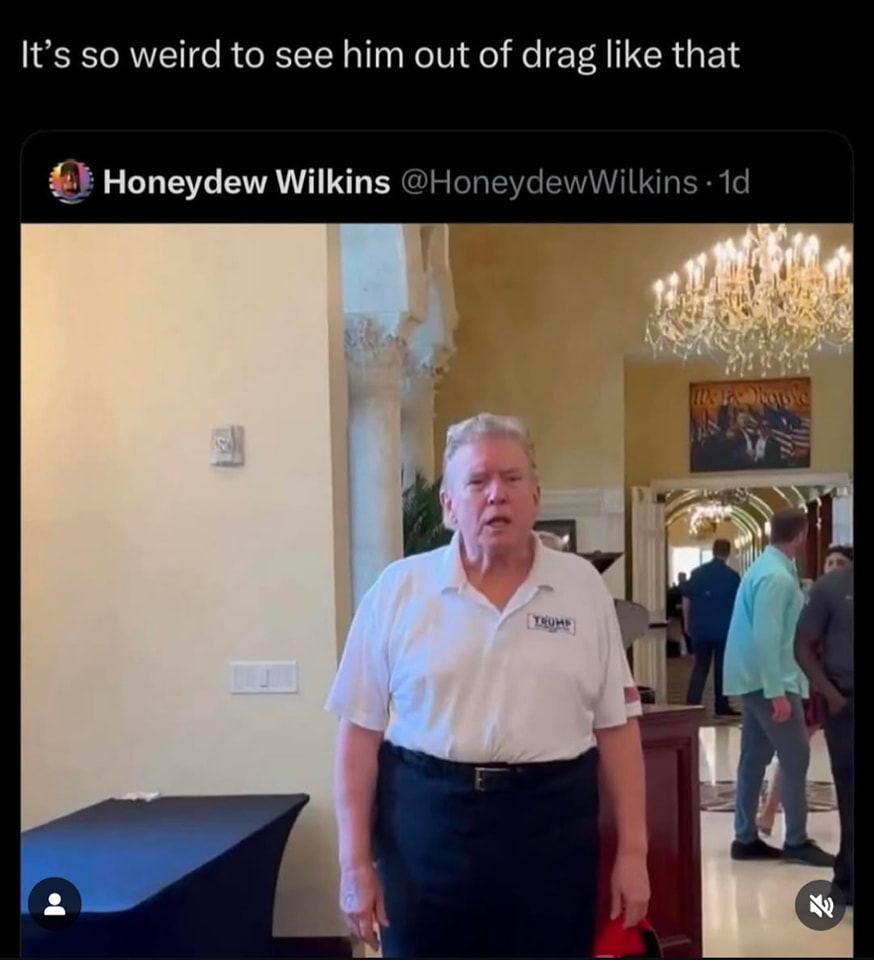
The image features a man, identified as a supporter of Donald Trump, wearing a white polo shirt with “TRUMP” emblazoned on the chest. He is standing in an ornate, opulent interior – likely a hotel lobby or similar space suggestive of wealth. His stance is somewhat awkward, almost defensive. The background contains blurred figures of other people. The lighting and décor suggest a lavish, deliberately crafted environment. The image’s composition draws attention to the man as a figure within a system of wealth and power.
---
Foucauldian Genealogical Discourse Analysis
Foucault’s work is central here. The meme taps into Foucault’s concept of power/knowledge. The man in the image represents a discourse (a system of thought, language, and practice) linked to the Trump brand and the ideology it embodies (nationalism, anti-establishment sentiment often masking pro-wealth agendas, etc.).
The "drag" comment isn't about actual drag; it's about the constructed nature of this man's identity. The polo shirt, the setting, the very posture are all performative elements designed to project a specific image – a "strong," "patriotic," "successful" persona. Foucault would argue that power doesn't simply repress; it produces subjects (like this man) through normalizing discourses.
The meme's humor lies in unmasking this production – showing the fragility and constructedness of that persona. It destabilizes the power dynamic by suggesting the identity is a “costume,” a performance.
A genealogical approach reveals that this performance isn't natural or inevitable; it's a product of historical and social forces, tied to the rise of a specific form of political branding and the cultivation of a particular type of "masculine" authority.
---
Critical Theory
From a Critical Theory perspective, particularly inspired by the Frankfurt School, this image illustrates the “culture industry” at work. The Trump branding isn't simply a political symbol; it's a commodity. The man wearing the shirt is participating in the consumption of that commodity, becoming a walking advertisement for a specific worldview.
The meme critiques the way the culture industry manufactures consent and reinforces existing power structures. The opulent setting further underscores this point – it highlights the material conditions that enable the creation and dissemination of these ideologies.
The phrase "drag" functions as a deconstructive element, suggesting that the entire performance is a façade masking underlying interests (wealth, power, control). The Critical Theory perspective would also examine who benefits from the perpetuation of this constructed identity and the ideologies it represents. (The Oligarchs, in this case).
---
Marxist Conflict Theory
This meme has strong resonance within a Marxist Conflict Theory framework. The man represents a segment of the population potentially exploited by the oligarchy, yet actively participating in reinforcing the power structures that oppress them. He’s a "useful idiot" in Lenin's terms.
The lavish setting is a clear signifier of class disparity. It represents the wealth accumulated by the ruling class, while the "TRUMP" shirt-wearer may be struggling economically. The meme implicitly critiques the way ideology (in this case, Trumpism) can be used to create false consciousness, preventing the working class from recognizing their shared interests and challenging the oligarchy.
The "drag" comment subtly points to the way capitalist culture commodifies and manipulates identity to serve the interests of capital. The performance of patriotism or strength distracts from material conditions and class struggle. The meme encourages viewers to see beyond the superficial performance and recognize the underlying power dynamics.
---
Postmodernism
Postmodernism plays a role in understanding the meme's embrace of irony and its deconstruction of grand narratives. The idea of a single, authentic identity is challenged. The meme highlights the fragmented and fluid nature of identity in the contemporary world.
The “drag” analogy emphasizes the performative aspect of self-representation. It suggests that all identities, to some degree, are constructed and staged.
This deconstruction of authenticity is central to the anti-oligarchic perspective. It recognizes that those in power often rely on creating illusions of legitimacy and authority, and that challenging these illusions is crucial to dismantling oppressive structures.
---
Queer Feminist Intersectional Analysis
While not the primary focus, a Queer Feminist Intersectional Analysis adds nuance. The use of the term “drag” appropriates language from queer subcultures. Though not intended to be explicitly about gender, it leverages the cultural understanding of “drag” as a deliberate performance of identity.
This appropriation can be read as a way to destabilize traditional notions of masculinity, especially the hyper-masculinity often associated with right-wing political movements.
The intersectional aspect comes into play when considering how this performative masculinity reinforces broader systems of oppression—particularly how it intersects with class and economic power. This man’s allegiance to Trump can be seen as complicit in policies that harm marginalized communities.
In Conclusion:
This meme, through its ironic language and visual elements, is a powerful critique of the performative nature of power, the manipulation of identity, and the role of ideology in maintaining oligarchic control. It’s a call to see through the constructed personas of those who represent wealth and privilege and to recognize the underlying power dynamics at play. The anti-oligarchic lens reveals the meme as a challenge to the legitimacy of a system that benefits a few at the expense of many.
simple-description (llama3.2-vision_11b)
The meme is a photo of Donald Trump, the former President of the United States, with a caption that says "It's so weird to see him out of drag." The meme is poking fun at Trump's reputation for being flamboyant and theatrical, implying that he's not as masculine as he's made out to be. The caption is a play on words, suggesting that Trump is more comfortable in a more feminine or androgynous style of dress, which is a humorous and ironic take on his public image.
detailed-analysis (gemma3-27b-vision)
Okay, let's break down the image and its accompanying text ("It’s so weird to see him out of drag") through the lenses of several theoretical frameworks. I'll cover the relevant sections, and indicate where a theory isn't particularly applicable.
I. Visual Description
The image appears to be a candid snapshot taken indoors, likely within a grand lobby or hotel. The dominant colors are muted pastels, primarily peach and cream, and the overall aesthetic leans toward a traditional, perhaps even ostentatious, style.
- Subject: The central figure is a man, visibly older, dressed in a light pink polo shirt with the name "Trump" prominently displayed, and dark shorts. He appears to be standing in front of a highly polished, dark-colored table or console. His posture is relatively upright and self-assured.
- Setting: The background reveals ornate architectural details, including large pillars, patterned flooring, and an elaborate chandelier. Other individuals, mostly men, are visible in the background, walking or standing, creating a sense of an event or gathering. The space is large and appears to be formal or luxurious.
- Composition: The image isn't formally composed; it seems like a quick capture. The subject is centered, but the background is busy, creating a sense of context but also perhaps a slight visual distraction.
II. Foucauldian Genealogical Discourse Analysis
This is a strongly relevant theoretical lens for interpreting the image and its caption. The caption’s use of "drag" is not referencing literal drag performance, but uses the term as a metaphor.
- Discourse of Masculinity: The image immediately brings into question the constructed nature of masculinity. Traditional notions of masculinity often emphasize power, stoicism, and a particular style of dress. The man in the image, while seemingly attempting a polished appearance, is deliberately presenting in an atypical fashion – the light pink polo and shorts are a deviation from many conceptions of "masculine" attire. The caption's use of "drag" suggests the individual is performing a specific version of himself—a version that feels incongruous or exaggerated.
- Power/Knowledge: The association of “Trump” on the shirt signifies a particular political allegiance. The connection between dress, identity, and political affiliation illustrates how power operates through seemingly trivial or superficial markers. What is considered "appropriate" or "normal" dress is often tied to social and political expectations.
- Genealogy of the "Normal": A genealogical approach would trace the historical evolution of standards of masculinity and political display. The shift in what is considered “normal” political attire or acceptable male presentation has changed over time. What was considered a suitable way of presenting as a man or a supporter of a politician decades ago could be radically different from today.
III. Critical Theory
Critical Theory, stemming from the Frankfurt School, focuses on understanding and critiquing power structures and societal domination.
- Culture Industry & Spectacle: The image, even in its candid nature, is a form of spectacle. The man’s self-presentation, coupled with the brand “Trump,” contributes to the larger spectacle of political performance and personality cults. The “Trump” logo becomes a signifier of ideology, and the man's attire is part of that sign system.
- Commodification of Identity: The man is, in a sense, commodifying his political identity through the “Trump” branded clothing. He’s presenting himself as a product of a particular ideology, for visibility and affirmation.
- Ideology: The image reveals how ideology operates through everyday practices. The man’s attire isn’t just a fashion choice; it’s a visible expression of his beliefs, reinforcing and perpetuating a particular worldview.
IV. Marxist Conflict Theory
While not the strongest framework here, Marxist Conflict Theory can offer some insights:
- Class Performance: The setting—a potentially upscale hotel lobby—suggests a degree of economic privilege. The man’s presentation can be seen as a performance of a certain social class and its associated values.
- Symbolic Capital: The “Trump” shirt represents symbolic capital – a signifier of belonging to a specific political group, conveying status and power. This symbolic capital can be used to reinforce existing hierarchies.
V. Queer Feminist Intersectional Analysis
This lens is potentially relevant, although it requires careful consideration:
- Deconstruction of Gender Norms: The caption’s use of “drag” intentionally evokes the subversion of gender norms. Drag is a performance of gender that challenges traditional binaries. By applying this term to the man, the author is highlighting the performative aspects of all gender expression, and suggesting that this man’s presentation is particularly exaggerated or incongruous.
- Intersectionality: While the image doesn’t explicitly show intersectional dynamics, it's important to consider how class, race, and other factors might intersect with gender performance.
- Subversion & Resistance: The caption's tone suggests a degree of amusement or critique. The author may be using humor to challenge dominant norms around masculinity and political affiliation.
VI. Postmodernism
Postmodernism emphasizes the instability of meaning and the rejection of grand narratives.
- Hyperreality: The image could be seen as part of a hyperreal political landscape where images and performances overshadow reality. The man's presentation and the focus on the "Trump" brand contribute to a world of simulation and spectacle.
- Deconstruction of Identity: Postmodern thought emphasizes that identity is fluid and constructed. The caption’s use of “drag” points to the performative nature of identity and the idea that individuals adopt roles and personas.
In conclusion, the image and its caption offer a complex commentary on masculinity, politics, and identity. By using the term "drag" metaphorically, the author challenges conventional notions of performance and highlights the constructed nature of self-presentation. A variety of theoretical frameworks—particularly Foucauldian discourse analysis and Critical Theory—can shed light on the image's underlying meanings and its critique of power structures.
simple-description (llama3.2-vision)
This meme features a photo of Donald Trump, the former US President, with a caption that implies he's attending a drag show, a type of performance where people dress up as the opposite sex. The image is likely a joke about Trump's personality and the idea that he would be out of place in a drag show. The caption "It's so weird to see him out of drag like that" is likely meant to be humorous and ironic.