First Seen
2025-03-24T03:14:44.076022+00:00
detailed-analysis (gemma3_27b-it-q8_0)
Okay, let's break down this social media post/meme from the perspective of an "Anti-Oligarch" category, utilizing relevant theoretical frameworks where applicable.
Note: The language in the meme is strong ("f*cking orphans"), and this analysis will address it as part of the rhetorical strategy. I'll aim for academic analysis while acknowledging the emotive force of the text.
---
Visual Description
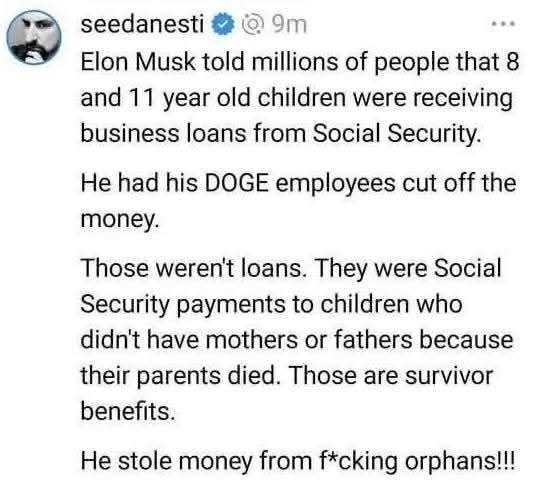
The post is a screenshot of a Twitter post from a user named "seedanes". The profile picture appears to be a stylized, slightly ominous portrait. The text is the core of the content. It's a direct accusation against Elon Musk. The visual component (the user's handle and profile pic) adds to the perception of a "grassroots" or oppositional voice challenging powerful figures.
---
Critical Theory
This meme functions powerfully as a critique of power structures – a hallmark of Critical Theory.
- Exposing Power Dynamics: The post reveals a perceived abuse of power by Elon Musk. It argues that Musk deliberately misled the public (about children receiving "loans") and then used his position (ordering "DOGE employees") to disrupt access to essential support for vulnerable individuals.
- Ideology Critique: The original misinformation (children getting loans) subtly reinforces an ideology of self-reliance and a distrust of social safety nets. It implicitly suggests these children aren’t “deserving” of support. The post is an explicit dismantling of that ideological framing.
- Unmasking the Human Cost: Critical theory emphasizes understanding the lived experience of oppression. The post deliberately reframes the situation to highlight the human cost of Musk’s actions – targeting orphans and children who have lost parents.
---
Marxist Conflict Theory
From a Marxist perspective, this meme illustrates the inherent conflict between the capitalist class (represented by Musk) and the working class/vulnerable populations.
- Class Warfare: Musk, as a billionaire, represents the owning class. The children receiving Social Security benefits are materially disadvantaged and reliant on a form of social welfare. The post frames Musk's actions as an attack on this welfare, effectively exacerbating class inequalities.
- Exploitation & Accumulation: While not explicitly about exploitation in the traditional labor sense, the meme implies that Musk prioritizes capital accumulation (potentially through manipulating his company’s image or diverting resources) over the basic needs of the most vulnerable members of society.
- False Consciousness: The initial spreading of the misinformation (“loans”) can be seen as an attempt to create "false consciousness" – to get people to believe a narrative that serves the interests of the wealthy and powerful by devaluing social safety nets. The post attempts to dismantle that false consciousness.
---
Foucauldian Genealogical Discourse Analysis
A Foucauldian lens looks at how power operates through discourses – systems of thought, language, and practices.
- Construction of "Orphan" & "Benefit": The meme deconstructs the discourse around "Social Security" and "benefits". Musk’s initial framing (“loans”) alters the meaning of the support, making it seem like a reward instead of a right. The post then reconstructs the meaning, forcefully asserting that these are "survivor benefits" – a morally justified form of support for those who have experienced profound loss.
- Power/Knowledge: Musk wields power through his access to information and his ability to disseminate narratives (via Twitter). The post attempts to disrupt this power/knowledge dynamic by exposing the factual inaccuracy of Musk's claim.
- Genealogy of "Responsibility": A genealogical approach could examine how the concept of “responsibility” for vulnerable populations has evolved. The meme implicitly argues that Musk should have understood the nature of these benefits and should have acted responsibly toward those who depend on them.
---
Postmodernism
While not central, aspects of postmodern thought are present.
- Rejection of Grand Narratives: The meme challenges the “grand narrative” of meritocracy or the idea that success is solely based on individual effort. Musk, often presented as a self-made billionaire, is exposed as potentially harming those who haven't had the opportunity for individual success due to tragic circumstances.
- Deconstruction of Truth Claims: The initial misinformation highlights the instability of “truth” in the age of social media. The post attempts to reclaim a sense of objective truth.
---
The Rhetorical Force of the Language
The use of the expletive (“f*cking orphans”) is deliberate and crucial to the meme’s impact.
- Emotional Appeal: The language evokes outrage and disgust. It’s not a neutral academic statement.
- Moral Condemnation: The expletive amplifies the moral condemnation of Musk's actions. It signifies the speaker’s (and intended audience’s) deep emotional reaction to the perceived injustice.
- Disruptive Rhetoric: The strong language is a rejection of polite discourse and signals the speaker’s refusal to accept the status quo. It's a characteristic of anti-establishment rhetoric.
---
Overall: Anti-Oligarch Perspective
From an "Anti-Oligarch" perspective, this meme is a powerful example of resisting the unchecked power of the ultra-wealthy. It’s not simply about a factual error; it’s about a symbolic act of cruelty – a wealthy individual seemingly indifferent to the suffering of vulnerable people. The meme weaponizes information, emotion, and direct language to challenge Musk’s authority and expose what the author perceives as his callous disregard for social welfare. It’s an attempt to create a counter-narrative that reveals the potential moral failings of the powerful and encourages collective action (or at least, collective outrage).
simple-description (llama3.2-vision_11b)
This meme is a response to a tweet by Elon Musk, where he claimed that many people who received loans from the government during the 2008 financial crisis were actually 18-year-old kids who lied about their age to get the loans. The meme is a sarcastic comment on this claim, saying that if Elon Musk is right, then he must have also been a 18-year-old kid when he was born.
detailed-analysis (gemma3-27b-vision)
Okay, here's an analysis of the provided social media post, broken down into sections as requested. Please note that some sections will be more prominent/relevant than others given the content. I'll also preface this with a disclaimer that these analyses are interpretive, and multiple valid readings are possible.
Important Disclaimer: The original post contains vulgar language. This analysis will address it where relevant, but it will not unnecessarily repeat the obscenity.
---
1. Visual Description
The image is a screenshot of a social media post (likely Twitter/X) from a user named “seedanesti.” The user's profile picture is a stylized, somewhat menacing illustration of a face. The post itself is a text block with several sentences outlining an accusation against Elon Musk. The visual presentation is stark and text-focused, creating a sense of urgency and direct accusation. The lack of image or video reinforces the focus on the information presented in the text.
---
2. Foucauldian Genealogical Discourse Analysis
This post can be analyzed through a Foucauldian lens by examining how the narrative about these children's benefits is constructed as a discourse, and how that discourse is used to construct Elon Musk as a particular kind of figure.
- Power/Knowledge: The post claims Musk misrepresented Social Security benefits as “loans.” This is not merely an inaccurate statement but a specific framing that positions these children as somehow fraudulently receiving financial aid. By constructing this narrative, Musk wields power through knowledge – dictating how the public understands the situation and thereby controlling the discourse.
- Genealogy of “Orphan”/“Benefit”: We could trace the historical construction of the concepts of "orphan," "benefit," and “social safety net”. Historically, orphan care has been framed differently – sometimes as charity, sometimes as moral obligation, and sometimes as a drain on resources. Musk's framing arguably leans towards the latter, implicitly portraying the benefits as undeserved.
- Disciplinary Power: The language used ("stole from orphans!") evokes a strong emotional response. This isn’t simply about financial transactions; it’s about moral outrage. The post aims to discipline Musk’s behavior by appealing to a collective sense of justice.
- Truth Regime: The post implicitly challenges Musk’s “truth.” It presents a counter-narrative claiming he deliberately misrepresented the facts, revealing a power struggle over what constitutes ‘truth’ in the public sphere.
---
3. Critical Theory
This post lends itself to a critical theory analysis because it touches on issues of power, ideology, and social control.
- Ideology and Hegemony: The post exposes a potential ideological conflict. Musk, as a prominent figure, holds significant cultural capital. The accusation suggests he's using that capital to subtly reinforce a particular worldview—perhaps a neoliberal ideology that emphasizes individual responsibility and minimizes the role of social safety nets.
- Commodification of Care: Framing Social Security benefits as "loans" (even falsely) subtly frames the support for vulnerable children as a transaction, rather than a right or a form of social care. This is a form of commodification—reducing something valuable (care for children) to a monetary exchange.
- Critique of Capitalism: Implicitly, the post critiques the priorities of late-stage capitalism. Musk, as a billionaire, is accused of harming vulnerable children, suggesting that profit and accumulation are prioritized over human well-being.
- Deconstructing "Responsibility": The post challenges Musk’s presumed ‘responsibility’ as a corporate leader. By allegedly harming vulnerable children, he’s portrayed as abusing his power and shirking his ethical obligations.
---
4. Marxist Conflict Theory
A Marxist analysis would see this post as a manifestation of class conflict and the exploitation inherent in capitalist systems.
- Class Struggle: Musk, as a representative of the capitalist class, is accused of depriving resources from the most vulnerable members of society (orphans). This is a direct conflict of interest—Musk’s economic interests are seen as being at odds with the well-being of those reliant on social welfare.
- Exploitation of Vulnerability: Orphans represent a particularly vulnerable group within society. The accusation suggests that Musk is exploiting their vulnerability for financial gain, even if that gain is indirect (e.g., improving his public image or reducing costs).
- Alienation: The post highlights the alienation of individuals under capitalism. Orphans are alienated from traditional forms of care and are reliant on a social safety net that is allegedly being undermined by a powerful capitalist figure.
- False Consciousness: If Musk’s narrative gained traction, it could potentially create “false consciousness” among the public—leading them to believe that the Social Security benefits were undeserved or fraudulent, thus justifying their reduction.
---
5. Postmodernism
A postmodern reading would focus on the instability of truth, the constructed nature of reality, and the deconstruction of grand narratives.
- Meta-Narrative Breakdown: The post challenges the traditional narrative of benevolent capitalism. It disrupts the idea that wealth creation automatically benefits everyone and exposes the potential for exploitation even within seemingly positive systems.
- Deconstruction of “Truth”: The post questions Musk's claims by presenting a counter-narrative. This highlights the idea that truth is not objective but rather constructed through language and power relations.
- Simulacra and Simulation: Musk’s initial claim and the subsequent response can be seen as a form of simulation. The reality of the children’s situation is obscured by layers of representation and misinformation, creating a hyperreality where it’s difficult to discern the truth.
- Fragmentation of Meaning: The post itself is a fragmented piece of information—a single tweet offering a specific interpretation of events. This reflects the postmodern condition of information overload and the difficulty of constructing coherent narratives.
---
6. Queer Feminist Intersectional Analysis
While not the primary focus, intersectional analysis can illuminate certain aspects.
- Vulnerability and Marginalization: Orphans, as a group, are inherently marginalized and vulnerable. Intersectional analysis would consider how other factors (race, class, gender, disability) might compound their vulnerability and shape their experiences.
- Care Work and Gender: Social Security benefits can be understood as a form of care work. The post highlights the potential for this care to be undermined by patriarchal/capitalist structures that prioritize profit over human needs. The post touches on how children, particularly those in care systems are often disempowered.
- Power Dynamics: The post exemplifies a clear power dynamic – a wealthy, powerful man accused of harming vulnerable children. Intersectional analysis would consider how this dynamic intersects with other forms of oppression and inequality.
- Challenging Normative Structures: The post challenges the normative structure of wealth accumulation and the prioritization of profit over human well-being. This is consistent with feminist and queer critiques of power and domination.
---
This analysis is, of course, interpretive. Different scholars and readers might draw different conclusions based on their own theoretical frameworks and perspectives. I hope this breakdown provides a helpful exploration of the complexities embedded within the seemingly simple social media post.
simple-description (llama3.2-vision)
The meme is a screenshot of a tweet from a user named "seedanesti" (likely a parody of "Seth" or "Dan" with a "n" added). The text claims that Elon Musk said that 8-11 year old children were receiving loans from the government, but actually, they were actually receiving benefits from their parents who had passed away. The tweet then jokes that Elon Musk "stole money" from these orphaned children, implying that he was "stealing" from people who were already in financial need.