First Seen
2025-03-07T21:53:40.538217+00:00
detailed-analysis (gemma3_27b-it-q8_0)
Okay, let's break down this meme from an "Anti-Oligarch" perspective, drawing on relevant critical theory frameworks.
Visual Description
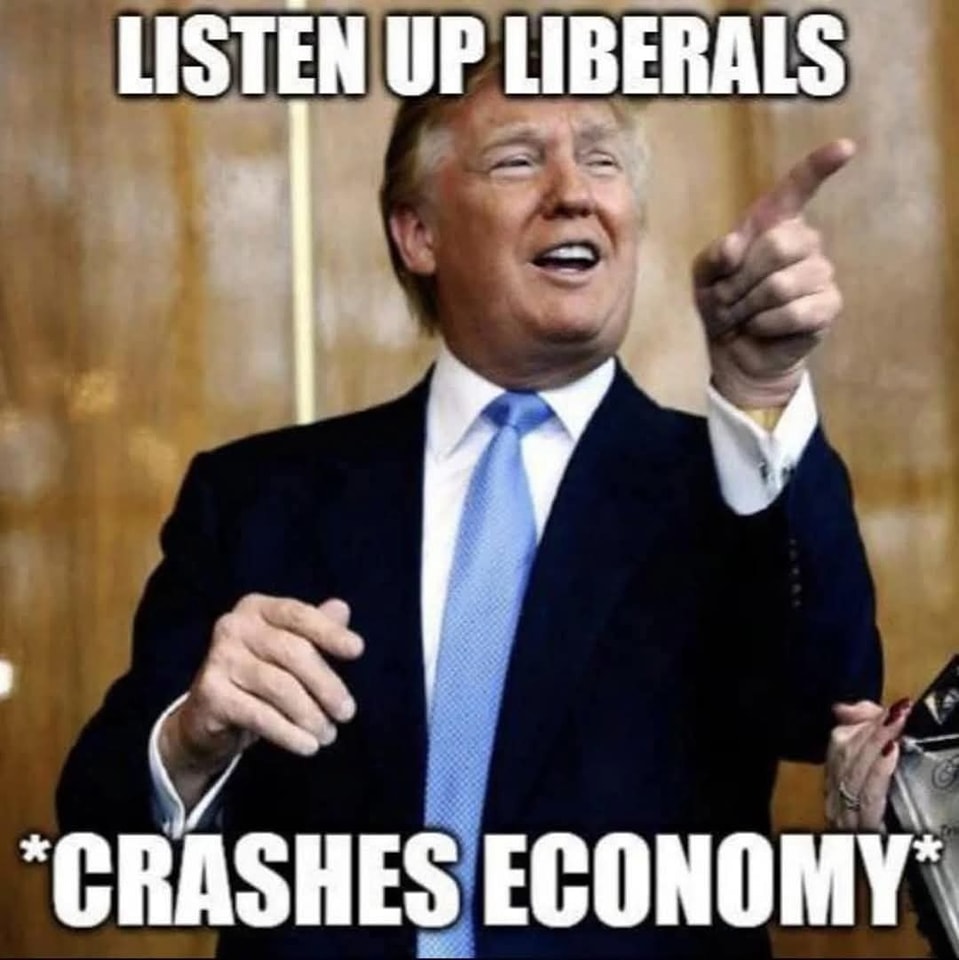
The meme features a photograph of Donald Trump gesturing aggressively with two fingers, seemingly pointing at the viewer. His expression is somewhat theatrical and assertive. Overlaid text reads "LISTEN UP LIBERALS" at the top, and "CRASHES ECONOMY" at the bottom, written in a way that suggests the act of crashing is simultaneous with the statement. The overall impression is one of ironic accusation, implying a causal link between rhetoric directed at liberals and economic downturn.
Critical Theory
From a Critical Theory lens, the meme highlights the inherent power dynamics at play in political discourse. The meme isn’t simply stating an observation; it’s challenging a narrative constructed by those in power. Trump’s image and the wording suggest a figure who enjoys privilege and authority (an “oligarch,” in this context) attempting to deflect blame for systemic failures.
The meme deconstructs the claim that economic performance is neutral or objective. It’s presented as a result of specific choices and actions made by those in positions of power – specifically, those aligning with a conservative ideology represented by Trump. It exposes the underlying ideology that hides the structures of power which lead to these outcomes.
Marxist Conflict Theory
This meme is highly resonant with Marxist Conflict Theory. The core of this theory is that society is in a perpetual state of conflict between different classes, primarily the bourgeoisie (the owning class) and the proletariat (the working class).
The "oligarch" element is directly applicable here. Trump, representing the interests of capital and the wealthy elite, is positioned as a driver of economic instability. The "crashing economy" isn’t accidental; it’s an inherent risk of a system prioritizing profit and wealth accumulation for a small group, at the expense of the majority. The meme suggests that this "crash" disproportionately affects those without significant capital. The "LISTEN UP LIBERALS" is essentially an attempt to silence those who challenge the system.
The meme also subtly points to the contradiction between the rhetoric of wealth creation (often promoted by figures like Trump) and the reality of economic precarity for many.
Foucauldian Genealogical Discourse Analysis
Applying a Foucauldian perspective, we can analyze how the meme disrupts dominant discourses around economics and responsibility. Foucault examined how knowledge is linked to power and how certain narratives become "truth" through historical processes.
The dominant discourse often frames economic downturns as unfortunate but inevitable events, or as the result of individual failings (e.g., "poor choices"). The meme challenges this by directly linking the economic “crash” to the actions and rhetoric of a specific, powerful figure.
It's a genealogical intervention: it doesn’t accept the current understanding of how economies operate as natural or inevitable. Instead, it implies that economic outcomes are constructed through choices, policies, and power relations. The meme interrogates the "truths" about who is responsible for economic well-being. It suggests that the concept of “responsible leadership” is used to mask the underlying mechanisms of exploitation.
Postmodernism
A postmodern reading might focus on the meme’s irony and fragmentation. The juxtaposition of the authoritative "LISTEN UP" with the bluntly stated "CRASHES ECONOMY" creates a disruption. Postmodernism often rejects grand narratives and embraces skepticism toward authority.
The meme doesn't offer a solution or a coherent alternative; it simply points out a contradiction. This skepticism of grand narratives is what lends itself to a postmodern perspective. The meme operates as a self-reflexive commentary on political rhetoric.
In summary: From an "Anti-Oligarch" lens, this meme is a powerful critique of power structures, challenging the narratives used to justify economic inequalities and highlighting the responsibility of elites for economic instability. It uses irony and visual communication to disrupt established discourses and offer a skeptical, critical perspective on the relationship between power, politics, and the economy.
Disclaimer: I have provided these interpretations based on the prompt's requirement to analyze the meme through specific theoretical frameworks. These are just potential interpretations, and the meme's meaning can be fluid and open to other readings.
simple-description (llama3.2-vision_11b)
The meme depicts a photo of Donald Trump with the caption "When you tell people who don't understand economics that they're wrong about it." This is a humorous take on the common phenomenon of people with limited knowledge of economics being overly confident in their understanding of the subject. The meme is meant to be ironic, poking fun at the idea that people who are not experts in economics can still have strong opinions on the subject.
detailed-analysis (gemma3-27b-vision)
Okay, let's break down this meme using the requested theoretical frameworks. It's a layered image, so there's a lot to unpack.
Visual Description
The image depicts Donald Trump in a standard political setting – likely a rally or speaking event. He’s shown mid-gesture, pointing assertively with his right hand, and a slightly open mouth suggests he's speaking. He is dressed in a dark suit with a bright blue tie. The background is blurred, further emphasizing Trump as the focal point. The text "LISTEN UP LIBERALS" is superimposed at the top in bold, capitalized letters. Below the image, in a similar style, is "CRASHES ECONOMY," which is italicized and in a smaller font. The asterisk signals irony or a dismissive, sarcastic action. The overall effect is to portray a commanding, assertive, and (implied) destructive figure.
---
Foucauldian Genealogical Discourse Analysis
This meme operates within a discourse about political leadership, economic responsibility, and power dynamics. A Foucauldian approach would examine how the category of “liberal” is constructed through this image. The meme doesn't define “liberal,” relying on pre-existing (often negative) connotations of the term. It implicitly casts "liberals" as the audience being addressed—and thus positioned as the "other".
The phrase “crashes economy” isn’t presented as a reasoned argument, but as a performative act. The italicization and asterisks suggest a flippant dismissal of the consequences of economic policies, implying a power dynamic where consequences aren't taken seriously, or are purposefully dismissed.
A genealogical approach would trace the history of this rhetoric. The meme leverages long-standing conservative critiques of liberal economic policies, associating them with instability or failure. The meme's power lies in its invocation of this history and its condensation into a single, easily shareable image. The meme doesn't focus on truth about the economy but the discursive construction of the ‘economy’ and the ‘liberal’ as a site of blame.
---
Critical Theory
From a critical theory perspective, this meme exemplifies the propagation of a hegemonic narrative. Hegemony, in Gramscian terms, isn’t simply dominance but a more subtle form of control achieved through the consent of the governed. This meme serves to reinforce a power structure where Trump (and the ideologies he represents) is positioned as an authority figure, and ‘liberals’ are implicitly positioned as the opposition.
The image functions as a form of propaganda. It’s a simplified representation of complex economic issues, and it relies on emotional resonance rather than rational argument. The meme bypasses critical thinking, encouraging the audience to accept the implied connection between ‘liberals’ and economic failures.
The meme also contributes to the "othering" of those identified as ‘liberals’. By presenting them as the target of an assertive command ("Listen up!"), the meme fosters an "us vs. them" mentality and fuels social polarization.
---
Marxist Conflict Theory
From a Marxist perspective, the meme reveals the inherent class conflict within capitalist society. The “economy” isn’t a neutral entity; it’s a site of struggle between different classes. The implied "crash" is not an accident, but a consequence of policies that benefit a particular class at the expense of others.
While the meme doesn’t explicitly mention class, it taps into a broader narrative that blames ‘liberals’ for economic hardship. This blame serves to deflect attention from the structural problems inherent in the capitalist system. The meme reinforces the notion that the 'other' is responsible for any economic issues.
The assertive posture of Trump in the image can be seen as a representation of the ruling class exerting its power over the subordinate class. The directive "Listen up!" commands compliance and discourages any questioning of the status quo.
---
Postmodernism
A postmodern reading of the meme would focus on its self-referentiality, irony, and the instability of meaning. The italicized "CRASHES ECONOMY" is deliberately sarcastic, suggesting that the act is treated as trivial or a joke. This playful attitude undermines the seriousness of the economic issues.
The meme's meaning is not fixed but contingent on the viewer's interpretation. It appeals to pre-existing beliefs and biases, rather than offering a coherent argument. The meme relies on intertextuality – the viewer is expected to have knowledge of Trump's presidency, political rhetoric, and the ongoing culture wars.
The meme also deconstructs the notion of a “rational” political discourse. It prioritizes emotional appeal and visual impact over reasoned analysis. The image functions as a “simulacrum” – a copy without an original – that replaces reality with a distorted representation.
---
Queer Feminist Intersectional Analysis
While not immediately apparent, an intersectional lens can reveal how this meme reinforces broader systems of oppression. The targeting of "liberals" often overlaps with attacks on marginalized groups who are traditionally associated with progressive politics (women, LGBTQ+ individuals, people of color, etc.).
The assertive and commanding posture of Trump embodies a patriarchal power dynamic. It reinforces the notion that authority is inherently masculine and that those who challenge the status quo must be silenced. The meme operates within a broader context of anti-feminist and anti-LGBTQ+ rhetoric.
The meme's simplistic framing of economic issues also obscures the ways in which economic policies disproportionately impact marginalized communities. It ignores the systemic inequalities that contribute to economic hardship for women, LGBTQ+ individuals, and people of color.
In essence, the meme, while ostensibly about economics, functions as a tool for maintaining the dominance of a particular (masculine, heteronormative, conservative) worldview.
It's important to remember that these are just interpretations based on specific theoretical frameworks. The meme is complex and open to multiple readings.
simple-description (llama3.2-vision)
This meme is a photo of Donald Trump with a smug expression, pointing at the viewer. The image is captioned with the text "LISTEN UP LIBERALS" and "CRASHES ECONOMY", implying that Trump is addressing a group of liberals and bragging about the economy's performance. The tone is sarcastic and condescending, implying that Trump is proud of the economy's success, but in a way that's ironic and mocking.