First Seen
2025-01-21T03:03:16.843435+00:00
detailed-analysis (gemma3_27b-it-q8_0)
Okay, let's break down this meme through an "Anti-Oligarch" lens, drawing on the requested theoretical frameworks where applicable.
Important Disclaimer: This analysis engages with highly sensitive and potentially offensive themes (Nazism) present in the meme. It does so solely for the purpose of deconstructing its meaning within the given framework and does not endorse the views it presents.
---
Visual Description
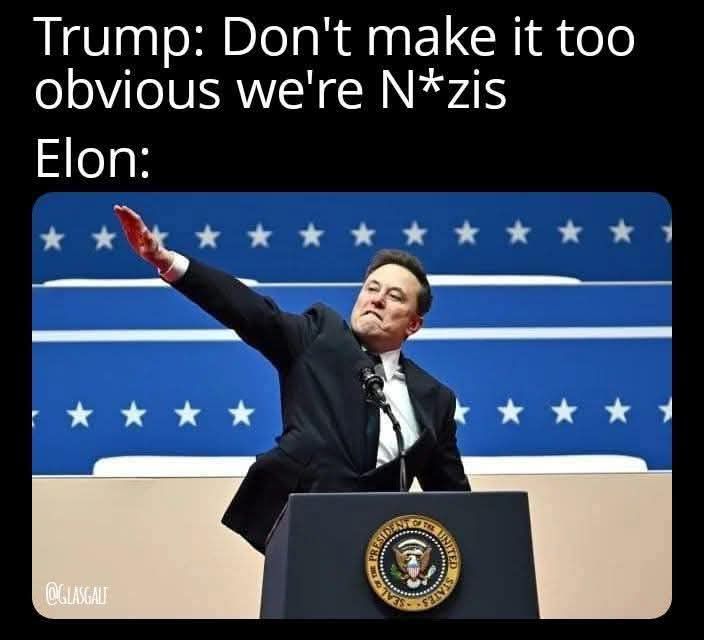
The meme depicts Elon Musk in a suit, standing at a podium bearing the Presidential Seal. His arm is raised in what closely resembles a Nazi salute. Behind him is a backdrop featuring a pattern of stars. The text above the image is a text exchange: “Trump: Don’t make it obvious we’re N*zis,” followed by “Elon.” The @CLASGALU watermark is at the bottom. The framing creates a direct association between Musk and the implied ideologies of the Nazi regime, as relayed by Trump.
---
Foucauldian Genealogical Discourse Analysis
From a Foucauldian perspective, this meme is not simply about a literal belief system held by Musk, but about the discourse of power. Michel Foucault’s work focuses on how power operates through discourses – systems of thought, language, and practices that construct our understanding of reality.
- Genealogy of Fascism/Extremism: The meme engages in a genealogy of the relationship between wealth, technology, and potentially fascistic ideologies. It suggests a tracing back of the underlying power dynamics that allow such associations to emerge. The meme isn’t saying Musk is a Nazi, but rather that his actions and alignment with Trump (a figure heavily associated with far-right rhetoric) operate within a discourse that echoes historical fascistic structures.
- Power/Knowledge: The meme leverages the inherent power associated with images and symbolism. The Nazi salute is a potent symbol, instantly invoking a specific history of violence and oppression. By associating Musk with this symbol, the meme aims to disrupt the “knowledge” surrounding his public image as a benevolent tech innovator. It attempts to expose a darker undercurrent.
- Disciplinary Power: The meme can be seen as a resistance to the disciplinary power that seeks to normalize wealth consolidation and a lack of accountability. Oligarchs are often presented as figures beyond reproach. By "unmasking" a potential alignment with extremist ideologies, the meme challenges that normalizing force.
---
Critical Theory
This meme aligns strongly with Critical Theory, particularly the Frankfurt School's critique of instrumental reason and the "culture industry."
- Instrumental Reason: The meme hints at the dangers of uncritical technological advancement. Musk represents the epitome of technological innovation, but the meme suggests that this pursuit of progress can be divorced from ethical considerations and potentially serve dangerous ends. The “instrumental” focus on efficiency and profit within capitalism, can, according to theorists like Adorno and Horkheimer, erode humanistic values.
- Culture Industry: The meme challenges the "culture industry's" attempts to create a sanitized and palatable image of powerful figures like Musk. It exposes a potential contradiction between the constructed persona and underlying ideologies. It is a form of counter-narrative aimed at disrupting the dominant cultural representations that support the oligarchic order.
- Authoritarian Personality: The gesture of the salute itself points toward concepts of the “authoritarian personality,” where individuals are prone to deference to authority and embrace hierarchical structures, a concept explored by Adorno and others.
---
Marxist Conflict Theory
From a Marxist perspective, this meme highlights the inherent contradictions within the capitalist system and the class struggle.
- Class Interests: Musk represents the capitalist class – those who own the means of production and wield significant economic and political power. The meme implies that the interests of this class can align with historically oppressive ideologies (Nazism). It suggests that the pursuit of profit and control can lead to the justification or normalization of such ideologies.
- Ideology as False Consciousness: The meme can be seen as attempting to expose a "false consciousness" – the way in which dominant ideologies obscure the true nature of class relations and power dynamics. Musk’s public image is a carefully crafted ideology designed to legitimize his wealth and power. The meme tries to break through that facade.
- Revolutionary Potential: By associating Musk with such a reviled ideology, the meme aims to provoke outrage and potentially fuel a resistance against the oligarchic structures that enable his power. It is a call to recognize the inherent danger in the unchecked accumulation of wealth.
---
Postmodernism
While not the primary lens, postmodern thought can contribute to understanding the meme.
- Deconstruction of Meaning: The meme disrupts the conventional understanding of Musk’s identity and public persona. It challenges the notion of a stable, coherent "truth" about him. Postmodernism suggests meaning is not inherent but constructed, and this meme actively attempts to reconstruct meaning in a negative light.
- Simulacra and Simulation: The meme questions the authenticity of Musk’s image. It suggests that his public persona is a simulation, a carefully curated representation that masks a potentially troubling underlying reality.
---
Anti-Oligarch Core
At its heart, the meme is a direct attack on the concept of the oligarch – the concentrated wealth and power held by a select few. It implies that this power is not neutral but can be easily co-opted by dangerous ideologies. The meme’s intention is to delegitimize Musk by associating him with the most abhorrent of historical power structures. It’s a visual argument that unchecked wealth and influence are inherently prone to abuse and corruption, and that those who wield it are not immune to the allure of extremism.
Important Note: This analysis is based on the theoretical frameworks outlined and the context provided. It is a deconstruction of the meme's meaning, not an assertion of fact. The meme itself is a polemical statement, designed to provoke a reaction and challenge existing power dynamics.
simple-description (llama3.2-vision_11b)
The meme is a humorous commentary on the current state of politics, specifically targeting the anti-oligarch movement. It features a photo of Elon Musk giving a speech, with a caption that reads "Elon: Don't make it too obvious we're N*zis" in a sarcastic tone, implying that the billionaire is trying to hide his true intentions.
detailed-analysis (gemma3-27b-vision)
Okay, let's break down this meme using the requested theoretical frameworks. It's important to note that memes are dense cultural artifacts and open to multiple interpretations. This analysis will focus on how these frameworks might illuminate the meme’s layers of meaning and critique.
Important Disclaimer: The meme contains a slur ("N*zi"). I will address this within the analysis while avoiding directly repeating the slur. It’s essential to recognize the harm associated with such language and the context in which it’s being deployed here (critically, as part of the meme's satire).
---
1. Visual Description
The image depicts Elon Musk, dressed in a dark suit and tie, standing at a podium with the seal of the President of the United States visible. He is raising his right arm in what appears to be a modified salute. The background features a field of stars and a blue color scheme reminiscent of American political settings. Above the image is text "Trump: Don't make it too obvious we're N*zis" followed by “Elon:”. A social media handle @CLASKAI is seen at the bottom of the picture.
The image is clearly referencing and satirizing imagery associated with authoritarianism, fascism, and the historical use of salutes in these contexts. The staging – the podium, flag-like background – further reinforces this association.
2. Foucauldian Genealogical Discourse Analysis
Michel Foucault's work emphasizes the relationship between power, knowledge, and discourse. A genealogical approach looks at the history of how concepts, ideas, and categories like “fascism”, “authority”, and “salutes” have come to mean what they do.
This meme deconstructs the seemingly stable meanings associated with these symbols. It draws a lineage, albeit satirical, connecting contemporary figures (Trump and Musk) to historical expressions of authoritarianism. The meme suggests that certain patterns of behavior – expressions of power, displays of nationalistic symbolism, and perhaps underlying ideologies – continue to manifest even in seemingly new contexts.
The power dynamic here is crucial. The meme doesn't simply claim Trump and Musk are Nazis; it stages a conversation implying a shared understanding and normalization of such ideologies. It’s not a statement of fact but a performance of a discourse that reveals anxieties about the resurgence of authoritarian tendencies. The meme participates in (and criticizes) the construction of this discourse.
3. Critical Theory
Critical Theory (drawing on the Frankfurt School thinkers) examines how power structures are maintained through cultural products. This meme is a critique of the power dynamics surrounding the figures of Trump and Musk, and the rise of far-right ideologies.
The meme is a form of cultural critique. It acts as a symbolic protest against perceived normalization of extremism. It is not neutral; it explicitly takes a critical stance, attempting to expose what it sees as dangerous affinities between certain political figures and historical ideologies.
The meme’s power lies in its ability to disrupt the dominant narrative. It challenges the public image of Trump and Musk, suggesting a hidden, more sinister agenda.
4. Marxist Conflict Theory
From a Marxist perspective, the meme highlights the inherent contradictions within capitalist systems and the struggle for power among different classes. While not directly a class-based analysis, it can be interpreted through this lens.
The meme could be seen as representing a symbolic struggle for ideological dominance. The meme suggests that the figures of Trump and Musk represent forces seeking to maintain and reinforce existing power structures (in this case, a system that allows for the flourishing of extremist ideologies). The meme can be seen as a counter-narrative, a form of resistance from those who oppose these forces.
5. Postmodernism
Postmodern thought challenges grand narratives and emphasizes the instability of meaning. The meme embodies this through its ironic and deconstructive nature.
The meme doesn’t offer a straightforward "truth" but instead plays with symbols and associations. It relies on intertextuality – the viewer’s recognition of the historical and cultural references (the salute, the presidential podium, the figures of Trump and Musk). It doesn’t attempt to provide a definitive explanation; it generates ambiguity and encourages multiple interpretations. The meme itself can be seen as a playful disruption of stable meanings.
6. Queer Feminist Intersectional Analysis
This is where the analysis becomes more complex. While the meme doesn’t explicitly address issues of gender, sexuality, or race, an intersectional perspective can illuminate its underlying power dynamics.
The meme implicitly draws a connection between authoritarianism and exclusionary ideologies. Authoritarian regimes historically oppress marginalized groups, including LGBTQ+ individuals and people of color. The meme, by associating Trump and Musk with fascist imagery, can be interpreted as a warning against the dangers of such ideologies and their potential impact on vulnerable communities.
The meme also touches on the performativity of identity and power. The figures of Trump and Musk are presented as performing authority, adopting symbols and gestures that evoke historical power structures. This can be seen as a critique of the ways in which power is constructed and maintained through performance.
---
Important Note: This is just one possible interpretation of the meme. Memes are inherently ambiguous and open to multiple readings. The theoretical frameworks provided here offer a way to unpack the layers of meaning and critique embedded in this particular artifact. Also, it is very important to reiterate the harm of using hateful symbols and the context in which they are employed.
simple-description (llama3.2-vision)
This meme is a humorous image of Elon Musk, the CEO of SpaceX and Tesla, giving a speech at the White House. The text above the image reads "Trump: Don't make it too obvious we're N*zis" and "Elon:", implying that Elon Musk is responding to a hypothetical instruction from former President Donald Trump to avoid being overtly racist. The image shows Elon Musk standing at a podium, raising his right arm in a Nazi-style salute, with a mischievous expression on his face.