First Seen
2024-12-28T11:46:02.877867+00:00
detailed-analysis (gemma3_27b-it-q8_0)
Okay, let's break down this meme through the lens of an "Anti-Oligarch" category, incorporating relevant theoretical frameworks where appropriate.
Visual Description
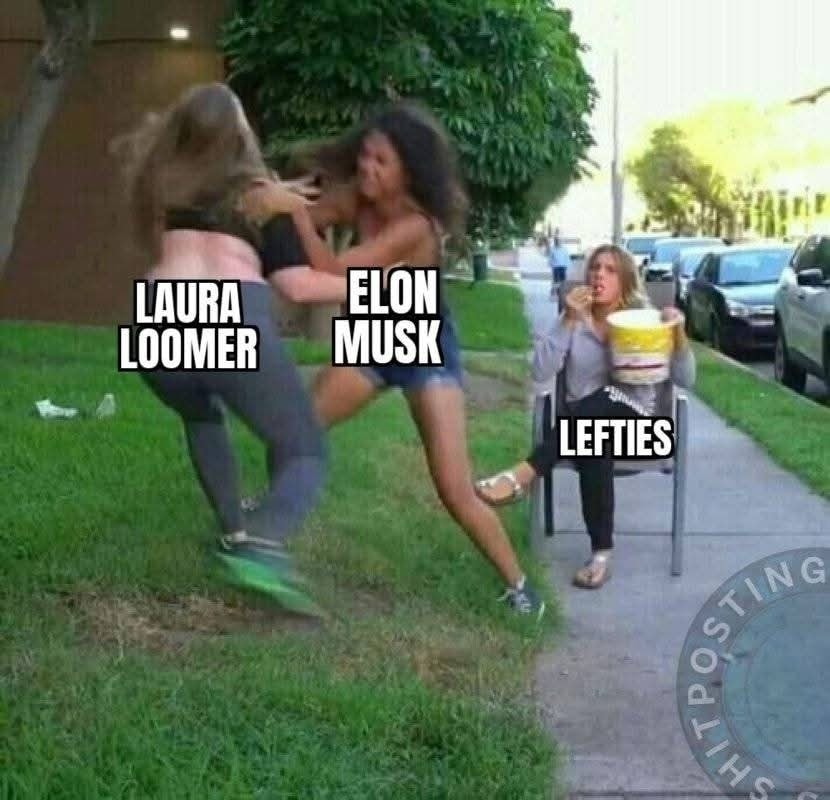
The image depicts a street scene. A woman in athletic wear is aggressively shoving another woman who appears to be stumbling forward. A third woman sits on a bench watching the event. The meme labels the actively shoving woman "Laura Loomer," the woman being shoved "Elon Musk," and the seated woman "Lefties." The setting is a fairly mundane suburban or residential street.
Marxist Conflict Theory
This meme is profoundly rooted in Marxist conflict theory. At its core, this theory posits that society is structured around class conflict, primarily between the bourgeoisie (the owning class) and the proletariat (the working class). In the context of an "Anti-Oligarch" stance, this expands beyond traditional class to include critique of concentrated power in the hands of a few extremely wealthy individuals – oligarchs.
- Musk as Bourgeoisie: Elon Musk embodies the modern oligarch—a billionaire whose influence extends far beyond economic control into the political and social spheres. He’s a symbol of the capitalist accumulation and unchecked power of a new tech elite.
- Loomer as a Tool/Proxy: Laura Loomer, a far-right activist, is positioned as the agent of aggression against Musk. This is where the meme gets complex. Within an anti-oligarch framework, Loomer is not necessarily celebrated. Rather, she represents a different kind of power play—a highly visible, often inflammatory, proxy used to create chaos and distract from larger systemic issues. Her attack is perceived to be on Musk, but it is a symptom of the larger, destabilizing power structures.
- "Lefties" as Passive Observers: The labeling of the seated woman as “Lefties” is extremely cynical. The meme suggests that those who oppose oligarchy are passively watching these power struggles play out, seemingly unable to intervene effectively. This critique is aimed at perceived ineffectiveness of progressive movements. It implies a feeling of impotence, a frustration that criticism alone does not dislodge the power of the oligarchs.
- The Conflict: The central "conflict" isn’t just about Musk himself, but about the nature of power and the ways in which those in power (or those seeking power) engage in battles that ultimately perpetuate the system that benefits them.
Foucauldian Genealogical Discourse Analysis
Foucault’s work is useful here in understanding how power operates, not just through brute force, but through discourse and knowledge.
- Power/Knowledge: The meme itself is a discourse. It constructs a narrative about power dynamics. It implies that Musk’s power is so vast that even those who vehemently oppose him are unable to directly confront him and instead use proxies or engage in performative outrage.
- Genealogy & the History of Oligarchy: A genealogical approach would trace the historical evolution of oligarchic power—from traditional landed aristocracies to modern tech billionaires. The meme implies that the form of power changes, but the fundamental structure of a small elite wielding disproportionate control remains.
- Discipline & Normalization: The "Lefties" on the bench also contribute to the normalization of these power dynamics. Their passive observation can be seen as a form of acceptance, an implicit acknowledgment of the oligarchs’ dominance.
Postmodernism
Elements of postmodernism are present in the meme's cynicism and its rejection of grand narratives.
- Rejection of Meta-Narratives: The meme doesn’t offer a solution. It doesn’t advocate for a specific political ideology. Instead, it presents a fragmented, chaotic image of power struggles, suggesting that there is no single, overarching narrative or solution to oligarchy.
- The Simulacrum: Musk himself, as a highly mediated and public figure, can be seen as a simulacrum—a copy without an original. His public persona is carefully crafted and presented through social media and media coverage, obscuring the underlying realities of his power and influence.
- Irony and Parody: The meme uses irony to highlight the absurd spectacle of power dynamics. The act of Loomer shoving Musk is presented as an exaggerated, almost farcical confrontation.
Critical Theory
The meme resonates with core tenets of Critical Theory, which seeks to expose power structures and challenge the status quo.
- Ideology Critique: The meme critiques the ideology that allows oligarchs like Musk to amass and wield such power. It questions the narratives that justify wealth inequality and the concentration of control.
- Dominant Discourse: It challenges the dominant discourse around "innovation" and "disruption" often associated with figures like Musk, revealing the ways in which these narratives mask exploitative practices and social consequences.
Queer Feminist Intersectional Analysis (Application is weaker, but present)
While not the primary focus, an intersectional analysis could add nuance.
- Loomer’s Gender and Performance of Aggression: Loomer's identity as a woman being the aggressor challenges traditional gender roles. Her actions can be seen as a performative display of power that is amplified by her far-right ideology.
- Silencing and Visibility: The seated "Lefties" could be interpreted as representative of marginalized groups whose voices are often silenced or ignored in debates about power and inequality.
In conclusion, this meme, viewed through an “Anti-Oligarch” lens, is a cynical commentary on the current state of power dynamics. It critiques the unchecked influence of billionaires, the use of proxies to wage power struggles, and the perceived ineffectiveness of opposition movements. It uses irony and fragmentation to reject grand narratives and expose the underlying instability of a system dominated by concentrated wealth and power. It’s a dark joke, but one rooted in genuine anxieties about the future.
simple-description (llama3.2-vision_11b)
The meme is a screenshot of a woman physically attacking another woman, with the text "Elon Musk vs. Laura Loomer" overlaid on the image. From the perspective of the Anti-Oligarch category, this meme is a commentary on the perceived conflict between Elon Musk, a wealthy and influential figure, and Laura Loomer, a far-right activist, with the image implying a physical altercation between the two.
detailed-analysis (gemma3-27b-vision)
Okay, let's break down this meme through several theoretical lenses. It's a rather layered image with potential for quite a bit of interpretation.
Visual Description
The image is a still from what appears to be a video clip, likely a meme format known as a "woman yelling at a cat." It depicts three figures in a suburban outdoor setting.
- Figure 1 (Left): A blonde woman, labeled "Laura Loomer," is aggressively lunging forward, appearing to be in a physical altercation. Her body language is animated and hostile.
- Figure 2 (Middle): A woman with dark hair, labeled "Elon Musk," is in mid-stride, seemingly attempting to move away from Laura Loomer. Her facial expression is not fully visible, but the body language implies an attempt to evade the conflict.
- Figure 3 (Right): A woman, labeled "Lefties," is seated at a small table with a bucket of popcorn, watching the altercation. She appears detached and unconcerned.
- Setting: The scene is a sidewalk in a residential area, with houses and parked cars visible in the background. The overall tone is satirical.
Foucauldian Genealogical Discourse Analysis
This meme can be analyzed through a Foucauldian lens by examining the discourses it activates and the power dynamics they reveal.
- Discourses in Play: The meme relies on established discourses surrounding political labels ("Laura Loomer," "Elon Musk," "Lefties"). These are not neutral terms but are imbued with historical baggage and associations. Loomer is a far-right activist known for conspiracy theories and aggressive tactics, Elon Musk has recently become a figure of contention for his decisions related to Twitter, and "Lefties" is a broad, often pejorative, label for those on the political left.
- Power/Knowledge: The meme creates a power dynamic where Loomer is presented as aggressive, active, and possibly dangerous, while Musk is portrayed as a fleeing target and "Lefties" as a passive audience. This construction of power is not based on objective truth but is a specific construction within the discourse of political commentary. The "Lefties" are positioned as spectators, losing any real agency in the discourse.
- Genealogy: A genealogical approach would explore how these labels have come to mean what they do. How did "Lefties" become a term often used to dismiss or marginalize political opponents? What historical events and social forces have shaped the perception of Elon Musk and Laura Loomer? The meme doesn't reveal this history, but it operates within it.
Critical Theory
Applying Critical Theory, we can see the meme as a commentary on the spectacle of contemporary political conflict and the construction of "us vs. them" narratives.
- Commodification of Conflict: The meme format itself can be seen as a commodification of political conflict. It reduces complex issues to easily digestible, viral content. The conflict is presented as entertainment.
- Hegemony: The meme could be interpreted as reinforcing a certain hegemonic view of political discourse—one that emphasizes sensationalism and personal attacks over substantive debate. The meme’s simplicity might mask deeper ideological structures.
- Ideology: The labeling of the figures isn't neutral, it reinforces an ideological framework. The implication is that the 'left' are just spectators to the conflict while Loomer is a force of action, and Musk is the target.
Marxist Conflict Theory
From a Marxist perspective, this meme reflects class struggle and the power dynamics inherent in ideological conflict.
- Contradictory Forces: The meme depicts a clash between opposing ideological forces (far-right activist, tech capitalist, and the political left). This can be seen as a manifestation of the broader class conflict inherent in capitalist society.
- False Consciousness: The "Lefties" seated with popcorn might be interpreted as representing a passive, disengaged segment of the population, potentially suffering from "false consciousness" – a lack of awareness of their own class interests and the systemic forces at play.
- Capitalist Spectacle: The entire scenario can be seen as a spectacle designed to distract from the underlying material conditions of inequality. The focus on personality clashes and political theatrics obscures the real issues of class struggle.
Postmodernism
A postmodern reading of the meme would focus on its self-referentiality, irony, and questioning of grand narratives.
- Hyperreality: The meme operates within a hyperreal environment where representations of reality (political figures, ideologies) become more real than reality itself. The image is not a literal depiction of events but a constructed simulation.
- Deconstruction of Meaning: The meme challenges the fixed meaning of political labels. It suggests that these labels are fluid, arbitrary, and subject to interpretation. The irony inherent in the scene undermines any attempt to take it at face value.
- Irony and Parody: The meme relies heavily on irony and parody. It mocks the exaggerated rhetoric and polarized nature of contemporary political discourse.
Queer Feminist Intersectional Analysis
While the image doesn’t explicitly depict gender or sexuality, an intersectional analysis can unpack how the meme relies on and reinforces existing power dynamics.
- Gendered Performance of Aggression: The image showcases a woman labeled as a far-right activist performing aggressive action. This potentially taps into existing tropes about women and aggression, and could be interpreted as reinforcing a certain narrative about the performance of gender.
- Marginalization and Spectatorship: The depiction of "Lefties" as passive spectators could be analyzed through a lens of marginalization. It suggests that certain groups are relegated to the role of observers, denied agency, or excluded from the central conflict.
- Intersectional Power Dynamics: How do race, class, gender, and sexuality intersect within the broader power dynamics depicted in the meme? The meme doesn’t explicitly address these intersections, but a critical analysis could explore how these dynamics might be implicitly at play.
It’s important to remember that these are just interpretations, and the meaning of the meme is ultimately subjective and dependent on the viewer's own context and perspective. However, these theoretical frameworks provide valuable tools for unpacking the complex layers of meaning embedded within this seemingly simple image.
simple-description (llama3.2-vision)
This meme is a humorous image of three women fighting on a sidewalk. The text labels on the women read "Laura Loomer", "Elon Musk", and "Lefties". The image is likely meant to be humorous and satirical, poking fun at the idea of a high-profile figure like Elon Musk getting into a physical altercation with someone who is left-leaning.